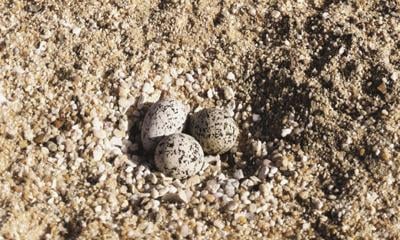

When Susan Preciado spotted the dainty, mottled eggs on a Sand City dune, politics were the last thing on her mind. She didn’t know her discovery could affect the fate of a controversial development.
It was late afternoon on April 8, and the Royal Oaks resident was strolling the beach with her son. They saw a small white bird fly off and approached the nest it left behind. She used her phone to pin the location, snapped a photo and, on the advice of her birding brother-in-law, emailed it to California State Parks.
The email made its way to State Parks environmental scientist Amy Palkovic, who inspected the site two days later and found a complete clutch of three plover eggs. Even more significant: It was on the high beach, near the building footprint of the 368-unit Monterey Bay Shores.
The discovery happened just as the California Coastal Commission was considering a permit for the hotel and condo project, which has been stuck in planning and litigation for over two decades.
Following a marathon meeting April 9, during which project supporters including The Pelican Network and opponents including Audubon California made their cases, the commission approved the permit April 11.
The commission had rejected the permit in 2000 and 2009, but developer Ed Ghandour prevailed in appeals. “I celebrated my Passover for two reasons: One is the exodus from the pharaohs in Egypt,” Ghandour says, “the other is the exit from the bondage of the Coastal Commission staff over the last 21 years.”
But just before the meeting, the U.S. Fish and Wildlife Service sent a letter to the Coastal Commission regarding the project’s potential impacts on the Western snowy plover, Smith’s blue butterfly and Monterey spineflower. Ghandour never finished the process of obtaining a federal “incidental take permit,” so he could be held liable for any harm done to the protected species.
The commission added a condition to its approval, requiring Ghandour to submit an updated habitat protection plan addressing the USFWS’s concerns.
Andrea Jones, Audubon’s coastal program director, says the nonprofit decided to oppose the project out of concern for the plover, which now numbers about 2,300.
“This whole region, which has supported a lot of plovers in the past, is now under multiple threats,” she says. “There are plovers there, and after a development like this there will not be.”
Ghandour says in 20 years of observation, no plovers have been discovered on his project site – only on the lower beach (in 2012 and 2013). He’s suspicious of the conveniently timed nest discovery.
“The evidence submitted was a phony,” he says. “It was doctored up to create excitement with the Coastal Commission.”
Palkovic, though, says it’s legit: “I’m 100-percent confident it’s a naturally occurring nest.”
It may not have made a difference in the approval – the Coastal Commission found the project consistent with Sand City’s local coastal plan – but it will focus more scrutiny on the buildout.




(0) comments
Welcome to the discussion.
Log In
Keep it Clean. Please avoid obscene, vulgar, lewd, racist or sexually-oriented language.
PLEASE TURN OFF YOUR CAPS LOCK.
Don't Threaten. Threats of harming another person will not be tolerated.
Be Truthful. Don't knowingly lie about anyone or anything.
Be Nice. No racism, sexism or any sort of -ism that is degrading to another person.
Be Proactive. Use the 'Report' link on each comment to let us know of abusive posts.
Share with Us. We'd love to hear eyewitness accounts, the history behind an article.