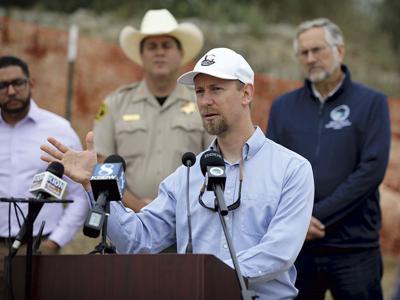

On an overcast morning on Friday, Aug. 25, as jets of water from sprinklers rain down on the surrounding fields of lettuce, a gaggle of journalists, politicians and public officials are gathered at a press event along the Pajaro River levee, just more than a stone’s throw from where it breached last March.
The breach occurred after weeks of sustained rainfall on the Central Coast, and it wasn’t a surprise – for over 50 years, federal, state and local officials have known the levee was deficient, but there was never enough buy-in, or urgency, to do something about it.
Seemingly, that is starting to change, but time will tell if it’s real, or just a public relations band-aid to save face after the flooding in the community of Pajaro, which displaced thousands of residents from their homes and left some of those homes unlivable.
The topic du jour was an update on repairs to the existing levee, and the main takeaway was that the repairs would be completed – hopefully – by the end of November. Monterey County Supervisor Glenn Church, whose district includes Pajaro, called the project “an opportunity to make a better, stronger, more resilient levee.” Supervisor Luis Alejo said, “Monterey County is committed to staying in the foxhole to the very end” with respect to the project.
The Army Corps of Engineers, which originally built the levee in 1949, is responsible for the current repair and ultimate reconstruction of the levee system, but once the agency’s work is done, it falls upon local jurisdictions to maintain it.
Mark Strudley, executive director of the Pajaro River Flood Management Agency says the reconstruction of the levee system – not the repairs, which are happening right now – is expected to begin sometime in 2024.
But that timeline is dependent on the proposed project sailing through the regulatory process with little resistance. To that end, California Assembly Speaker Robert Rivas, D-Hollister, introduced a bill, AB 876, that is intended to reduce those hurdles. It’s expected to be voted on by mid-September.
In a statement Rivas’ office sent out Tuesday, Aug. 29, Assemblymember Dawn Addis, D-Morro Bay, called the bill a “thoughtful and urgent response” to the flooding in Pajaro earlier this year.
State Sen. John Laird, D-Santa Cruz, said in the statement that he “strongly [supports] expediting repairs and enhancements to flood protection to ensure Pajaro can both recover as quickly as possible, and be protected from future catastrophes in this new age of unpredictable weather.”


(0) comments
Welcome to the discussion.
Log In
Keep it Clean. Please avoid obscene, vulgar, lewd, racist or sexually-oriented language.
PLEASE TURN OFF YOUR CAPS LOCK.
Don't Threaten. Threats of harming another person will not be tolerated.
Be Truthful. Don't knowingly lie about anyone or anything.
Be Nice. No racism, sexism or any sort of -ism that is degrading to another person.
Be Proactive. Use the 'Report' link on each comment to let us know of abusive posts.
Share with Us. We'd love to hear eyewitness accounts, the history behind an article.