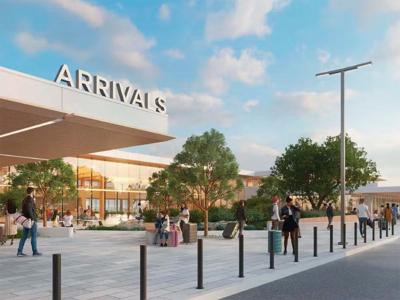

With $37 million of federal grant money in its sails from the 2024 fiscal year and another $14.2 million expected to come this spring, the Monterey Regional Airport’s transformation is continuing. If all goes as planned, a sleek new passenger terminal will be ready for takeoff come May 2027.
But “transformation” is not the word the airport uses. Officially, the project is called Metamorphosis, the idea being that each project goes through three stages: design (caterpillar), construction (chrysalis) and migration (butterfly), the latter reflecting completion and flight-readiness.
It’s a metamorphosis that’s been years in the making. The existing terminal, which was built more than 70 years ago and expanded in the 1970s, has long been in need of replacement.
Terminal construction is expected to begin this summer on a design by architectural firm Hellmuth, Obata & Kassabaum (HOK). On Feb. 19, the Monterey Peninsula Airport District board approved entering into an agreement with construction company Hensel Phelps to be the “construction management as constructor” – aka CMaC – for the replacement terminal project. Hensel Phelps will oversee construction, hiring subcontractors as needed, and deliver it at a guaranteed maximum price (GMP). If Hensel Phelps goes over budget, they incur the cost, if they go under, MRY would see savings.
But what that price is has not yet been determined – Hensel Phelps is currently coming up with an estimate based on HOK’s final designs, and has until April 3 to submit its GMP to MRY. The airport made its own estimate in December of $88 million, which factors in projected inflation over the next two years. But that now seems uncertain with the tariffs imposed by President Donald Trump, which include a 25-percent tariff on all steel and aluminum imports and the same on imports from Canada, a key supplier of wood for construction projects in America. (As a federally funded infrastructure project, MRY is required to use American-made materials, but tariffs still impact the prices of commodities like steel or wood in the U.S. market.)
Chris Morello, the airport’s deputy executive director, says if the cost rises too much, the airport will look to do “value engineering,” essentially doing something similar but less costly than the existing plans.
The $14.2 million in federal funding expected to come this spring will go toward the replacement terminal, and Morello says it’s possible there could be up to $22 million in additional funding available later this year through the Federal Aviation Administration’s Airport Improvement Program. But the airport isn’t expecting the feds to foot the whole bill: Morello says the airport will be utilizing a Department of Transportation program that will allow MRY to borrow at half the U.S. Treasury rate, which would be paid back through airport revenues.
Tariff uncertainties aside, Morello says, “It’s a once-in-a-generation opportunity.”
When the new terminal opens, the existing terminal building will continue to house airport offices and Woody’s at the Airport, and potentially provide the space for international passengers to go through customs. The goal is for the building to become LEED Platinum-certified.


(0) comments
Welcome to the discussion.
Log In
Keep it Clean. Please avoid obscene, vulgar, lewd, racist or sexually-oriented language.
PLEASE TURN OFF YOUR CAPS LOCK.
Don't Threaten. Threats of harming another person will not be tolerated.
Be Truthful. Don't knowingly lie about anyone or anything.
Be Nice. No racism, sexism or any sort of -ism that is degrading to another person.
Be Proactive. Use the 'Report' link on each comment to let us know of abusive posts.
Share with Us. We'd love to hear eyewitness accounts, the history behind an article.