
The U.S. government does not negotiate with fishermen.
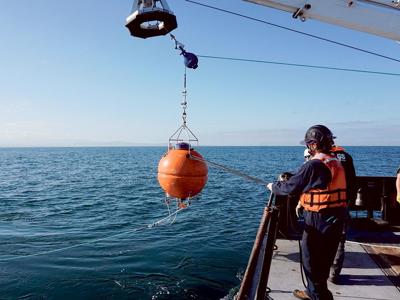
In a federal lawsuit filed March 25 in San Jose, the U.S. government alleges two California fishermen, Daniel Sherer and Patrick Anderson, stole and potentially damaged federal property: a scientific research buoy that had been moored in the Monterey Submarine Canyon off Moss Landing.
The buoy – a vertical, underwater line strung with an array of scientific instruments – was deployed last October, and was one of seven research buoys moored along the canyon at various depths. Together, the buoys were part of the Coordinated Canyon Experiment, a collaborative, international study that aimed to create a comprehensive dataset of things like current velocities and sediment concentration.
Around Jan. 15, the buoy somehow became detached from its anchor during a storm, and it floated to the surface.
On Jan. 17, the buoy’s homing beacon sent a message to the U.S. Geological Survey – the agency operating the buoy – that told federal officials it was in a slip at Moss Landing Harbor.
According to the lawsuit, on Jan. 19, Sherer and Anderson told USGS officials they had the buoy, and wouldn’t return it unless they got paid. Within a day, the buoy was moved, and subsequently taken from the harbor in a pickup truck.
So the battle for the buoy begins.
On. Feb. 19, Karen Glasgow, a solicitor for the U.S. Department of the Interior, sent a letter to Sherer’s father, Southern California-based attorney David Sherer, who was purportedly acting as legal counsel for the fishermen.
“Your client has no claim or right to possession of the… equipment,” she writes. Glasgow emphasized that if the buoy was not returned voluntarily, legal action would follow.
David Sherer responded with a letter Feb. 23, in which he refers to himself as an “old trial dog,” and offered that his clients would sell the buoy for $45,000.
“The flavor of the thing says that the principal authorities you represent have a fixed position,” he writes. “I’ll just have to deal with that.”
A month later, the government filed suit, arguing that the fishermen’s possession of the buoy was “adverse and hostile to the United States” rights, and that Sherer and Anderson are liable for “damages potentially equaling or exceeding $115,000.”
R. Michael Underhill, the federal attorney overseeing the case, says it’s government policy to not comment on cases beyond what is filed in court.
David Sherer says he took himself off the case March 28, but wouldn’t elaborate as to why. He also says he doesn’t have much experience in maritime law.
He’s also not sure if Anderson and his son Daniel – neither of whom could be reached for comment – have acquired other legal counsel.
As for whether they have a case, San Francisco attorney Marilyn Raia, who’s practiced maritime law for nearly 40 years, says definitely not. Salvage laws don’t allow for one to take whatever they find in the water.
“You don’t get ownership if you find something,” she says. “They’re using it basically for ransom, or extortion. I could not advocate that position as a maritime lawyer, particularly in a salvage context.”
The first hearing for the case is set for June 28.



(0) comments
Welcome to the discussion.
Log In
Keep it Clean. Please avoid obscene, vulgar, lewd, racist or sexually-oriented language.
PLEASE TURN OFF YOUR CAPS LOCK.
Don't Threaten. Threats of harming another person will not be tolerated.
Be Truthful. Don't knowingly lie about anyone or anything.
Be Nice. No racism, sexism or any sort of -ism that is degrading to another person.
Be Proactive. Use the 'Report' link on each comment to let us know of abusive posts.
Share with Us. We'd love to hear eyewitness accounts, the history behind an article.