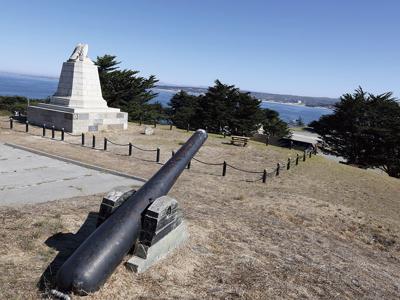

Lower Presidio Park in Monterey is arguably the most historic place in all of California, as it was long inhabited by Indigenous people and was among the first places Spanish colonizers set foot in the 1600s and 1700s. It’s also the place where the first non-native person was buried in Alta California, a freed Black slave named Alexo Niño, who died on a ship, San Antonio, en route to Monterey from San Diego in 1770 as part of Junipero Serra’s missionary expedition – Serra was also on the ship.
But like many historic locations in Monterey, Lower Presidio Park remains largely obscure, literally – it has some of the best views in the area code, but because it’s on U.S. Army-owned property, access is limited, and easy to miss from the road.
While no one disputes the 25-plus-acres that make up the park are a regional if not national treasure, there is tension in how it should be managed going forward, and how much, if anything, the City of Monterey’s taxpayers should spend on it.
That question was brought to the Monterey City Council Oct. 1, though it wasn’t a question the council was asked to answer – rather, the council heard a presentation about not only the site’s historic significance, but also the state of play with the city’s lease.
The city’s involvement with the property, which the Army has owned since 1847, came in the 1980s when the Army was proposing to sell 123 acres of the Presidio, including Huckleberry Hill, to private developers. Then-Congressman Leon Panetta got Congress to reject that proposal.
In 1984, the city also rezoned the property to preclude private development, and in 1996 the city entered into a 50-year lease with the Army to “celebrate the rich history of this place since 1602.”
Since then, the city has provided maintenance and stewardship of the park’s historical assets, which costs the city about $80,000 annually. Reportedly, the city has also invested about $1 million over time to maintain the property.
The park’s hillside, adjacent to Lighthouse Avenue north of the tunnel by Fisherman’s Wharf, harbors countless archaeological resources that today are being unearthed by ground squirrels. Once or twice a year, City Manager Hans Uslar says, the dirt that falls on the sidewalk by the road is collected in the presence of archaeological and Indigenous monitors.
The Army, in 2021, asked the city to up its investment in the site by stabilizing the hillside – although it’s not evident the hillside has moved – with a retaining wall the city estimates will cost $1.5 million, and per a city report, would “involve robust consultation” with local tribes.
Whether it’s worth it for the city to pay that, or have a nonprofit take it on, or, advocate for the site to be designated as a federal national monument or historic site is the open question that the council, per Uslar’s recommendation, will be answering early next year.
“It’s a very spiritual area and we have to acknowledge that,” Uslar says. “At the end of the day, this is the heart and soul of California.”



(0) comments
Welcome to the discussion.
Log In
Keep it Clean. Please avoid obscene, vulgar, lewd, racist or sexually-oriented language.
PLEASE TURN OFF YOUR CAPS LOCK.
Don't Threaten. Threats of harming another person will not be tolerated.
Be Truthful. Don't knowingly lie about anyone or anything.
Be Nice. No racism, sexism or any sort of -ism that is degrading to another person.
Be Proactive. Use the 'Report' link on each comment to let us know of abusive posts.
Share with Us. We'd love to hear eyewitness accounts, the history behind an article.