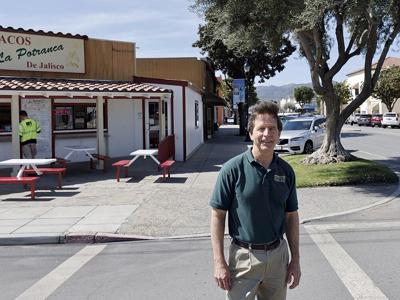

Future generations might one day point to King City’s renaissance as a textbook example of good government and long-term crisis management. Once a thriving Salinas Valley city, the departure of one of its largest employers in the early 2000s triggered a destructive domino effect of economic disinvestment, blight and increased crime. The 2008 recession exacerbated its issues, topped off with police corruption and a growing government debt.
Around 2015, the city began ushering in new leadership. A long-term economic development effort became the rallying cry for recovery; at its heart is a 2017 master plan to resuscitate the city’s once-thriving downtown.
“We knew economic recovery meant finding ways to attract new people to King City. We identified the downtown, which had become blighted, as one of the key assets that needed to be revitalized,” City Manager Steve Adams says.
The project, which has been an ongoing effort, received a boost on March 15 when President Joe Biden signed the $1.5 trillion spending bill. Tucked into the bill was $1 million for King City’s downtown streetscape plan, which will help finance the reconstruction of intersections to make them more pedestrian-friendly, landscaping, median reconstruction and decorative crosswalks along Broadway, between Rust and 1st streets.
This year’s federal spending bill marks the return of congressional earmarking, a political practice on hiatus for more than a decade that allows congressional representatives to secure financing in the federal budget for specific, local projects in their districts. The practice ended in 2011 after then-President Barack Obama, in the heat of the financial crisis, said he would veto any bill with congressional earmarks. Their return is an acknowledgment that congressional representatives understand local needs better than a federal budget officer.
Rebranded as “community projects funding,” local earmarks come with a new set of checks on lawmakers, including that representatives can only request funding for 10 projects and must show evidence that there is community support for the requested projects. The $1 million for King City’s downtown revitalization marks a large slice of the $5.9 million Congressman Jimmy Panetta, D-Carmel Valley, was able to secure for eight projects in his Central Coast district.
Half of those projects are in Monterey County, and include $250,000 for a farmworker workforce development center in Salinas, led by the Agriculture & Land-Based Training Association; $200,000 to buy the commercial equipment to build a kitchen incubator in East Salinas for entrepreneurs; and $400,000 for a Monterey One Water effort to relocate the electrical equipment for a Pacific Grove wastewater pump station away from the coast and to higher, drier land. The project is part of M1W’s effort to reinforce its critical infrastructure against the inevitabilities of climate change.
Applications for local project earmarks in the FY 2022-23 federal budget will open in a few weeks.


(0) comments
Welcome to the discussion.
Log In
Keep it Clean. Please avoid obscene, vulgar, lewd, racist or sexually-oriented language.
PLEASE TURN OFF YOUR CAPS LOCK.
Don't Threaten. Threats of harming another person will not be tolerated.
Be Truthful. Don't knowingly lie about anyone or anything.
Be Nice. No racism, sexism or any sort of -ism that is degrading to another person.
Be Proactive. Use the 'Report' link on each comment to let us know of abusive posts.
Share with Us. We'd love to hear eyewitness accounts, the history behind an article.