A gate with stone pillars will separate the haves from the have-nots at Marina’s recently approved Cypress Knolls development for seniors. The project’s 142 affordable units will be lumped together on an eight-acre plot outside the fence that will surround the market-rate homes and “bridge” homes.
Before approving the development on Nov. 8, the Marina City Council adopted an affordable housing ordinance that reads: “All inclusionary units…shall be reasonably dispersed throughout the development.”
So much for that idea.
City officials say the Cypress Knolls affordable homes will be built outside the gate so the residents don’t have to pay homeowners association fees. The fees, which will fund street maintenance, landscaping and security, are expected to cost about $350 a month.
“If they had to pay that homeowners fee they probably couldn’t afford to live there,” says Councilman Ken Gray.
The project will turn 188 acres north of Imjin Parkway and west of California Avenue into a “retirement-lifestyle development” with 712 homes and a community center. The homes will be sold or rented to people 55 years of age or older. The project will fill a critical need for senior housing, proponents say. With the Baby Boomers retiring, the state estimates that by 2010, one in five Californians will be 60 years of age or older.
Forty-nine of the homes will be for-sale units reserved for elderly households with moderate incomes, while 93 apartments will be set aside for low- and very low-income seniors. Annual household income limits for a single person are $52,200, $34,900 and $21,800 for moderate, low- and very low-income households, respectively, according to the California Department of Housing and Community Development. The project’s 71 “bridge units” will be priced affordably for households that earn between 120 and 150 percent of area median income. In Monterey County that’s between $52,200 and about $65,250 for a single person. These bridge homes will be intermixed with the market-rate units.
The poorer residents of Cypress Knolls and the community at large will still be able to access the development’s network of walking and bike trails through pedestrian entrances. The development will have more than 30 acres of open space, a fitness center, bocce ball and shuffleboard courts, to name a few of the amenities. If residents outside the gate want to jump in the pool or do yoga in the community center, however, they will have to pay.
Market-rate homeowners will pay for the services through their membership in the homeowners association, to which low-income residents won’t belong. Real estate regulations don’t allow subsidized homeownership fees for low-income households, says Jennifer Coile, the city’s project manager for Cypress Knolls. “It’s the Department of Real Estate regulations that has backed us into this,” Coile says.
Still, the separation between the affordable and market-rate units goes against the trend of intermixing families of different income levels. This new urbanism approach will guide new developments in Salinas and is being implemented in creative ways throughout Monterey County.
In King City, for example, affordable housing developer CHISPA is planning to build 40 affordable apartment units on eight different parcels in the Mills Ranch subdivision. Single-family homes will sit between the apartments, says Alfred Diaz-Infante, president and CEO of CHISPA. The low-income residents will be neighbors with the market-rate homebuyers instead of living on a different block or in a distinct section of the development.
“That’s how they were designing neighborhoods in the past,” Diaz-Infante says. “In the last 30 years we got away from that.”
Cypress Knolls has been in the works for more than a decade. The project was the first development proposal chosen by the Fort Ord Reuse Authority after the military base closed in 1994. Front Porch, the project’s developer, will have to demolish 260 old military houses left over from the closure of Fort Ord.
Cypress Knolls is designed to appeal to seniors, who are active, environmentally sensitive, spiritually-minded and volunteer-oriented, say Front Porch officials. Despite the gate, officials expect the residents to be highly involved in the surrounding community—from volunteering at adjacent Marina High School to attending classes at Cal State Monterey Bay.
“The irony is the people who will be living in Cypress Knolls will be highly connected to the community,” says Lee Ratta, senior vice president of organization advancement for Front Porch.
The gated design is new to Marina, which is considered the bedroom community of the peninsula. The city’s general plan only allows gated communities if there is significant public benefit.
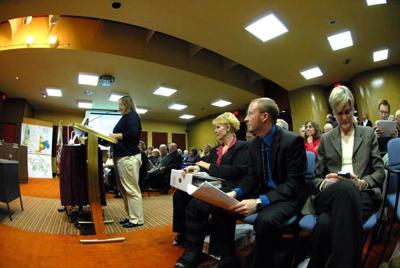
At the Nov. 8 City Council meeting, residents defended the gate because of the added privacy and safety it will afford seniors.
Vivian Raymer lives in Marina Manor Senior Housing, an apartment complex at 3082 Sunset Ave. Raymer told the City Council she supports the gate. “I think we should think about the safety of the seniors and let them live a comfortable life in Cypress Knolls,” she said.
The Burbank-based developer has agreed to pay an additional $2.8 million toward a city senior center. This center won’t be behind the gate and will be accessible to the entire community. Moreover, the not-for-profit senior housing developer will fork out $1.8 million to extend Patton Parkway.
On Nov. 21, the City Council is slated to approve business terms for the new development. Marina is expected to sell the 188 acres for between $14 and $16 million—half of which would be split with FORA. Profits above 22 percent would be split evenly between city and developer.
Construction is expected to start at the end of next year, and homes will go on sale at the end of 2008, Coile says. As proposed in the disposition and development agreement, the affordable units won’t be built until 60 percent of all market-rate units are completed.
The model homes will be equipped with solar lighting, and homeowners will have the option of purchasing solar panels. There is also land set aside for a 60-bed assisted living facility, so some residents may never have to leave Cypress Knolls when age catches up to them.
“This will be a very kind of ageless community,” Ratta of Front Porch says. “They are finding meaning in life together.”



(0) comments
Welcome to the discussion.
Log In
Keep it Clean. Please avoid obscene, vulgar, lewd, racist or sexually-oriented language.
PLEASE TURN OFF YOUR CAPS LOCK.
Don't Threaten. Threats of harming another person will not be tolerated.
Be Truthful. Don't knowingly lie about anyone or anything.
Be Nice. No racism, sexism or any sort of -ism that is degrading to another person.
Be Proactive. Use the 'Report' link on each comment to let us know of abusive posts.
Share with Us. We'd love to hear eyewitness accounts, the history behind an article.