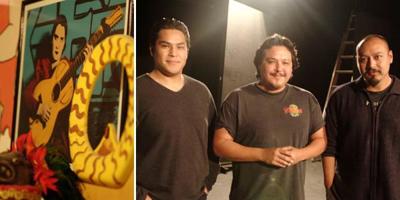
“There were efforts to mechanize the harvest of grapes,” Luis Valdez says. “But it wasn’t possible, because it’s an organic fruit. You can’t really mechanize it. I saw them try and change the trellises for grapes so a machine could just come in and cut them off, but it was clumsy, it didn’t work. They tried to change the fruit itself, like the tomato, right? Thicken the skin so it doesn’t bruise, but it doesn’t work, man, you need the human hand, the human hand to get in there.”
To Valdez, the subjects of art and agriculture are interchangeable. One look at his body of work, and the subsequent legacy of American political theater, reveals that the human hand has always been in there. Even his most commercial work, La Bamba, the 1987 hit he wrote and directed about Mexican rock ‘n’ roll sensation Ritchie Valens, was a soulful and earthy affair.
Yet it’s his work with El Teatro Campesino, the legendary “farmworkers theater” he founded in 1965, that defines his lifelong commitment to art and the politics of survival.
Created to educate his people about the problems facing Mexican labor and to get his fellow field workers to join César Chávez’ United Farmworkers of America, Valdez and his players began to develop teatro chicano, a style of agitprop theater incorporating the spiritual and presentational style of the Italian Renaissance commedia dell’arte with the humor, character types, folklore and popular culture of early Mexican theater.
Valdez largely credits El Teatro’s stylistic development to the company’s relocation to San Juan Bautista in 1971. The small, rural town offered a quiet retreat from the city’s distractions, enabling the troupe to focus on its award-winning and influential work. Nearly 40 years have passed since Valdez asked César Chávez permission to form El Teatro from the striking grape pickers in Delano, California, yet Valdez feels El Teatro’s most essential work is still ahead.
“I want to complete a couple of other pieces that deal with my early years as a farmworker and try to find some meaning,” he says. “I don’t think it’s ever been truly captured. Not even by us. We’ve danced about it, we’ve poked at it, we’ve done pieces that touch on the farmworker experience that are really quite reflective of the farmworker in music and in form. La Carpa de los Rasquachis, [“The Tent of the Underdogs”], one of our classics, is straight out of a farmworker’s ballad, but I want to deal more realistically, yet at the same time more epically with these themes.”
Down a dusty, pitted street in San Juan Bautista, the Quetzequatl soul of American theater inhabits a converted produce packing-shed warehouse. Squatting in the hot rural sun, the building wears a skirt of dry grass and a flaking coat of paint the color of dried blood. A piebald dog wanders the dirt and gravel parking lot before slumping in the shade of a pick-up truck to escape the blazing afternoon sun.
Within these sun-baked walls the magic is muy potente. Inside this theater, an old serpent is slowly shedding its skin; reinventing itself for the 39th time in as many years. Step inside the cool shade of El Teatro Campesino Playhouse and you will glimpse the shine of fresh scales, the arc of barbed fang; you will smell the intoxicating venom of some very powerful theater.
El Teatro Campesino is as rustic and feisty as the playhouse it inhabits. One of California’s oldest and most important troupes, their home’s rasquachi enchantment is a good indicator of how El Teatro has managed to keep its soul intact for nearly four decades.
The roots of El Teatro are sunk into a hallowed tradition of protest and action.
As an aspiring 25-year-old playwright, Valdez left the San Francisco Mime Troupe to join César Chávez in organizing farmworkers in Delano, Calif. in 1965. With the blessing of Chávez, Valdez organized the workers into a theater troupe in an effort to popularize and raise funds for the grape boycott and farmworker strike. His company created and performed actos, or short skits, on flatbed trucks and in union halls. Each performance was specifically geared for striking farm workers, and the casts were made up entirely of striking farmworkers. These early productions were ensemble improvisations, based on the workers’ daily lives, and using everyday language—San Joaquin Valley Spanish mixed with English.
The late ‘60s marked a turning point for El Teatro, as the company’s scope expanded beyond the farmworkers to more global issues, such as Chicano identity, racism in education, the Vietnam War, and police brutality.
Over the decades, Valdez has watched El Teatro come out of the fields and into the spotlight of American cultural iconography. His hit musical, Zoot Suit, based on the Sleepy Lagoon murder trial of 1942-3, opened in Los Angeles at the Mark Taper Forum in July 1978, and ran for eleven months, generating enough money to build the playhouse in San Juan Bautista before opening on Broadway and then becoming a highly influential film.
Zoot Suit depicts the events of a case in which 17 Chicano youths were convicted of charges ranging from assault to first-degree murder for the death of a Mexican-American boy discovered on the outskirts of Los Angeles. The trial created an anti-Mexican atmosphere that resulted in the so-called Zoot Suit Riot, as white soldiers on leave in the city attacked minority youths and burned their distinctive suits.
Next month, El Teatro will celebrate the 25th anniversary of the classic pachuco musical with a national tour that opens in San Jose before traveling on to various cities in Texas.
“[Zoot Suit] has elements that are quintessentially American,” Valdez says. “It combines music and the Big Band sound, which is very important, with the gangster appeal. Let’s face it, that’s very popular these days; that’s very commercial, you know? Gangsters set to music.”
In addition to reviving Zoot Suit later this summer, El Teatro Campesino provides a retrospective look at earlier popular classics by resuscitating two vintage one-acts for a rare three-week engagement beginning this Thursday.
Dos Vatos, a short play written by Ernie Palomino and Ricardo Duran, tells the story of two common houseflies in their quest to find sustenance and freedom in the violently oppressive environment of a young woman’s apartment. Told in a broad slapstick style, Dos Vatos was written as a puppet show and has never before been performed with real actors.
Along with Dos Vatos, El Teatro will present the Valdez-penned Dark Root of A Scream. Set during the Vietnam War, Dark Root examines the motives that propel young Chicanos to fight on the front lines of war and the subsequent effects on their immediate families and communities. Incorporating Mayan and Aztec mythology, the play considers the idea of blood sacrifice, asking whether the blood of the young purchases the security and prosperity of the nation.
Valdez is quick to acknowledge the influence of current events on his decision to let his youngest son Lakin revive the 36-year-old play.
“Yes, we have grown increasingly concerned about Iraq, and we’ve been around long enough to know that no war gets by without consequences—and I don’t just mean the killing, the maiming that goes on during the war. It’s the aftermath. The aftermath is real tough.
“Vietnam has been with us for so long because the consequences of that aftermath were really, really strong. The post-traumatic stress disorder cases are phenomenal. They’re reaching crisis proportions.”
In fact, Valdez recently performed a narrative on post-traumatic stress syndrome disorder for a nonprofit organization.
“I did one for Latino veterans coming back that deals with letters that have been sent by soldiers who are now dead who were blown up by suicide bombers in Iraq. Very touching stuff, but it’s the same response to war that you see in every war, going way back.”
In addition to being adamantly anti-war, Valdez is also adamantly realistic. He views war as a respiratory cycle, a tragic but inevitable component of human nature.
“If Iraq hadn’t happened I think it would have happened at another place. You could almost see this inhaling, exhaling action taking place in history, where people go to war, with all of its excitements and all of its potential for profit and all of its death and depravation and loss and destruction. People go to war and a generation exhausts itself on a war and it has to relax; it goes into this period where everything settles down for awhile. And then it goes up again, and it’s like the testosterone level grows and the frustration in human beings grows because it has to have another war, you have to get into some killing again. Bloodletting. This is a kind of bleeding; it’s up and down, rising and falling, in and out.”
At the age of 64, Valdez retains an active role as El Teatro’s artistic director. Despite success in Hollywood, he remains loyal to the artistic mission of live theater.
Fiercely intelligent and casually hip, Valdez continues to live in San Juan Bautista with his wife, Lupe, who serves as the theater’s administrative director. Yet in recent years, he has begun shifting much of the theater’s operational responsibility to the next generation of Campesinos—his sons Lakin, Kinan, and Anahuac; and Estrella Esparza, the daughter of Valdez’s long-time partner Phil Esparza.
Lakin, 25, makes his directing debut with the two one-acts, Dark Root of A Scream and Dos Vatos; Anahuac, 32, serves as the theater’s general manager; Kinan, 30, will direct the upcoming tour production of Zoot Suit; while Estrella directed last year’s version of El Teatro’s eye-popping annual Christmas pageant, La Pastorela. In addition, all four frequently take lead roles in El Teatro productions.
“We’re a family of families,” Valdez explains. “Which is both a strength and a weakness. Because it’s this organic family structure that requires a consensus; you can’t really delegate authority from the top down like an army. At the same time, it’s a strength because in times of great difficulty it pulls together and holds.”
With its 40th anniversary right around the corner, Luis Valdez and El Teatro Campesino have seen their fair share of great difficulties. Like most theater companies, El Teatro relied heavily on grants, and the current drought in government funding has forced creative solutions.
“What they don’t realize is that art turns the ground over,” Valdez says. “It’s like the earthworms, they make the earth breathe, right? And in the same way the artists are the earthworms, they make culture breathe, the lifestyle breathe, they make democracy breathe because it’s a public expression from the grassroots of what people are thinking and feeling. That’s one of my firm beliefs; it’s unshakable.”
El Teatro now depends on ticket sales for almost 100 percent of its funding, and it keeps the overhead low thanks to the help of more than a dozen volunteers. In addition, touring has always provided another profitable alternative, as El Teatro tends to enjoy a higher profile beyond the Central Coast. The Zoot Suit tour can be relied on to provide an infusion of funds.
“There are times of prosperity, depending on the mood in the country, when the money flows. If you tried not to think of a continuum, and to give it more of an agricultural interpretation—we plant different crops, man, the crops come and go, okay? And so there’s a time for seeding and there’s a time for harvesting and there’s a time for irrigating. You know what I’m saying? There’s a time for digging up the ground and turning it over and planting something else, because the corn has depleted the nutrients in the ground. So sometimes we do small things, sometimes we take on huge projects for us, and sometimes we go out on tour.
“We either expand or we contract and that’s one of the ways that you survive. You cut away your overhead and go back down to some kind of basic survival mode. The last two or three years have been survival modes because of cutbacks in funding everywhere. You find alternatives like touring, and just hope that enough groups survive to maintain surface tension in the area.”
Valdez is not unaccustomed to functioning in survival mode. Having been cast in the crucible of the UFW’s struggle for survival, the theater’s origins lay in Valdez’s resourcefulness and courage.
“I went to César Chávez and pitched him the idea of a farmworkers’ theater,” Valdez recalls. “This is the first week of the grape strike and he said, ‘Fine, but there are no actors in Delano and there’s no money in Delano and there’s no stage and no time to rehearse and no costumes. There’s nothing,’ he says. ‘You still want to do it? We only have a strike.’ And I said, ‘That’s enough. Thank you for the opportunity.’
“So I joined the strike, basically, and the striking farmworkers became the actors. I didn’t even have to feed them. They fed off the strike kitchen. There wasn’t very much. Eventually the union paid people $5 a week, so that’s what our actors got, $5 a week. Not for acting, but for being on strike.”
Valdez and the infant El Teatro Campesino suddenly found themselves fighting a guerilla war with nothing but their ideas, bodies, voices and music. Covering a thousand square miles on a flatbed truck, they’d set out before dawn looking for scab crews, then pull up to the side of the road and start performing.
“We improvised a lot of stuff. It was not easy to work with scripts because some of the farmworkers really weren’t good at it. They could barely read in some instances. And some were quite literate. It varied. But then it had to be either Spanish or English…it just got to be too much of a mess, so we started improvising everything.”
In 1968, the company left the fields to create the agitprop theater style that, within a year, had won its first of two Los Angeles Drama Critics Awards, and a special Obie Award for “demonstrating the politics of survival.”
Relocating to San Juan Bautista in 1971 and collaborating with Peter Brook (the celebrated, iconoclastic former artistic director of England’s Shakespeare Academy) and his Paris-based International Center of Theater Research, El Teatro shot into the consciousness of the international theater community.
The ‘70s saw Valdez’s company further explore the relationship between music, dance, and theater while also focusing on the production of film and video. Their subsequent productions toured the nation and world, were produced for television, and made into movies.
“We used to do major tours to Europe and across the country, until we started to have children, and that made touring more and more difficult. So we acquired this playhouse and said, ‘Let’s stay put while the kids grow.’ Well, we got this playhouse in 1980, right? That’s 24 years ago. The kids are grown!” Valdez laughs.
Grown up and carrying on the legacy of El Teatro, the children of the Campesino veteranos have also begun creating their own legacy. In addition to the theater, the Valdez brothers co-manage an independent film company called “Chicanos on the Run.”
Founding the film company in 1994, they produced a short called Little Luis based on some of their father’s childhood experiences, which won an award for Best Short at the International Latino Film Festival. They followed this success with a feature length film called Ballad of a Soldier, based on a one-act play by their father, which won the Jury Award at the acclaimed San Antonio CineFestival in 1999.
“My brothers and I are very close,” explains Anahuac, whose name is Aztec for ‘America.’ “Growing up in San Juan in the theater shaped us. At a very young age we knew we’d be involved in the arts for the rest of our lives. I can’t imagine doing anything else.”
Luis Valdez’s life and work has also inspired two full generations of Latino actors, directors and technicians. From El Teatro alumni like Edward James Olmos and Lou Diamond Phillips to the new wave of blockbuster Mexican directors like Alfonso Cuaron (Harry Potter and the Prisoner of Azkaban), Guillermo del Toro (Hellboy), and Robert Rodriguez (El Mariachi).
Valdez acknowledges the actors that in turn inspired him.
“I used to look at Ricardo Montalban or Anthony Quinn from a distance,” he says. “These guys were stars, man. These were idols. I got to know them as time went by and I also got to know they were part of the struggle.”
It is Valdez’s devotion to “the struggle” that keeps him and El Teatro in San Juan Bautista. Rooted in the indigenous culture of Mexican farmworkers, while remaining open to the flow of new ideas, El Teatro Campesino continues to combine urban and rural realities with an aesthetic that encompasses a vision for the future while embracing the ancient past.
San Juan Bautista, a sleepy town near the junction of four different highways, remains the perfect place for them to do it.
“Our location here in San Juan Bautista is part of the magic of the work. San Benito County is the wrong place to be as far as funding is concerned, but the right place to be in terms of the spirit of the group.
“Mainly what I’m trying to do also is help Teatro make this transition to its new period,” Valdez says. “I always figured that the last phase of my work would be as a teacher basically.
“The last few years have been less than productive because of the cash flow and also because of transitions in personnel in our company, people deciding what they want to do with their lives. Twenty-somethings become thirty-somethings and then they have to decide what the next step is. So you bring the teenagers, you see, into the next level. And so we’re looking at, frankly, the next group of high school kids coming through here.
“Survival, like art, must be organic,” Valdez says. “You have to deal with the particular conditions that you’re in right now. The only thing I can tell you is that we’re still here and we have no intention of going away, and we hope that people will come see the plays.”
Stepping back out of the El Teatro Campesino Playhouse and into the late afternoon sun, the landscape of sun-bleached wood and peeling paint has taken on aspects of a languid dream. In the distance, golden hills undulate in a warm wind. The piebald dog has disappeared, replaced by long shadows, lazy scratches in the gravel, and the sounds of soft laughter and music from inside the playhouse, where rehearsal has begun.



(0) comments
Welcome to the discussion.
Log In
Keep it Clean. Please avoid obscene, vulgar, lewd, racist or sexually-oriented language.
PLEASE TURN OFF YOUR CAPS LOCK.
Don't Threaten. Threats of harming another person will not be tolerated.
Be Truthful. Don't knowingly lie about anyone or anything.
Be Nice. No racism, sexism or any sort of -ism that is degrading to another person.
Be Proactive. Use the 'Report' link on each comment to let us know of abusive posts.
Share with Us. We'd love to hear eyewitness accounts, the history behind an article.