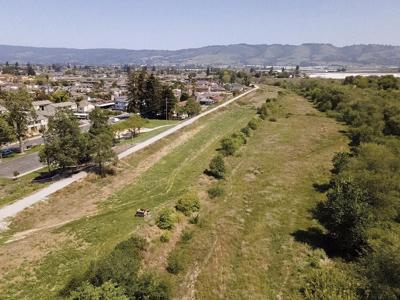

For over 50 years, since 1966, the Pajaro River levee has been on the radar of the U.S. Army Corps of Engineers’ reconstruction list as a needed upgrade to protect the community from flooding, yet it has remained undone. The $400 million project is now one step closer to reality, thanks to $67 million in federal funds from the Infrastructure Investment and Jobs Act for its first construction phase. (It’s currently in its design and environmental phase.)
Since the levee was built in 1949, it has broken several times. In 1995 the flooding caused $95 million in damage; in 2017, the levee almost broke again.
About 3,000 properties – including residential, industrial, commercial and agricultural – in both North Monterey County and South Santa Cruz Country border the Pajaro River.
Normally a project like this would require locals to bear part of the cost – in this case, 10 percent, or $42 million – but the Pajaro River Flood Risk Management Project is unique in that it has full state and federal funding. “It was just not affordable to raise the local share for that amount of funding,” says Kim Floyd, public outreach consultant for the Pajaro Regional Flood Management Agency.
That’s thanks to Senate Bill 496, co-authored by Assemblymember Robert Rivas, D-Hollister, and State Sen. John Laird, D-Santa Cruz. Under SB 496, the Department of Water Resources will pay 100 percent of the local and state cost-share for the project, or $140 million.
But before breaking the ground, there is one more step the project has to achieve: Proof that the PRFMA can maintain the levee to tune of $3.8 million per year. There is a $1.2 million annual shortfall.
PRFMA is asking property owners to cover the shortfall. Under a proposed tax assessment, each river-adjacent parcel would pay an amount based on factors like size, flood risk, land use, etc.
Floyd says the project is long overdue, and if people vote no on the assessment it would have catastrophic consequences. “We will lose the $400 million in state and federal funding,” she says. “This is a once-in-a-lifetime opportunity and it’s not likely that money will be available again.”
To pass, the assessment needs a simple majority of 50 percent plus one. On April 22, assessment ballots were sent to property owners. The last day to return ballots is June 8. If it passes, it will take effect in the fall. Construction would begin in 2025, to be completed in 2032.


(0) comments
Welcome to the discussion.
Log In
Keep it Clean. Please avoid obscene, vulgar, lewd, racist or sexually-oriented language.
PLEASE TURN OFF YOUR CAPS LOCK.
Don't Threaten. Threats of harming another person will not be tolerated.
Be Truthful. Don't knowingly lie about anyone or anything.
Be Nice. No racism, sexism or any sort of -ism that is degrading to another person.
Be Proactive. Use the 'Report' link on each comment to let us know of abusive posts.
Share with Us. We'd love to hear eyewitness accounts, the history behind an article.