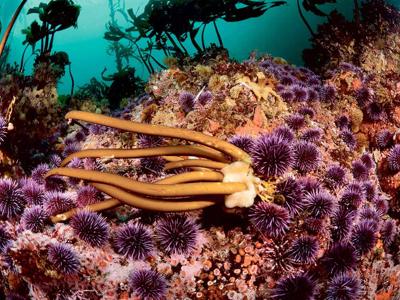

All around the Monterey Peninsula, and off of much of the California coast, the marine ecosystem has changed dramatically in the last few years: Kelp forests are being replaced by purple sea urchins.
The phenomenon has alarmed divers, who seek out the biodiversity kelp forests harbor. Scientists are questioning what, if anything, can be done about it.
The issue was discussed by the Monterey Bay National Marine Sanctuary Advisory Council on April 20, and kicked off with a presentation by Cynthia Catton, a California Department of Fish and Wildlife scientist who has been studying the issue off the Northern California coast.
She shared some alarming statistics about that region: There was a 93-percent loss of kelp in 2014, a 33-percent loss in 2015 and only limited growth in the past two years. The population of purple urchins, meanwhile, exploded.
She laid out the confluence of factors that happened simultaneously, even though scientists haven’t yet proven what caused the dramatic shift. In 2013, sea star wasting disease impacted the entire West Coast, decimating one of purple urchins’ predators. The population of purple urchins – which eat kelp, among other things – exploded in 2014. That same year, ocean temperatures increased on the West Coast; kelp thrives in colder water.
“It was a double whammy against kelp,” Catton said.
Locally, the situation is not as dire as further north, but it’s getting worse.
Reef Check, a citizen science nonprofit that operates globally, has been tracking the Monterey Peninsula’s kelp forests for the past 12 years with the help of volunteer divers. Dan Abbott, Reef Check’s Central Coast regional manager, says there have been “unprecedented changes in the past two years” with the loss of kelp and increased purple urchin density.
“The trend is not slowing down,” Abbott says.
Keith Rootsaert has been diving locally for 30 years, and has volunteered with Reef Check for the past nine. He has seen the transformation: “The urchins have been marching,” he says.
When purple urchins displace kelp and cover the seafloor, they form what scientists call an “urchin barren.” While it’s somewhat counterintuitive that urchins would proliferate in a region with sea otters, which prey on them, the theory, Abbott and Rootsaert say, is that the urchins in the barrens are so malnourished that otters don’t consider them worth eating.
Rootsaert says many divers would love to go underwater and start hammering away at the urchins – literally killing them with a hammer – but that because the region is a Marine Protected Area, it’s not legal.
So Rootsaert is helping spearhead a project to do it legally: Mark Carr, a marine biologist at UC Santa Cruz, is proposing to study how much urchin populations need to be reduced for kelp to recover, and Rootsaert will team up with other divers to cull urchins in specific areas around the Peninsula.
The study would require the blessing of state officials, and Carr says state funding for the project won’t be available until 2019.
Whether or not the decline of kelp is a harbinger of the future, as climate change continues warming oceans, “That’s the million-dollar question,” Carr says. “I don’t think anyone knows.”



(0) comments
Welcome to the discussion.
Log In
Keep it Clean. Please avoid obscene, vulgar, lewd, racist or sexually-oriented language.
PLEASE TURN OFF YOUR CAPS LOCK.
Don't Threaten. Threats of harming another person will not be tolerated.
Be Truthful. Don't knowingly lie about anyone or anything.
Be Nice. No racism, sexism or any sort of -ism that is degrading to another person.
Be Proactive. Use the 'Report' link on each comment to let us know of abusive posts.
Share with Us. We'd love to hear eyewitness accounts, the history behind an article.