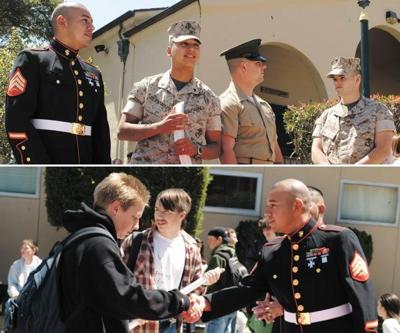
In the main courtyard at Monterey High School, brass buttons and highly polished medals gleam in the bright noontime sun. Four patient young Marine recruiters stand politely behind a collapsible table laid with neck-strap key rings, posters and high-gloss promotional materials while students swirl and mill through yet another lunchtime of their high school lives.
Some students smile at the Marines as they pass, most ignore them. A military presence on their campus is nothing new. In fact, it’s almost a daily occurrence. As lunch progresses, some of the students approach the table and linger there, quietly asking questions and fingering the merchandise. The Marine recruiters are in various states of dress. Two are in blue dress uniforms. Two are in crisp service “C” uniforms.
Only 20 years old, Lance Corporal Jordan White is a good-looking young man in light fatigues. A gaggle of high school girls have noticed him and made their way around to the back of the table to talk. He’s relaxed and charming—obviously enjoying the attention. After all, these flirting, giggling girls are only a few years younger than he is. Usually the Marines bring along a pull-up bar for White to do his stuff on. This time he simply relies on his Hollywood smile and his unassuming and mature military bearing. The girls look weak in the knees.
The older recruiters, in their mid- to late-20s, let White handle the girls and focus on the young men congregating before them in groups of twos and threes. The young Marines answer their questions. Yes, the Marine Corps is all about opportunity. It’s about a career, job skills, personal development, advancement. The Marines are about the challenge; discipline, direction and self-reliance; courage and confidence; leadership and management skills; pride and belonging.
Some of the boys nod, backpacks filled with textbooks and notebooks slung over their young shoulders. The message appears to affect them. Confidence and belonging. Direction and pride. The words are powerful landmarks in a landscape of adolescent insecurity.
Finally, a young man asks the hard question. “Have you ever killed anybody?”
It’s a question Sergeant Jason Garcia gets a lot from high school students. Garcia is 27 years old. He was recruited into the Marines as a teenager in Los Angeles. He describes his own recruitment as the impetus he needed to do something with his life.
“I was at home washing my car when the recruiter pulled up,” he says. “I was one of those guys who needed to be pushed.”
Garcia is one of two recruiters in the courtyard today who has been to war. His primary duty was purifying water for troops in Iraq.
“I can honestly say I never killed anybody,” he says. “We don’t sugarcoat anything here. We make it clear the kind of commitment they’re making here.”
“We wouldn’t want it any other way,” White adds. “This is the Marines.”
The recruiters offer each of the interested young male students a neck-strap key ring and they eagerly take them. One young man unwraps his and immediately puts it on. The words “United States Marines” loop around his neck like a yoke. Or a noose.
° ° ° °
At the same time, a few hundred feet away, a different group of students shuffle into Room 77 of Monterey High’s English Building, find their desks and unwrap their lunches. Their teacher, Maj Britt Eagle, welcomes them and tells them she has a movie she wants them to watch. It’s called The Ground Truth: The Human Cost of War.
The half-hour documentary is a soldier’s perspective of the Iraq War. The Ground Truth is being disseminated throughout Monterey County high schools and colleges as a counter-recruitment tool by Valori George, coordinator of the Monterey Peace and Justice Center.
“The recruiters are so well-trained,” George says. “We simply don’t have the kind of staff and resources to compete with the military, so a film like The Ground Truth is invaluable to counter-recruitment. These kids are impressionable. We feel like we have a responsibility to make sure they get both sides of the story.”
It’s a sentiment frequently voiced by parents, teachers, administrators and activists involved in what is being called the counter-recruitment movement.
Although most insist they are not anti-military, they say they are deeply concerned by the access military recruiters have to young people.
In addition to a heavy campus presence, military recruiters have been provided with the personal information of high school juniors and seniors since the controversial No Child Left Behind Act was passed by Congress in January, 2002.
High schools receiving federal funds must give the military the same access that college and career counselors have or risk losing their federal money. Unless parents specifically request otherwise, schools are currently required to hand over personal contact information, addresses and telephone numbers to the military. Parents and legal guardians who do not want student information released to the military can submit “opt-out’’ forms to their school districts, but this fact is not widely publicized and few parents are aware of this option.
Rep. Mike Honda, a Democrat whose 15th Congressional district includes western San Jose and central Santa Clara County, feels that parents should be asked to opt in, rather than opt out.
Last February, he introduced legislation that would turn current policy around, allowing the military to only talk to students whose parents approve of such contact.
“I got some complaints from parents about recruiters calling them,” says Honda, a former teacher. “There didn’t seem to be a great deal of awareness about the process. We looked into the amended parts of the No Child Left Behind Act and felt if we went back to the old way it returns the responsibility to the parents.
“This is not to say I’m against military recruiters,” he says. “I’ve been accused of being anti-military. That’s not the case. I just don’t believe we should be handing over the personal information of minors wholesale.”
Although critics charge that Honda’s Student Privacy Protection Act would make it far more difficult for recruiters to discuss military careers with the nation’s high school students, Sergeant William Bennett, US Army Recruiter at the Salinas Recruiting Station on Natividad Road, isn’t worried.
“We would just adjust our strategy,” he says. “We would adjust.”
Currently that strategy includes visiting the campuses of every high school in Monterey County on a regular basis.
“Kids are scared to do anything,” Bennett says. “You’ve been told since you were two to go to school, then you’re 17 or 18 and you have to make a choice and the choice is what kills people. People don’t like to make choices. They want a career, they need money for school, they want to leave Salinas. We help them.”
Bennett insists possible recruits are given full disclosure before they sign on.
“I tell them it is hard. I tell them that basic training will be the hardest thing they ever do,” he says. “I won’t tell them they can’t go to Iraq. There are possibilities. But it depends on what job you’re interested in, where you’re stationed, what your particular mission requirements are.
“People say as soon as you join the Army, ‘You’re going to Iraq! You’re going to Iraq!’ That’s not the case. Yeah, if you choose infantry and you want to be a Ranger and jump out of helicopters you may very well be in Iraq. But look at the numbers. The chances of getting killed are very low.”
Bennett and recruiters like him are feeling some heat. After 32 years, America’s all-volunteer military is facing its first sustained challenge. Despite bonuses as high as $20,000 and lowered educational requirements, the US Army and the Marines are having trouble meeting monthly enlistment quotas.
° ° ° °
The Army missed its recruiting goals in March, expects to do the same in April, and is working on a revised sales pitch appealing to the patriotism of parents, Army Secretary Francis J. Harvey said in an Associated Press report last month.
This is the first time the United States has been in a sustained period of combat since the all-volunteer force was introduced in 1973. The Air Force and Navy, which have relatively smaller roles in Iraq and Afghanistan, have no recruiting problems, but the Army and Marines are hard pressed.
As a result, the Army has increased the number of recruiters on the street by 33 percent and is offering larger sign-up bonuses. This recruiting push has made California teachers uneasy.
Fred Glass, communications director for the California Federation of Teachers, says his organization is opposed in general to the military trawling in schools.
“Schools are for learning; not for recruiting for dubious wars,” Glass says. “We are concerned about the military’s intensified efforts. We are concerned that we are not giving children a complete picture of what war’s about.”
Filmmaker Patricia Foulkrod, who produced and directed The Ground Truth, recounts an interview she did with a soldier who told her that joining the military should have the same kind of surgeon general’s warning as a pack of cigarettes.
Foulkrod believes that recruitment numbers are down because students today sense that the military is not telling the truth or being up-front about the consequences of enlistment.
Yet Foulkrod insists she has not made an anti-military film.
“I have enormous respect for these guys,” she says. “But military recruiters need to define the job clearly. If these kids are putting themselves in a position to be sent to Iraq, they have to understand exactly what that entails. I interviewed a lieutenant colonel who told me, ‘You can pick up 100 military manuals and you will never see the word kill.’”
However, this may be more indicative of our national mentality than military policy, Foulkrod suggests.
“The military isn’t just in denial that we kill,” Foulkrod says. “We are in denial too. We are them. We like people to kill in our name and we like them to do it somewhere else.”
° ° ° °
As a nurse, Carole Erickson of Monterey Peninsula College’s Student Health Services feels she has an obligation to provide what she calls “anticipatory guidance” to students exposed to military recruiters. She likens joining the military during wartime to alcohol, drugs or unprotected sex.
“These people are salesmen. Being aware of a military recruiter’s language and what you’re signing before you sign anything is vital,” Erickson says. “The recruiter can promise you anything. Even if it’s in writing it holds no water.”
Erickson gives presentations and organizes counter-recruitment workshops. She says she only provides information.
“There is a tradition of military service in this area,” she says. “It’s reasonable to see why people want to join. But they need to have their eyes open.”
Erickson says students see the military as a way out of poverty, gangs, sexual abuse. Equally important, it makes the family proud (“Don’t underestimate the power of that uniform,” she says) and it draws a salary, “which is something.”
“Plus,” she says. “We are a nation that was attacked and many want to do their duty and defend their country.”
But if a student’s motivations are purely financial, Erickson wants all prospective recruits to understand that the military is not a good deal.
“The education bonus that is promised is taken out of your salary monthly. If you don’t finish the eight years or have even the most minor of infractions, the government takes the money.”
The Resource Center for Nonviolence (RCNV) in Santa Cruz is one of the largest counter-recruitment forces in the country. The organization provides information about how to pay for college without joining the military, things that can shatter many military recruiters’ myths.
Bob Fitch, coordinator of the GI Rights and Drafts Alternative Program for the RCNV, says his organization is primarily focused on disseminating information and manning a hotline for soldiers, students and parents.
“We have a lot of experience keeping them out and getting them out, since the Vietnam era,” Fitch says. “We advise and train any student—high school, college, university, youth group—who wants to do counter-recruitment work in this region. We mostly tell them what the law is, how it works and what the hot issues are.
“Recruiters won’t show you the fine print. We want students to look closely at the contract.”
Fitch says the Army can change all the terms of the contract without informing the recruit.
“They tell you it will only be a certain amount of time, three or four years and then you’ll be in the reserves,” he says. “Well, 40 percent of the troops in Iraq right now are in the reserves. We just want potential recruits aware of the facts.”
Fitch says one of the major hot button issues today is the Delayed Enlistment Program. Most high school seniors who enlist are signed up into the DEP, which allows a recruit to defer active duty training up to a year. Recruiters don’t tell recruits, Fitch says, that DEP enlistees are not obligated to appear for active duty.
“A lot can happen in a year, and many young people change their minds about what they want to do with their lives,” Fitch says. “All military recruiters tell DEP students they are enlisted. That’s not the truth. All you have to do is not show up. Or if you want to be polite, just write a letter.”
Sergeant Bennett says recruiters are not trying to “trick” people into the Army.
“We try to be clear, concise and to the point,” he insists. “You have selected this job for this many years. You are joining the Army for this number of years. This is what you’re going to get.”
Yet a two-year stint in the Army is actually an eight-year obligation—a fact that is not immediately clear when reading Army promotional materials.
“Well, yes,” Bennett says. “If you sign up for two years, you have a two-year active duty obligation. But it’s an eight-year Army obligation. You’re inactive. Your name is on a list somewhere in the Department of Defense, but that’s it.”
Back in Room 77, the Monterey High students calmly eat their lunches and take in The Ground Truth’s first person accounts of young amputees and cripples, both male and female, without much visible response. When the bell rings, the half-hour film is not over, but the students immediately gather their things, get up and file out the door.
Out in the courtyard, the recruiters are still answering questions. A new group of girls has surrounded White. Yet as the minutes tick away to the second bell, the specter of tardiness sends the last few students scurrying into the buildings that skirt the courtyard. Soon the recruiters are alone again and they begin packing up their materials. ° ° ° °



(0) comments
Welcome to the discussion.
Log In
Keep it Clean. Please avoid obscene, vulgar, lewd, racist or sexually-oriented language.
PLEASE TURN OFF YOUR CAPS LOCK.
Don't Threaten. Threats of harming another person will not be tolerated.
Be Truthful. Don't knowingly lie about anyone or anything.
Be Nice. No racism, sexism or any sort of -ism that is degrading to another person.
Be Proactive. Use the 'Report' link on each comment to let us know of abusive posts.
Share with Us. We'd love to hear eyewitness accounts, the history behind an article.