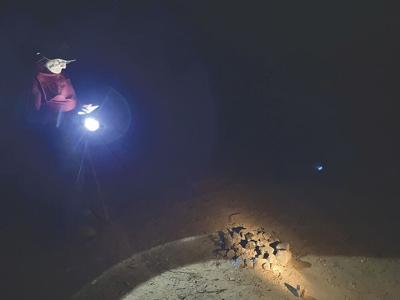

As the sun dips behind the Pacific Ocean, Lindsay Romanow’s souped-up silver Toyota Tundra kicks up a cloud of dirt as it exits Highway 1 near the Gorda General Store and climbs the steep and winding ridge road that leads to his home on Big Sur’s south coast.
Romanow is not headed home – his Saturday night is only just beginning. With Connie McCoy riding shotgun, the two locals in their mid-70s are on patrol, armed with an iPad, flashlights, a gardening hoe and walking sticks.
Romanow pulls up unannounced on a group of about eight young people and a large black dog who have settled in on a cliff’s edge, watching the horizon slowly disappear into darkness as a bouncing reggae bassline carries them into the night.
“Hi there, how are you guys doing?” Romanow affably asks, as he turns his flashlight on the campsite and scans the area. “Just out checking for campfires.”
The group seems to let out a collective sigh of relief as they assure the stranger with the interrogating flashlight that there are no campfires here. Romanow and McCoy tell the campers they represent a small volunteer patrol group of local residents who take it upon themselves to ensure no one in the dozens of nearby dispersed campsites has wood or coal-burning campfires.
The young people appear happy to learn that a group is taking the issue of illegal fires seriously. Romanow ends the brief exchange of small talk with a reminder: “Oh, and if you’re going to smoke, you have to do it in the car.”
Romanow and McCoy click off their flashlights and hop back in the Tundra, with up to 33 more similar inspections ahead (if the area is full) before they can go to sleep with peace of mind.
Organized citizen campfire patrols through Los Padres National Forest land began in 2020, when crowds, tipped off by travel bloggers and social media buzz, began gravitating in unprecedented numbers toward Big Sur’s prime dispersed camping locations as an antidote to the pandemic lockdowns. For locals, the scars were still healing from the 2016 Soberanes Fire, a massive blaze that began as an illegal campfire in Garrapata State Park that would go on to swallow 57 homes and more than 130,000 acres. Feeling they needed more than the limited patrol offered by the U.S. Forest Service, the Community Association of Big Sur began paying locals $25 per hour to snuff out illegal campfires.
However, those on patrol are not only seeking out fires. Twice on this particular Saturday night, Romanow and McCoy pull up on visitors that have illegally set up camp on the side of the steep ridge road. “You are not allowed to camp here,” Romanow tells one man standing outside a tent that is sheltering a woman, child and dog. The man is surprised and worried. “It’s a $1,000 fine if enforcement rolls through. We’re not enforcement, but we are going to patrol to the top of the ridge for illegal fires. If you guys are still here when we come back down, we’ll have to collect it in our database.” Romanow gives the man directions to the nearest legal campsite.
Later in the night, Romanow and McCoy pull up on the same group, setting up their tent in an allowable area.
Data collection has become the tool for progress on visitor management in Big Sur. The ability to tally observed abuses of the area and present them objectively to local officials has sparked changes. A steadfast effort to quantify the level of illegal car camping along Highway 1 prompted the County Board of Supervisors last month to increase the penalty for such violations from $200 to $1,000. Now the data is being collected by residents as part of the USFS’ Visitor Use Management effort, the first hard look at how to manage the explosion of tourism through the region.
The volunteer patrols do not have enforcement power, and on this Saturday night in August, they do not need it. The campfires they encounter are fueled by propane hook-ups, which are legal. As Romanow and McCoy lean on their walking sticks while navigating a steep, cratered downslope, Romanow says he had to use his tractor earlier in the day to deconstruct a handful of illegal fire rings he found in the area.
McCoy says that while “99 percent” of the people with illegal campfires extinguish their blazes upon learning of a potential $5,000 fine, on rare occasions she runs into people who are “just jerks.”
She recalls on the most recent Memorial Day Weekend, she approached a large group who had blocked the road with a log and were preparing to set off a giant pile of foraged brush.
The USFS has a single law enforcement patrol officer for the all of Big Sur. USFS Spokesperson Andrew Madsen says the patrolman cannot be everywhere at all times, nor does the USFS have any plans to increase the number of law enforcement officers in the area. So, Madsen says, the agency has to depend on the help of local volunteers.
However, Madsen emphasizes that these volunteer residents need to act thoughtfully and safely, which he says has not always been the case.
As the Saturday night patrol closes, Romanow drops McCoy off at her house around 11pm. The two will team up again the following night, and the following weekends until winter arrives and fire restrictions ease.

(0) comments
Welcome to the discussion.
Log In
Keep it Clean. Please avoid obscene, vulgar, lewd, racist or sexually-oriented language.
PLEASE TURN OFF YOUR CAPS LOCK.
Don't Threaten. Threats of harming another person will not be tolerated.
Be Truthful. Don't knowingly lie about anyone or anything.
Be Nice. No racism, sexism or any sort of -ism that is degrading to another person.
Be Proactive. Use the 'Report' link on each comment to let us know of abusive posts.
Share with Us. We'd love to hear eyewitness accounts, the history behind an article.