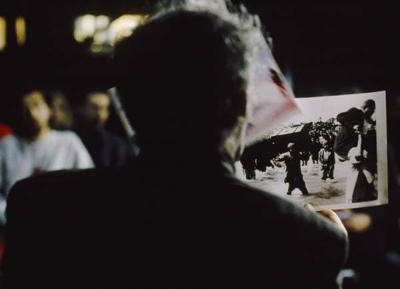
More poetic essay than movie, Jean-Luc Godard’s Notre Musique is an unsettling and slightly disjointed meditation on killing and destruction in the “age of fables.” It’s an examination of the vanquished and victor, fiction and documentary, suicide and hope. It’s a stroll through the lonely and didactic landscape of Godard’s purgatory. It’s a movie without answers that only seems to be sure of one thing—when all is said and done, “history” is decided by the nation with the best poets and artists and no one is held accountable.
NOTRE MUSIQUE ( * * * )
Directed by Jean-Luc Godard.
Starring Sarah Adler, Nade Dieu, Jean-Luc Godard and Mahmoud Darwish.
(Not Rated, 80 mins.) At the Osio Cinemas.
Divided into three Dantean kingdoms: “Hell,” “Purgatory,” and “Heaven,” Notre Musique begins in the inferno—a masterful 10 minute montage which hovers in the air somewhere between grotesque atrocity and transcendent ballet like an avenging angel. Godard has woven together images from documentaries and Hollywood movies in a silent, churning river of blood and bodies and weapons and smoke and clashes. It’s breathtaking and gut-wrenching introduction that leaves the audience slightly ashen and exhausted as Godard ushers us into the film’s second kingdom.
Purgatory is a dreamy (nightmarish) tour guided by the poets and writers of defeated nations, by a trio of ghostly Native Americans (the ultimate victims) and by Godard playing himself. As a stand-in for purgatory, Sarajevo is Godard’s overarching metaphor. This city, which witnessed both the start of the Great War and years of unspeakable genocide at century’s close, is repairing itself—slowly but surely. Despite the film’s dark opening and haunting close, Godard imbues Notre Musique with a resilient hope by including images of Sarajevo healing: the rebuilding of the Mostar bridge and a pile of unburned books in the burnt out shell of the Sarajevo Public Library.
Some semblance of a plot revolves around two Israeli women. The first is a young journalist named Judith (Sarah Adler) who seems to symbolize light and hope. Attending a literary conference, we encounter a Palestinian poet (Mahmoud Darwish, playing himself), a Spanish novelist (Juan Goytisolo), an aging enfant terrible film director (Godard), a Jewish-Egyptian translator (Romy Kramer) and a French diplomat (Jean-Christophe Bouvet.)
A secondary “plot” follows Olga Brodsky (Nade Dieu) who attends Godard’s lecture, “Text and Image” and wanders through Sarajevo and the surrounding countryside capturing images with a digital camera. Olga is meant to be the antithesis to Judith (and the two women look confusingly similar). Where Judith gathers light and understanding, Olga seems to struggle with some dark compulsion—an internal conflict that eventually results in the movie’s sole, powerful plot twist.
Godard’s heaven, which concludes the film, is a primeval forest guarded by chain link, US Marines and children. It’s a paradoxical image that seems to reinforce something the French writer Pierre Bergounioux says earlier in the movie. When asked whether writers know what they’re talking about he answers without hesitation, “Of course not.” He goes on to explain that people who act don’t have the ability to express themselves about what they do; and likewise people who tell stories don’t know what they’re talking about.


(0) comments
Welcome to the discussion.
Log In
Keep it Clean. Please avoid obscene, vulgar, lewd, racist or sexually-oriented language.
PLEASE TURN OFF YOUR CAPS LOCK.
Don't Threaten. Threats of harming another person will not be tolerated.
Be Truthful. Don't knowingly lie about anyone or anything.
Be Nice. No racism, sexism or any sort of -ism that is degrading to another person.
Be Proactive. Use the 'Report' link on each comment to let us know of abusive posts.
Share with Us. We'd love to hear eyewitness accounts, the history behind an article.