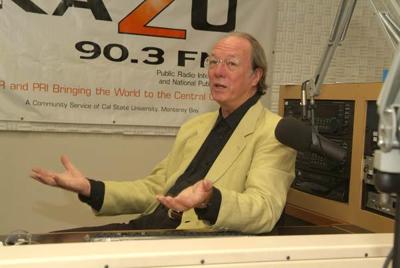
<></>When John McNally left Los Angeles to take a job as general manager of Pacific Grove NPR affiliate KAZU, he knew he was in for a much different life.
But in the move to 90.3 FM, McNally did more than exchange warm summer nights for coastal fog. He traded in calm for calamity, unwittingly planting himself in a hotbed of controversy.
Shortly after his arrival seven years ago, the public outcry over changes—implemented under McNally’s direction—began.
Some changes were McNally’s idea; others belonged to the board of directors. McNally took the fall for all of it. Today, however, McNally’s changes have paid off.
McNally’s last day at KAZU is Aug. 31. On Aug. 27, the station will host a fundraiser/farewell party featuring long-time NPR host Bob Edwards (see story, pg. 13).
Now, on the eve of his retirement from the formerly embattled station, McNally runs a different kind of KAZU—a viable one, a listened-to one.
It was no easy feat.
McNally arrived at KAZU in 1998. The station had been in turmoil for years. In 1996, KAZU lost the bulk of its cash when the Corporation for Public Broadcasting pulled the plug on funding the tiny station. The $70,000-a-year hit was bad enough.
But then, in 1997, a fire destroyed the building and equipment.
The station moved to its current location in Pacific Grove, forked out double the rent to keep a roof over its head, and hired McNally. He came in quietly, announcing simply: “There won’t be any drastic music changes. We’re just going to make it a little more interesting.”
It was unofficially the understatement of the year. Six weeks into his tenure, McNally axed the entire paid staff. The station had no money, and the KAZU board of directors decided that the staff should go. But critics didn’t care. They blamed McNally.
Shortly after, McNally announced his plan to revamp KAZU, and take the station from an eclectic sound of music and talk to strictly news and public affairs.
“I had to make suggestions that wouldn’t go down well because it would be disenfranchising people who had the airwaves to themselves for a long, long time,” McNally says.
Protesters picketed the station and, more specifically, McNally.
“I became one of the most hated people around,” McNally remembers. “It was, ‘Who in the hell do you think you are? We don’t need no stinkin’ badges around here.’”
The resistance didn’t last forever. In order to keep afloat, KAZU sold its FCC license to the CSU-Monterey Bay Foundation. The Corporation for Public Broadcasting eventually provided funding again, and KAZU—under McNally’s new mix of National Public Radio broadcasting and local news, information and programming—became the KAZU of today.
At the start of McNally’s tenure, KAZU had about 18,000 listeners. Today, the station boasts nearly 40,000.
“This area has a super-educated audience,” McNally says. “It’s extremely educated. Therefore, this kind of format resonates very well. Of course I have to pat myself on the back just a little.”
He’s not the only one.
Terry Green is the general manager of KUSP, a Santa-Cruz based public radio station that competes with KAZU for listenership in Santa Cruz and Monterey counties.
“John took over at a really star-crossed time,” Green says. “He has been the single essential constant there and made change work. That’s no simple task.”
KAZU’s Board President Diane Cordero de Noriega, who is also CSUMB’s interim president, agrees with Green. “John is the heart and soul of local public radio. He took this faltering little station and made it successful.”
To McNally, that success is defined by the way in which listeners approach KAZU today.
“When listeners turned to the old KAZU, they were escaping something,” he says. “People are not escaping to this radio station anymore. We’re presenting the realities of the world as they happen. They come here to be connected. I’d like to think I played a part in that transition.”
KAZU now ranks in the top 5 percent of “growth stations” nationwide—meaning that it is growing faster than 95 percent of NPR stations nationwide. It is also in the top 10 percent when it comes to listener loyalty. “It means our audience says, ‘I’ll listen to it come hell or high water, and I don’t care what anyone else says or does,’” McNally says.
The numbers, however, don’t tell the entire story.
“There will be some big shoes to fill,” Cordero de Noriega says. “His personality and style can’t be replaced. But eventually, we’ll get through this because John has laid the groundwork that has made that possible. He’s leaving a place that’s better because he was there.”
McNally and his bride, KAZU’s director of local programming, Brita Heizmann, plan to spend a month traveling the US before heading to Germany to start an English and German radio service.
“We’re a public radio couple,” McNally jokes. “I feel like I’ve made the difference I came to make. It’s time to turn the station over. Maybe it’s just that I’m a start-up kind of guy. Now it’s up to listeners to keep their individual preferences strong by supporting their local radio station. My job here is done.”


(0) comments
Welcome to the discussion.
Log In
Keep it Clean. Please avoid obscene, vulgar, lewd, racist or sexually-oriented language.
PLEASE TURN OFF YOUR CAPS LOCK.
Don't Threaten. Threats of harming another person will not be tolerated.
Be Truthful. Don't knowingly lie about anyone or anything.
Be Nice. No racism, sexism or any sort of -ism that is degrading to another person.
Be Proactive. Use the 'Report' link on each comment to let us know of abusive posts.
Share with Us. We'd love to hear eyewitness accounts, the history behind an article.