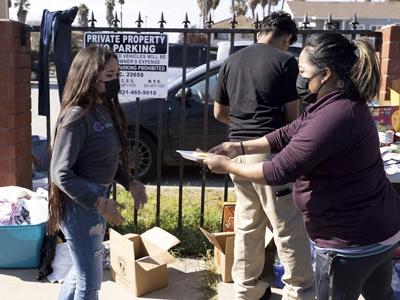

On the morning of Friday, March 17 – nearly a week after the people of Pajaro were forced to flee their homes as floodwaters swept through their community in the dead of night – Ruby Gouker and two other volunteers from the Volunteer Center of Santa Cruz County canvassed the several dozen displaced residents milling around on the Watsonville side of the Pajaro River Bridge.
In Spanish, Gouker and the volunteers took requests: for underwear, shoes, hygiene products and other necessities left behind in the flood. Residents spoke of their kids having to go to school in the same clothes for multiple days, telling her they had “no clue” when they would be able to return home. “Our concern is the children – where are they sleeping?” Gouker said.
About 90 minutes later, she and her fellow volunteers returned to the bridge in a white pickup truck loaded with goods from the nearby Westview Presbyterian Church, provided by donors like Watsonville-based agriculture giant Driscoll’s, Gouker said. They passed out clothes, shoes, toiletries and bottled water to Pajaro residents who lined up, many with children in tow.
In the wake of the flood, much of the relief work aiding the residents of Pajaro has been left to local nonprofits, many of them predominantly staffed by volunteers like Gouker. With state and federal governments proving slow to get aid out the door, and the county governments of Monterey and Santa Cruz limited beyond their ability to provide immediate shelter, the onus has fallen on nonprofits to provide everything from food and clothing to health care and direct financial assistance.
Many of these nonprofits have been active in the area for decades and “have a connection to the community” that enables them to work more effectively, says Daniel Gonzalez, an emergency services planner with the Monterey County Department of Emergency Management.
Gonzalez was on the Pajaro River Bridge on Friday, March 17, working to set up a mobile relief van operated by the Pajaro-based nonprofit Casa de la Cultura Center. Sister Rosa Dolores Rodriguez, who founded Casa de la Cultura in 1989, says her organization has previously provided such mobile services for farm workers in the Pajaro Valley’s bountiful strawberry fields. In addition to the van, she adds that they are working to help Pajaro families find accommodations at local hotels.
“I’m just doing a supportive role for our community because people are really stressed out,” Rodriguez says. “They’re out of their homes, there are so many needs. They’re trying to be patient.”
Casa de la Cultura is among the local groups to receive grant funding from the nonprofit Community Foundation for Monterey County, which has raised around $1.1 million for its Storm Relief Fund launched in the wake of January’s floods, according to president and CEO Dan Baldwin. The Community Foundation has since disbursed roughly $500,000 through the fund, with another $100,000 in recently approved grants on the way.
“Philanthropy is very nimble,” according to Baldwin, who says the Community Foundation’s focus has turned toward “getting direct financial support to people impacted” by the Pajaro flood by backing nonprofits able to provide that help.
Among such groups is Community Bridges, the Watsonville-based nonprofit predominantly serving Santa Cruz County but also active in North Monterey County. Community Bridges CEO Raymon Cancino notes that Pajaro’s location on the border of Monterey and Santa Cruz counties places Pajaro residents in an awkward position as far as public services are concerned – making them even more reliant on organizations like his.
In many respects, “the infrastructure of Monterey County ends in Castroville,” Cancino says. “The reality is these folks use services in Watsonville and are more dependent on Santa Cruz County, and that’s what makes it tricky.”
Community Bridges has already disbursed more than $75,000 in direct cash aid to displaced residents seeking refuge at the Santa Cruz County Fairgrounds in Watsonville, in the form of $500 grants per household. Cancino expects that figure to eventually reach around $110,000 once the nonprofit completes its program at the fairgrounds and other local shelters, but notes that the work only starts there; Community Bridges’ triage-based approach will follow up with residents in the coming months and years to ensure they’re accessing all the help available to them, including federal aid from FEMA and other agencies that may eventually arise (see story).
In addition to financial relief, the organization is also facilitating transportation to help the displaced access shelters and providing services like a mobile laundry trailer at the Santa Cruz County Fairgrounds. Cancino says this work is particularly urgent given the limited support being provided by the government on the ground in Pajaro.
“The federal and local resources aren’t here. These are our communities, and we need to be providing the resources they need as much as we can,” he says. “Right now, we have a makeshift group of scrappy nonprofits that are holding it down. That’s what we’ll continue to do.”


(0) comments
Welcome to the discussion.
Log In
Keep it Clean. Please avoid obscene, vulgar, lewd, racist or sexually-oriented language.
PLEASE TURN OFF YOUR CAPS LOCK.
Don't Threaten. Threats of harming another person will not be tolerated.
Be Truthful. Don't knowingly lie about anyone or anything.
Be Nice. No racism, sexism or any sort of -ism that is degrading to another person.
Be Proactive. Use the 'Report' link on each comment to let us know of abusive posts.
Share with Us. We'd love to hear eyewitness accounts, the history behind an article.