Jane Smiley says she has no real expertise when it comes to horses, but anyone who watched the Kentucky Derby in 2001 and reads the New Yorker is not going to believe her.
That was the year Point Given was supposed to win. Point Given this, Point Given that. But when the first Saturday in May rolled around, the first nose across the wire was not Point Given’s, but that of Monarchos. This medium-shot gray colt came out of nowhere, judging from the pre-Derby buzz.
The next day I picked up the previous week’s New Yorker , and there was a “Talk of the Town” by Jane Smiley about Monarchos. Clearly, she knew something the sport’s pundits didn’t.
“Well, I wish I could say I’m a handicapping genius, but alas, I cannot,” Smiley said when I caught up with her by phone in her Carmel Valley home one afternoon last week as she was gearing up for a dinner party, still reeling from the price of free-range chicken in Carmel Valley Village ($6 a pound).
Smiley says it was simple good fortune. Monarchos’ breeder, Jim Squires, is a friend of hers, and Squires said he believed Monarchos was great from the moment he was born. And as it happens, Smiley’s own horse, Hornblower, also a gray, was born the same year.
“I remember going to visit Jim in Kentucky and pointing out one and saying, ‘That’s a nice foal. He looks like my foal,’” Smiley says. “And it was Monarchos. So when he got to the Derby I wanted to write about him. It was just lucky.”
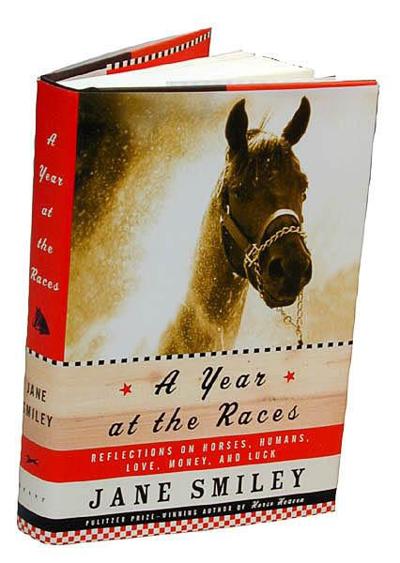
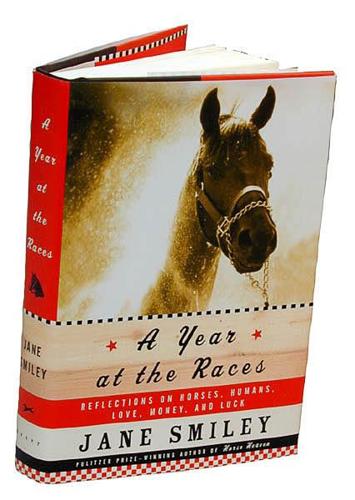
Smiley’s new book, A Year at the Races: Reflections on Horses, Humans, Love, Money and Luck , arrived at my house unexpectedly on a gray Thursday three weeks ago. When I reached inside the mailer and pulled out the kitschy little red-white-and-black volume, with its achingly beautiful sepia cover portrait of a horse drenched in water droplets and sunlight, it was joy, wonder, a big fluffy birthday cake, a surprise ticket out of town. I headed straight for the couch and read late into the night, unaware of anything else. Surrender was headlong and complete.
Anyone who has read Smiley knows the pleasure of letting her lively and confident prose pull you along, in and out of characters’ thoughts as the plot unfolds in perfect rhythm. I have not read everything she’s written, but I have loved what I’ve read. I have not tackled the weighty history The Greenlanders or girded my loins for the (always described as “Shakespearean”) Nobel Prize winner A Thousand Acres . Her Dickens biography, and last year’s novel, Good Faith , about real estate, did not tempt me.
I know her comedies— Moo , a hilarious comeuppance of campus politics set at a Midwestern university and starring a 700-pound pig named Earl Butz, and Horse Heaven , a funny and poignant soap opera about Thoroughbred horse racing as seen through the eyes of six very opinionated horses and dozens of quirky people. These are delectable. The pace is hyperactive, the characters engaging, and Smiley’s keen eye for human foibles, while it could be eviscerating, is instead blunted by generosity and kindness, making for wise and oddly uplifting reading.
A Year at the Races is in that tradition. Smiley fans will recognize characters from Horse Heaven , notably the saintly gelding Mr. T. And they’ll recognize the spirit of the project: A complicated story line, large helpings of humor, lots of characters—many of them horses—all idiosyncratic, all good. (Even Fanny, a mare that resolutely dislikes Smiley and snubs her mount, turns out to have the capacity to adore her new teenage owner.)
That’s right: “dislikes,” “snubs” and “adores”—all of these are attributed to a horse. A Year at the Races is a meditation on equine personality and psychology. Ostensibly a memoir of Smiley’s first foray into the world of horse racing, it is more fundamentally a delighted examination—one she admits is based largely on conjecture and quite possibly naivete—of the fascinating inner workings of her own beloved horses. And it is richly interspersed with theories about love, motherhood, ambition, ESP and neurosis.
It is a gutsy book. Horse people are not known for their sentimentality, and Smiley knows she risks looking batty.
Jane Smiley says she doesn’t know yet how her neighbors, the Carmel Valley/Pebble Beach equestrian crowd, have received her book, which just went on sale last week. “The few who have read it like it,” she says. “The worst that can happen is they think, ‘She’s just as crazy as we thought she was.’”
The horsey set might raise their eyebrows when Smiley asserts that her mare Persey’s balkiness is not recalcitrance or stupidity, but fear buttressed by the conviction that her terror is justified. Smiley goes a step further, postulating that Persey’s malaise stems from having had a nervous and inattentive mother.
“The ways in which Lucy had not been a good mom to Persey were legion,” Smiley writes, recalling the older mare’s anxiety and inability to stand still long enough to let Persey nurse.
Horse people local and elsewhere might think it nutty when Smiley consults a horse astrology Web site to see why her gorgeous stallion Hornblower (a Pisces) is so indifferent to winning races. The answer—that Pisces horses are “dreamers” who take “a larger, more evolved perspective on things”—does not sit well with Smiley, so eventually she consults a horse communicator named Hali.
Hali reads horses’ minds and relays questions and answers between horses and their owners. As the story continues, Hornblower conveys to Hali that he feels his name ill suits him. Its vibrational quality is too low.
“A racehorse, he said, needed a name full of high vibrations to be a winner,” Smiley recounts. “It was a herd-status thing. All the other horses around the backside [the part of the track where the horses live and train] knew your name and judged you by it.”
Eventually Smiley and Hali present Hornblower with a name he deems acceptable: Wowie, his colthood nickname. And soon Wowie rewards Smiley and her trusted trainer Alexis by running fourth, then third, then second and finally winning. Wowie has at last gotten in touch with his ambition.
What Smiley has to say about ambition illustrates why a person would not have to be a horse-crazy girl to like A Year at the Races . True, it’s all about horses—it’s stuffed with anecdotes about herd politics and training conundrums—but it’s highly applicable to the human experience. Anyone who has ever tried, failed, persevered, loved or been difficult could embrace this book.
“Ambition is not agreeability or willingness. It is a seeking out rather than a receptivity,” Smiley writes. “When, in morning training at the racetrack, two fillies go out to breeze, one shows her ambition not only by going fast but also by going straight, not only by galloping strongly…but also by not being distracted by the other sights and sounds on the track. Her companion might try to duck out through the opening and head back to the barn, but the ambitious filly doesn’t even notice the opening.”
Smiley acknowledges in the book’s last chapters that there came a point when she realized, this being life and all, that the story might not have a happy ending. Indeed, Wowie did not go on to take the Breeder’s Cup by storm, nor did Waterwheel, her sexy, lightning-fast black filly. But true to form, Smiley refuses to consign their tales to the junkyard of defeats, in letters or in life. This is the magic of Jane Smiley’s world—everything is interesting, even news you thought was bad. And so Wowie has found a new avocation, and even though his status in the pasture is “way low” owing to the presence of a more spirited gelding (and probably not Piscean) Jackie, he is reportedly feeling “great.”
“When I take him down for his jumping lesson he couldn’t be more relaxed,” Smiley said. “I told Dick [the trainer] the other day, ‘He likes this better than being in the pasture, better than eating, better than going on trails.’ So I think it’s great, and he is redeemed.
“And Waterwheel is redeemed, too. She’s in foal to the hottest sire in California. His book was closed and Alexis just nagged and wheedled and did all those girlie things and finally she got it and so Waterwheel was bred in early March.
“So they both had happy endings.”
I had to ask what Smiley thought of the Derby field, if she had any favorites, thinking she was going to say Smarty Jones or Action This Day or another one of the big names bandied about in the pages of The Blood-Horse . But no. She was rooting for—surprise, surprise—a gray colt named Tapit, who she’d just seen come from dead last to win a Derby prep race.
“Well, I saw the Wood Memorial Saturday and the winner came from way off the pace, and he looked awkward coming out of the gate but then he ran as easy as you please. He went out around four horses coming around the backstretch and he just poured it on,” Smiley said.
“I guess because he’s gray and the trainer is unorthodox, and he came from off the pace…So why not him?”
A Year at the Races: Reflections on Horses, Humans, Love, Money and Luck , by Jane Smiley, Knopf, $22.


(0) comments
Welcome to the discussion.
Log In
Keep it Clean. Please avoid obscene, vulgar, lewd, racist or sexually-oriented language.
PLEASE TURN OFF YOUR CAPS LOCK.
Don't Threaten. Threats of harming another person will not be tolerated.
Be Truthful. Don't knowingly lie about anyone or anything.
Be Nice. No racism, sexism or any sort of -ism that is degrading to another person.
Be Proactive. Use the 'Report' link on each comment to let us know of abusive posts.
Share with Us. We'd love to hear eyewitness accounts, the history behind an article.