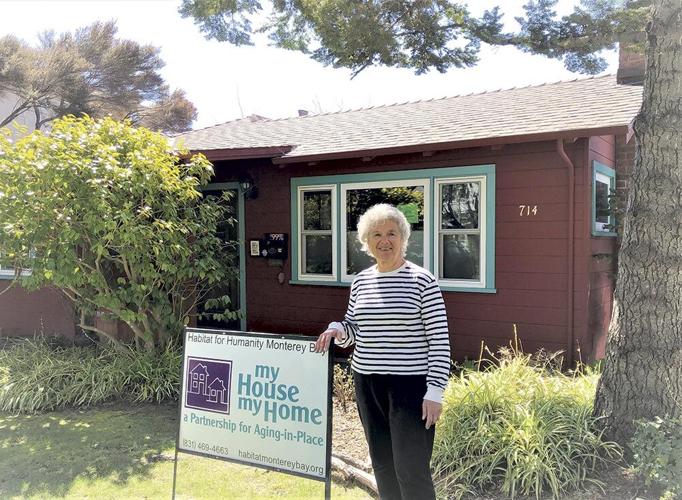


House-rich, but cash-poor. That’s the challenge the staff of Habitat for Humanity Monterey Bay saw local seniors on fixed incomes were up against. Retirement incomes couldn’t keep up with the cost of living, forcing some out of their homes, sometimes into homelessness. What if there was a way to turn their valuable real estate into an income-producing asset? Accessory dwelling units (ADUs) provided an answer.
The nonprofit’s Big Idea for MCGives! this year is to raise money to expand its My House My Home program that builds ADUs in the backyards of low-income senior homeowners. “We were a big proponent of ADUs even before they became a buzzword,” says Satish Rishi, CEO of HHMB. My House My Home originated in Santa Cruz County where the group has constructed five ADUS. Its first in Monterey County is now underway in Marina.
The idea is that with the addition of an ADU the senior homeowner (age 62 and above, with an income less than 80 percent of the area median income, which is $63,700 for one person in Monterey County) will rent out the unit and use the supplemental income to be able to afford to continue living in their own home. Or, they can move into the ADU and rent out the main home.
Unlike other Habitat builds, where the client provides sweat equity in constructing the home they will own, seniors aren’t required to help build, but they do contribute 20 percent of the costs and are asked to rent to low-income tenants. HHMB contributes another 30 percent through a CalHome state grant; the rest is paid for through fundraising.
“We build the ADUs with the help of volunteers and also by getting donations from local businesses,” Rishi says. The ADUs are mainly one-bedroom, 500-square-foot units. They utilize universal design, which incorporates elements to make the units accessible to those with mobility issues.
In fiscal year 2021-2022, HHMB’s 530 volunteers logged over 18,000 hours. HHMB Resource Development Director Lyndsey Marks says it takes a tremendous amount of community support to build the homes – approximately 60 over the last 30 years – with sweat equity and volunteers, as well as donations. “The expression ‘it takes a village’ really applies,” Marks says.


(0) comments
Welcome to the discussion.
Log In
Keep it Clean. Please avoid obscene, vulgar, lewd, racist or sexually-oriented language.
PLEASE TURN OFF YOUR CAPS LOCK.
Don't Threaten. Threats of harming another person will not be tolerated.
Be Truthful. Don't knowingly lie about anyone or anything.
Be Nice. No racism, sexism or any sort of -ism that is degrading to another person.
Be Proactive. Use the 'Report' link on each comment to let us know of abusive posts.
Share with Us. We'd love to hear eyewitness accounts, the history behind an article.