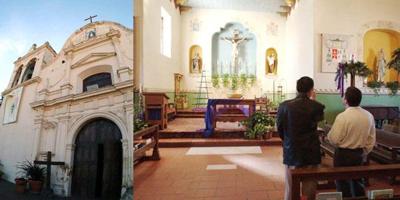
The evidence cuts through the stone in a most obvious way near the back of the church. On the left-hand wall, just above a row of pews, a crack runs down from a deep-set window and winds its way through the masonry of Monterey’s San Carlos Cathedral. And like a mechanical bandage, a two-sided, ruler-like device known as a crack monitor has been placed over the fissure to determine whether the split grows in time as the building ages and the ground beneath it shifts.
An institution since 1770, San Carlos Cathedral is said to be the oldest stone building in California, and it needs work. Also known as the Royal Presidio Chapel, because it served as the chapel to Spanish colonial forces when Monterey was an army outpost, it’s been in continuous use as a church longer than any other in the state.
Kevin Drabinski of the Diocese of Monterey, a chain of parishes that stretches from San Luis Obispo up to Santa Cruz and contains several aging mission churches that are also still in use, says that while a crack in the thick wall in Monterey may look precarious, the church is not about to crumble.
“The building is not in any danger right now,” he says. “It has good structural integrity.”
This winter, however, the diocese plans to begin a major fund-raising campaign for what’s expected to be a very expensive and labor-intensive repair job. An estimate of the work needed on the church in 1999 put the total cost at over $1 million, a number that’s sure to have increased, Drabinski says. The Monterey Parish has 1,500 families, but the campaign will have to be geared to approach major sources of funding such as charitable foundations.
“We’re just setting that up right now,” Drabinski says.
Over the last few years, the church has had several minor upgrades, including a new heating system and new windows. But the major improvements will take significant time and money. For one thing, the tile roof has not been replaced since 1935—most roofs require replacement every 30 years or so.
Five years ago, Edna Kimbro led the study on the restoration requirements of the San Carlos Cathedral. Even though it’s lasted as long as it has, through several earthquakes and more than two centuries of wear and tear, it needs major help.
“It’s like saying a guy has survived three heart attacks and he’s fine,” she says. “We want to get this one before it’s too late.”
In addition to a new roof, the building needs a seismic retrofit, since the Peninsula is in the zone designated for highest earthquake danger. Kimbro, who works for the State Parks department, says the retrofit likely will not be visible to the public, rather it will involve repairing the roof, then fastening it down to the building.
The building is made of un-reinforced masonry in an ancient technique known as “rubble stone,” in which an interior and an exterior wall are constructed, then filled in with loose rock and concrete. The builders used local sandstone as well as Monterey shale, which is composed of diatoms, or dead sea plankton. Over time, the shale deteriorates and becomes susceptible to water damage, compounding the restoration task. Another major undertaking, Kimbro says, will be the repainting and strengthening of each stone in the rock walls.
“It’s going to cost a lot,” she says. “It’s all handwork.”
The new roof, a seismic retrofit, the stone re-finishing work, as well as a new drainage system to prevent dampness from creeping into the stone, could take the better part of a year, but Kimbro says the church should be able to stay in operation.
Government-Funded Church Repairs
Part of the omnibus appropriations bill passed by Congress last week was an allocation of $10 million for the California Missions Preservation Act. An effort led by Rep. Sam Farr (D-Carmel) and Sen. Barbara Boxer (D-California), the funding provides federal money—to be matched by state and private grants—for the repair of 21 historic missions in California.
The bill met with some resistance from organizations opposed to putting public money toward a religious organization. Although three of the missions are owned by the state of California, the rest are the property of the Roman Catholic Church.
Although the San Carlos Cathedral is technically not a mission, Kimbro and others would like to see it considered as one to make it eligible for funding.
“It’s extremely historic, as historic as any mission, and older than a bunch of them,” she says.
Kimbro might have some more allies. The California Missions Foundation, which organizes preservation and provides grants to the historic missions around the state, might soon change its bylaws to accommodate San Carlos.
Tanya Rathbun of the foundation says the board of trustees will be meeting next month to consider reworking its institutional scope to bring in San Carlos.
“We’re not unsympathetic by any means,” she says.
Not everyone supports the notion however.
The advocacy group known as Americans United for the Separation of Church and State will be taking this matter to court, potentially jeopardizing the repair funds. Rob Boston, a spokesman for the 75,000-member organization, says the California Missions Preservation Act amounts to pork barrel politics.
“We fought that all the way,” he says. “We opposed it in Congress. Of course we were unsuccessful. Now we’re looking at litigation. The question of government funding a religion is a very important one.”
Boston says the suit will be filed this week in US District Court in Washington, DC. Public funding for religious causes started, he says, under the Bush Administration, but has found bipartisan support in Congress.
“In this country, the government doesn’t take on the burden of keeping up a place of worship,” he says. “We need to put a stop to it.”

(0) comments
Welcome to the discussion.
Log In
Keep it Clean. Please avoid obscene, vulgar, lewd, racist or sexually-oriented language.
PLEASE TURN OFF YOUR CAPS LOCK.
Don't Threaten. Threats of harming another person will not be tolerated.
Be Truthful. Don't knowingly lie about anyone or anything.
Be Nice. No racism, sexism or any sort of -ism that is degrading to another person.
Be Proactive. Use the 'Report' link on each comment to let us know of abusive posts.
Share with Us. We'd love to hear eyewitness accounts, the history behind an article.