
Back in 2016, when the nonprofit Trust for Public Land acquired 182 acres of the eastern Rancho Cañada golf course for over $10 million, mostly facilitated by state grants, the vision was to turn a country club back into country. And in addition to that, create a wildlife corridor that would connect the Los Padres National Forest with Jacks Peak and, further north, the Fort Ord National Monument. The acquisition was primarily intended to facilitate a rewilding project, and TPL conveyed the property to the Monterey Peninsula Regional Park District to expand Palo Corona Regional Park.
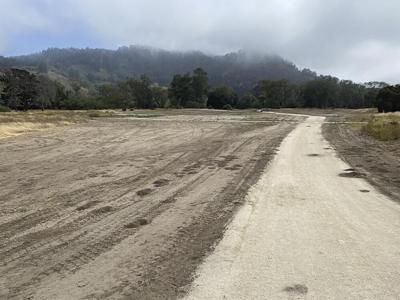
But after the nonprofit Big Sur Marathon Foundation built a cross-country course on the eastern part of the property this spring – a project that involved a lot of grading and disturbance of the soil – TPL feels that the spirit of that deal has not been honored.
In a statement provided to the Weekly about the course, Guillermo Rodriguez, state director for TPL, writes: “The damage is extensive. An Eagle Scout project and most of the wildlife corridor plantings have been destroyed – five years of community effort, gone.” He goes on to say that “cross-country running is a desirable and compatible activity if properly and publicly designed,” but that this project was “poorly planned” and violated the commitments made to TPL when it conveyed the land to the park district.
Rafael Payan, general manager of MPRPD, insists that it’s not a track – the only track in the county is at Laguna Seca, he says – but a “trail.”
In reality, it looks more like a dirt road. It’s wide enough to accommodate a monster truck race, and it looks like one has occurred there recently.
Recreation was always a contemplated use for the land, but part of the grant agreement, when TPL conveyed the land, was to create a 1,000-foot-wide wildlife corridor. The course could have been located outside of that area.
Scott Hennessy, who served as a county planning commissioner from 1995-2000 and then as the county’s planning director from 2000-2005, has spent countless hours to help spearhead a volunteer effort to rewild the property, planting trees and then watering them, as well as mowing down invasive grasses that might crowd out those saplings as they mature.
Hennessy also serves on the board of the Santa Lucia Conservancy, another nonprofit involved in the Rancho Cañada acquisition. He estimates that volunteers have planted and tended about 1,500 trees. When he first heard the proposal for the cross-country course, Hennessy, a lifelong runner, was of two minds: “I thought, that is great, but I wasn’t too hot about the idea of a trail in the wildlife corridor.”
Hennessy attended the public meetings about the general plan for the newly expanded park, but eventually stopped volunteering because he felt the district wasn’t honoring its word. “They committed to providing a light touch aspect to Palo Corona,” he says, “and to respect the integrity of the wildlife corridor.”
And as for the Eagle Scout tree-planting project, he says, “They took out probably 100 trees.”
Hennessy says he was “astounded” there was no environmental review for the project.
Payan says the project falls under the umbrella of an already-completed environmental document, a mitigated negative declaration for the Palo Corona Regional Park General Development Plan, which was completed in 2018 and approved by the MPRPD board in March 2021. That document does not contain any detailed plans for a cross-country course.
When the district board approved the course in September 2021, a report from staff stated that it would be “low-impact,” and there was no mention of the California Environmental Quality Act.
Though the park district ostensibly supports access, it takes some hiking to get to the track. There remains a chain link fence separating that part of the park from the parking lot. (Payan says the district is trying to remove the fencing as quickly as possible.)
Monta Potter, chair of the MPRPD board, also refers to it as a “trail,” and thinks it’s “very exciting,” while also conceding that “it looks pretty bad right now.” Both Potter and Payan emphasize that planned habitat restoration on the site will transform it.
The agreement Big Sur Marathon Foundation inked with the park district in March states the nonprofit would “create detailed plans for design and construction of the course,” and that construction would not commence until Payan signed off on the plans. The Weekly requested those plans from the district, but they were not made available before deadline.
Christy Fischer, who now works for TPL but worked for the Santa Lucia Conservancy at the time the acquisition and played a fundamental role in the land transfer, has been a vocal critic of how the wildlife corridor has been treated. Nonetheless, she hopes there can be a course correction.
“What we’re seeing here is a lack of collaborative consultation,” she says, adding that she hopes the district can adopt a more “thoughtful approach” to managing the land.
“We’re not trying to provoke a fight,” she adds. “We’re just trying to get people to the table.”



(0) comments
Welcome to the discussion.
Log In
Keep it Clean. Please avoid obscene, vulgar, lewd, racist or sexually-oriented language.
PLEASE TURN OFF YOUR CAPS LOCK.
Don't Threaten. Threats of harming another person will not be tolerated.
Be Truthful. Don't knowingly lie about anyone or anything.
Be Nice. No racism, sexism or any sort of -ism that is degrading to another person.
Be Proactive. Use the 'Report' link on each comment to let us know of abusive posts.
Share with Us. We'd love to hear eyewitness accounts, the history behind an article.