It is the project that will not die.
The Monterey Bay Shores resort, a proposed development on 32 acres of Sand City coastal dunes, has been born, killed and reincarnated through a tedious series of drafts, permit denials, appeals and court rulings that span more than a decade.
After years on life support, the project is staging a comeback. In May, an appellate court ordered the California Coastal Commission to reconsider issuing the project a coastal development permit, which it denied eight years earlier.
But the vision won’t come to fruition unless the local water board and Coastal Commission approve a final round of permits. At the heart of the matter is the question of whether the resort’s cutting-edge green designs make up for the fact that it’s sited on coastal property that many environmentalists think should be off-limits to development.
“It’s one of these vampire-esque projects that you think has been dealt a death blow, but it rises from the dead and seems to get a new life behind it,” Monterey County Supervisor Dave Potter says. As a long-time member of both the California Coastal Commission and the Monterey Peninsula Water Management District board, Potter has voted against the project just about every time it’s come before him.
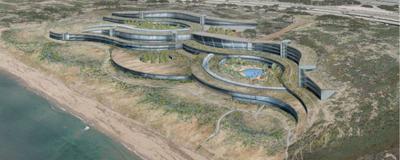
But Ed Ghandour, president of Security National Guaranty Inc., has persisted. His company bought the parcel in 1996 with intent to take advantage of the mixed-use zoning. The latest proposal includes 161 rooms, 180 condos, a restaurant, atrium, spa, yoga pavilion and a dizzying array of environmentally friendly features.
“This is the green future of America,” Ghandour says. “It’s an excellent project. It deserves to move forward expeditiously.”
Sand City officials have supported the project throughout its tumultuous life. City Administrator Steve Matarazzo says the newest proposal is in perfect compliance with the Sand City Local Coastal Plan (LCP), from zoning to habitat protection to water rights. “I think [Ghandour] has done a pretty good job with his redesign,” he says. “It looks quite a bit different from the previous project. It blends with the landscape.”
But as far as the hotel-less city is concerned, money speaks louder than landscape: The project is expected to generate more than $1 million in annual hotel tax along with hundreds of construction and permanent jobs. That’s a big deal, considering the 310-resident city’s tiny operating budget of about $5 million.
For now, the property is a littered stretch of rolling sand where invasive and native species– some on the brink of extinction– elbow for space. A large pit is legacy to a sand mine that operated through the late ’80s. On the famous “Scribble Hill,” enterprising locals etch messages for drivers heading down Fremont Boulevard toward Highway 1.
The resort proposal has seen more ups and downs than the dunes themselves. The City Council approved the project in 1998, but the Sierra Club appealed the decision to the Coastal Commission, which rejected the coastal development permit in December 2000. The resort would have too great an impact on sensitive habitats, block ocean views and otherwise violate the state Coastal Act, the commission concluded. Ghandour appealed.
Meanwhile, the tenacious developer waded through a water blockage. The local water board denied his water distribution permit in early 2001 and the Monterey County Superior Court rejected his appeal the next year. But in 2006 the Seaside basin was adjudicated, and Ghandour finally secured 149 acre-feet of water rights.
This year, the tide turned in Ghandour’s favor. An appellate court in San Francisco ruled that the commission can’t consider the property an “environmentally sensitive habitat area” under the Coastal Act because the LCP– which the commission approved more than 20 years ago– doesn’t designate it as such.
The court reversed the commission’s 2000 permit denial, ordering to it disregard the habitat issue and reconsider the project based on its compliance with the LCP. In October Ghandour’s team responded to the commission’s list of concerns with perhaps some of the shiniest, greenest hotel designs ever proposed for the California coast.
The features are eco-utopian: architecture that undulates with the dunes, passive solar designs for temperature and light control, a living roof to insulate the building while reducing stormwater runoff. A third of the resort’s energy comes from wind, photovoltaic panels and solar water heaters. Stormwater and graywater recycling provides much of the building’s non-potable water. The designs reduce the resort’s projected fossil fuel and potable water use by more than half.
Almost 7 acres are dedicated to threatened and endangered species, along with a larger-scale effort to stabilize dunes, remove invasive species, bring back natives and restore the coastal dune wetlands. The design provides underground parking for guests and a surface lot for public beach-goers. The resort would be obscured from Highway 1, have a seismically stable foundation, and perch high enough to avoid the rising sea level for at least 50 years.
The design addresses all of the Coastal Commission’s previous concerns, says project manager Raphael Garcia of local landscape architecture firm Rana Creek. “We’ve looked at the physical conditions of the site and developed it according to the ecological needs of the existing community,” he says.
But Potter isn’t impressed by the green bells and whistles. Ghandour may have won the right to re-apply for the coastal development permit, he says, but that doesn’t mean it will be approved.
“There’s no such thing as an invisible hotel, and that’s pretty much what he’s implying,” he says. “Waving a green flag and saying this is an environmentally sound project doesn’t have any bearing on the California Coastal Act.”
The coastal property is extremely hard to build on and still faces a series of hurdles, Potter says, including public access, water reliability and habitat protection. Erosion and sea level rise have already prompted two local beach hotels to build controversial seawalls, he notes.
Ghandour, however, says he has no beef with the project’s opponents. “It’s a false assertion to assume there’s any battle with anyone,” he says. “Dave Potter will come to our side if he believes in this green future in America.”
The developer was dealt a small setback last month, when the water board delayed a vote on his proposed water recycling systems in order to gather more information. The board is scheduled to continue the hearing in January. The Coastal Commission will later review the coastal development permit application, but that public hearing has not been scheduled yet.



(0) comments
Welcome to the discussion.
Log In
Keep it Clean. Please avoid obscene, vulgar, lewd, racist or sexually-oriented language.
PLEASE TURN OFF YOUR CAPS LOCK.
Don't Threaten. Threats of harming another person will not be tolerated.
Be Truthful. Don't knowingly lie about anyone or anything.
Be Nice. No racism, sexism or any sort of -ism that is degrading to another person.
Be Proactive. Use the 'Report' link on each comment to let us know of abusive posts.
Share with Us. We'd love to hear eyewitness accounts, the history behind an article.