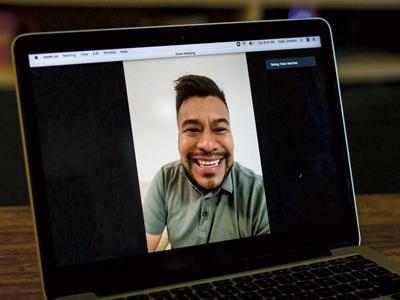

Since DACA – that’s Deferred Action for Childhood Arrival, the program meant to offer protection to children of those who immigrated to the U.S. without documentation – was fully reinstated by a federal judge on Dec. 4, local organizations realized they needed to do fast and meaningful outreach to help prepare those who qualify to apply.
The DACA program started in 2012, when former President Barack Obama signed an executive order for undocumented people who came to the U.S. as children; about 650,000 people, known as “dreamers,” came out of the shadows across the country. The policy granted a two-year permit to prevent deportations and gave access to common rights such as a social security number, a permit to work and access to apply for a state driver’s license.
Pablo Martinez Perez is a DACA recipient and has lived half of his life in Monterey County. “For me and my family, it was something that changed my life profoundly, forever,” he says in Spanish.
Once he got his two-year permit, Martinez Perez applied for jobs outside of the agricultural sector and went to college. Now he owns a recycling business in Bakersfield and commutes regularly back to Monterey.
But in 2017, the Trump administration tried to rescind DACA, declaring it unconstitutional. The program was allowed to continue for those who had applied before, but permits were reduced to one year, new applications were rejected and advance parole – a temporary travel permit for non-U.S. citizens – was discontinued.
According to the Immigration Policy Institute, almost 1 in 4 DACA recipients are in California and more than 350,000 people living in the state are eligible to apply.
When DACA was reinstated thanks to the Dec. 4 court ruling, a number of local groups decided to quickly amp up their outreach to prospective dreamers.
At Hartnell College’s Mi Casa – a center for dreamers – that meant forming a partnership with the United Farm Workers Foundation and the California Department of Social Services to provide free immigration legal services for students and Hartnell staff, in English and Spanish.
Project Coordinator Miriam Vazquez Gonzalez says it’s important to offer DACA workshops because “there’s so much information to be gathered and to be collected prior to them applying.” Vazquez says they also reached out to the parents and guardians of dreamers to make sure applicants have all the documents they need.
Many applicants have issues proving they were on U.S. soil before turning age 16, one of the program’s requirements.
“If you don’t have third-party documentation, you can get a declaration,” says Blanca Zarazua, a Salinas-based immigration lawyer. A relative or a friend can attest to when the applicant arrived.
“The more detail, the more precision you give to the facts you’re trying to prove, the better case you’ll have,” she says. “My cautionary word is that people need to move fast if they think they are eligible now.”
President-elect Joe Biden says he will protect DACA and create a path to citizenship. “We should keep fighting like before,” Martinez Perez says. “We should keep pushing [Biden] to carry out what he promised.”


(0) comments
Welcome to the discussion.
Log In
Keep it Clean. Please avoid obscene, vulgar, lewd, racist or sexually-oriented language.
PLEASE TURN OFF YOUR CAPS LOCK.
Don't Threaten. Threats of harming another person will not be tolerated.
Be Truthful. Don't knowingly lie about anyone or anything.
Be Nice. No racism, sexism or any sort of -ism that is degrading to another person.
Be Proactive. Use the 'Report' link on each comment to let us know of abusive posts.
Share with Us. We'd love to hear eyewitness accounts, the history behind an article.