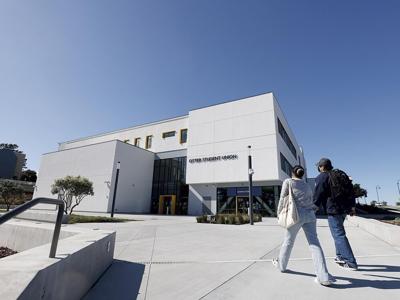

On the heels of adding a gleaming, modern, 70,000-square-foot student union as the new heart of the campus in August, CSU Monterey Bay officials signaled in a draft environmental impact report for the campus’ master plan that they’re ready to grow even more. By the year 2035, they project the possible addition of 3,800 student beds and more than 750 converted residential units for employees as part of 2.6 million square feet of new building space. Near-term, they expect to build a recreation center equal in size to the student union.
The draft report, in the works since 2017, also comes two years into a pandemic that sent students, faculty and staff online and created challenges returning to in-person instruction. Yet the plan bullishly projects a doubling of full-time equivalent students, from approximately 6,250 last year to 12,700. The number of faculty and staff would potentially more than double, from just over 750 to more than 1,775 full-time equivalents. The projection is based on the growing state population and the needs of employers for educated employees, the draft EIR states.
“This is a plan for students to be back on campus,” says Anya Spear, CSUMB’s director of strategic initiatives.
The last master plan (approved in 2007) was designed to accommodate 8,500 students on campus and 3,500 “distance learners,” although at the time that was a bit of an undefined term. “We didn’t really know what that meant,” Spear says. The new master plan still accounts for distance learning with the majority of students on campus.
This master plan also furthers the goal of turning an Army base, the former Fort Ord that was designed for large military vehicles, into a modern university campus that brings people closer together. A continual complaint is that students have trouble getting across the sprawling campus to classes on time.
One goal is to keep travel time between buildings to 10 minutes using a network of pedestrian and bicycle paths. Keeping new development within the main campus area will also help energize the campus core and create a feeling of a hub of activity, Spear says.
The master plan also sets a goal of providing enough on-campus housing for 60 percent of full-time students and 65 percent of full-time faculty. That helps reduce the number of cars on the road, the draft report states, and will help promote recruitment and retention of staff.
Sustainability was a major focus in creating the master plan, Spear says. One of five master plan committees of faculty, staff, students and community members was focused on sustainability, a major effort already underway to reduce the campus’ greenhouse gas emissions and divert 90 percent of waste from the landfill, among other goals.
Since CSUMB sits on state land, no local agencies have jurisdiction over approving the EIR. The draft is now available for review at csumb.edu/facilities/planning, and a public comment period ends March 21. Written comments may be sent to aspear@csumb.edu. If there are no major objections, Spear estimates the draft EIR will go to the California State University Board of Trustees for consideration of approval in May.


(0) comments
Welcome to the discussion.
Log In
Keep it Clean. Please avoid obscene, vulgar, lewd, racist or sexually-oriented language.
PLEASE TURN OFF YOUR CAPS LOCK.
Don't Threaten. Threats of harming another person will not be tolerated.
Be Truthful. Don't knowingly lie about anyone or anything.
Be Nice. No racism, sexism or any sort of -ism that is degrading to another person.
Be Proactive. Use the 'Report' link on each comment to let us know of abusive posts.
Share with Us. We'd love to hear eyewitness accounts, the history behind an article.