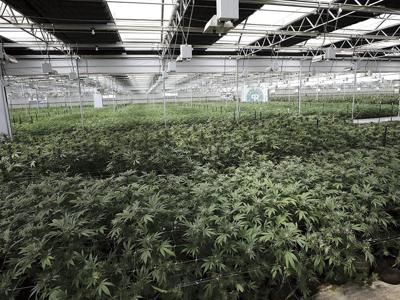

The Board of Supervisors is set to vote on another tax break for Monterey County cannabis cultivators, who are struggling amid challenging market conditions that have forced many to scale back operations – if not shut down entirely.
The board is scheduled to vote on a revised business tax structure for cannabis growers, who have lobbied for a lighter regulatory burden in the wake of an industry downturn. The lower tax rates – which would fall to $1.46 per square foot per fiscal year for mixed light cultivators, who comprise the large majority of growers in Monterey County, from $3 per square foot previously – come after the board previously approved a similar tax break last March.
Despite a boom in production that has seen cannabis become the third-most valuable agricultural product in Monterey County – total production value eclipsed $618 million in 2021, up from $484 million in 2020 – growers have suffered from declining market prices. Industry participants cite overproduction, and a lag in new dispensaries to absorb that crop, as key factors behind the industry’s headwinds.
Joann Iwamoto, program manager for the county’s cannabis program, says 15 cannabis businesses closed shop in 2022, taking the total number of shuttered operators to 35 since 2019. “It is a difficult industry right now,” Iwamoto says.
In turn, many cultivators have found themselves behind on unpaid taxes to the county, and have pleaded with regulators for interventions like a temporary tax freeze.
“How can we pay a tax when we’re not making any profits on what we’re selling?” says Michelle Hackett, CEO of Salinas-based cannabis cultivator Riverview Farms. In addition to declining crop values, Hackett cites the higher cost of soil, fertilizer, fuel and other operating expenses as compounding the issues faced by growers.
“The county knows we’ve been selling at or below our cost of production, yet they want to continue collecting a tax… Now they think they’re doing us a favor while we’re still fighting for our lives,” she says.
The revised tax structure would see the county’s projected tax revenues from cannabis cultivation decline to $5.26 million, from $7.25 million, for the 2022-23 fiscal year. That would still be enough to offset the county’s costs of administering its cannabis program, yet would diminish the amount contributed to other county programs.
That dynamic gives pause to officials like Supervisor Wendy Root Askew, who says that when Monterey County residents voted to legalize cannabis in 2016, they did so with “very real expectations… about the ways that there would be public benefit from the taxation of cannabis.”
Askew says that while she is “comfortable proceeding with the direction to bring the taxes down”, she is also mindful of “my responsibility to uphold the will of the voter” and would be less willing in the future to support lower cannabis taxes “beyond this moment of crisis – unless the public provides other direction.”


(2) comments
As the CEO of a Salinas-based ag supply business, I'd like to add for our readers that by our estimate, the legal cannabis operators have invested >$1 billion in the County. This is in ancillary spending including rebuilding abandoned greenhouses and warehouses, fencing and security systems, employment, buying forklifts and cargo vans, restaurants & hotels, soil and scissors, and more. The $70 million collected by the County in cultivation tax doesn't even consider the sales taxes, property taxes, employment taxes, and all other taxes paid by these businesses as any other.
Furthermore, the State of CA has suspended all cultivation taxes, as has other counties such as Humboldt. Legal operators must abide by labor and safety codes, maintain security, acquire building and electrical permits, not pollute nor divert waterways, and produce pharmaceutical-grade consumer products without use of hazardous pesticides. These legislators have deemed it critical to keep legal cultivators operating while curtailing black market supply which is unencumbered by such taxes and compliance overheads.
Please support the County's decision to give some much needed relief to our emerging green industry who have invested so much to operate here.
The county collected over $70 million from cannabis in the good times and spent it on benefits to our communities, so the promise to the voters is fulfilled for years to come. Now in its hard times they need the help themselves.
Welcome to the discussion.
Log In
Keep it Clean. Please avoid obscene, vulgar, lewd, racist or sexually-oriented language.
PLEASE TURN OFF YOUR CAPS LOCK.
Don't Threaten. Threats of harming another person will not be tolerated.
Be Truthful. Don't knowingly lie about anyone or anything.
Be Nice. No racism, sexism or any sort of -ism that is degrading to another person.
Be Proactive. Use the 'Report' link on each comment to let us know of abusive posts.
Share with Us. We'd love to hear eyewitness accounts, the history behind an article.