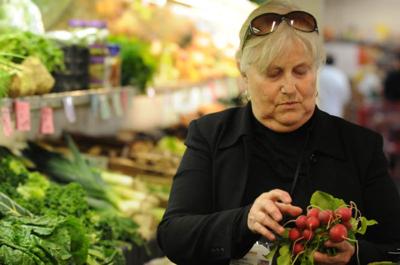
Examining radishes in Del Monte Produce, a small grocery store next to the Highway 1 overpass on Del Monte Boulevard, Kathleen Nolan is delighted by their freshness. “You should only buy radishes with greens still attached,” she says, adding two bunches to her colorful basket of lettuce, Fair Trade bananas and kale.
Nolan eats a salad a day, even on a tightened budget that imitates CalFresh (formerly known as Food Stamps, and federally called Supplemental Nutrition Assistance Program, or SNAP). Nolan, a Salinas-based nutrition education program manager for UC Davis Cooperative Extension, is living on a CalFresh budget for the month and using her experience as an educational tool, posting recipes and nutritional analysis on a Facebook page, SNAP-EE Monterey County.
Unconvinced that staples are limited to greasy fast food or beans and rice, Nolan set out to prove that eating well on a very constrained budget was doable.
Based on USDA nutritional guidelines and her CalFresh budget, Nolan calculates that she can spend up to 33 cents per serving of fruit or vegetables. Within that, she has been eating plenty of fresh produce. “It’s not punitive. I’m not living on bread and water,” she says.
The amount of assistance received via SNAP varies based on expenses, income and employment status. The maximum benefit an individual can receive is $200 per month. Leslie Sunny, Executive Director of Food Bank for Monterey County, says “most families run out of money before the month ends.”
Nolan has given up only Diet Coke and chocolate because, she says, they are too expensive.
But nationally recognized nutrition expert Marion Nestle, Professor of Nutrition, Food Studies, and Public Health at New York University, says there are many “big ifs” of eating nutritiously on SNAP: “It’s possible to manage if and only if you don’t eat out, don’t eat prepared food, keep junk food to a minimum, buy in bulk, cook, and have easy access to decent grocery stores and loads of time to deal with all that.”
Currently more than 15,000 households in Monterey County receive CalFresh benefits, and Nolan reached about 8,000 people through direct outreach last year. She says cultural obstacles pose the greatest nutritional challenge: “If the husband doesn’t like it, it’s not going to happen,” in reference to the women she helps who cook for their households. Nolan cooks only for herself. CalFresh also cannot support large portions of meat, says Nolan, who cooks mostly vegetarian.
But cutting back on meat is healthier, she adds. Nestle notes traditional Asian meals that “use meat as a condiment. A little goes a long way.”
Nolan also encourages increased participation in CalFresh. Statewide, USDA data for 2007, the most recent year for which such data is available, shows only 48 percent of those eligible for CalFresh use the benefits, ranking California 49th in the nation for SNAP participation. California Food Policy Advocates, an Oakland-based advocacy organization, calculates a $4.9 billion annual loss in federal benefits annually due to the low participation rate, with $50 million of that in Monterey County.
Those benefits could be used in more than 600 stores countywide, which correlates to a nearly $90 million increase in economic activity, according to CFPA.


(0) comments
Welcome to the discussion.
Log In
Keep it Clean. Please avoid obscene, vulgar, lewd, racist or sexually-oriented language.
PLEASE TURN OFF YOUR CAPS LOCK.
Don't Threaten. Threats of harming another person will not be tolerated.
Be Truthful. Don't knowingly lie about anyone or anything.
Be Nice. No racism, sexism or any sort of -ism that is degrading to another person.
Be Proactive. Use the 'Report' link on each comment to let us know of abusive posts.
Share with Us. We'd love to hear eyewitness accounts, the history behind an article.