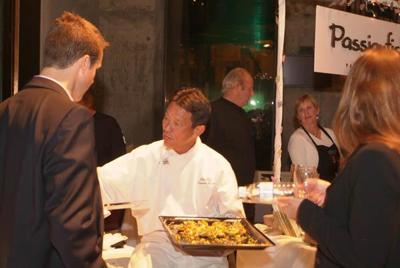
Gussied-up guests wander past sweeping views of the bay and beautifully lit sea-creature exhibits, pausing to sample gourmet food and wine at dozens of stations. The mood is gay, the scenery enchanted, the food divine. Laughter floats up to the rafters like bubbles from a diver’s regulator. It could be a scene from The Great Gatsby if not for the dedicated conservationism underpinning the whole venture.
All the celebrity chefs and winemakers at Cooking for Solutions have been invited because of their demonstrated commitment to treading lightly upon the earth, whether because the seafood they serve is harvested exclusively from healthy populations, or because they use produce grown and delivered with a minimum of chemicals.
Rick Bayless, the much-celebrated chef of Frontera Grill and Topolobampo in Chicago and star of the PBS cooking show Mexico—One Plate at A Time, is a case in point. He’s been showered with industry accolades and will receive the Cooking for Solutions Honored Chef Award this year. But he has the principles of a hippie and talks like a UC agronomy professor. Not only does Bayless buy his produce from small local farmers who grow year-round in greenhouses, he’s set up a foundation to help those selfsame farmers expand their operations, the better to provide local restaurateurs with a steady supply of sustainable produce. Otherwise, he says, stressed-out chefs will continue ordering from huge suppliers who can guarantee six boxes of butterleaf tomorrow.
“What we need is a regional system of mid-sized farms that can supply the restaurants and also bring their own character to the food so you know where you are,” Bayless says.
It’s hard to find chefs who walk the talk like Bayless. Coordinator Jim Dodge, a respected pastry chef and author, helps decide whom to invite after visiting restaurants and monitoring menus. He acknowledges it’s tough. “One chef in Texas was doing about everything right, but he had farmed salmon,” Dodge says. “So I told him we couldn’t give him an award because of that. Maybe in a couple of years.”
This year’s celebrity chefs, many of whom have received James Beard Foundation awards—the Nobel Prize of cooking—arrive with serious sustainability credentials. Melissa Kelly of Primo buys most of her produce from organic farmers near Rockland, Maine, and grows the rest herself. Benito Molina of Manzanilla in Mexico City marries sustainable ingredients with the cuisine of the Yucatan. Louis Osteen of Louis’s on Pawley’s Island, South Carolina, uses local oysters, rice and sweet potatoes to showcase his take on New Southern cuisine. All will dish up fancy food at the gala, alongside a cadre of local stars.
Saturday morning at the Aquarium will see Osteen and others doing cooking demos, while six pairs of local and guest chefs head out to host food-and-wine tours like “Big Sur Experience” and “Seafood Experience.”
Saturday evening the toques come off for the Sustainable Seafood Challenge, a cook-off between Kelly, Robert Clark of C Restaurant in Vancouver, Colby Garretts of Bluestein in Kansas City, and the Sardine Factory’s very own Douglas Sisk featuring a surprise ingredient (last year’s was salmon). Iron Chef fans, take note—all reports are that this is a hoot. Lynne Rossetto Kasper of public radio’s “The Splendid Table” will provide commentary with Bayless.
It’s all geared toward one goal: getting chefs fired up about sustainable cooking so they will in turn influence the public to make sustainable choices.
Apparently the strategy is working. After the first Cooking for Solutions, The Lodge at Pebble Beach adopted the Aquarium’s Seafood Watch guidelines.
“You left feeling like you were part of something,” says Executive Chef Jeff Jake. Now he’s a leading local champion of sustainable fishing techniques who refuses to buy farmed salmon unless it’s from a sustainable operation he’s located in Scotland. And the chefs de cuisine at Pebble know better than to buy swordfish that isn’t Hawaiian line-caught. “They know that’s something I’ll always ask them about,” he says.
Five years ago Jake had fear of the prospect of irate customers demanding Chilean sea bass. That never happened— he says no one really complained—but he now sees the clientele holding the establishment accountable.
“If we have sea bass, it’s usually bluenose,” he says, “and I see customers coming in and asking, ‘Well, what kind of sea bass is this, and where does it come from?’”
COOKING FOR SOLUTIONS GALA happens Friday at 7:30pm. Tickets are $105/general; $85/Aquarium members. Preceded by 6pm reception with Rick Bayless, $225/$180 (includes gala). Cooking demos run Saturday 8:30am-11:30am for $75/$60. Food and Wine Adventures are 9:30am-3:30pm Saturday for $175/$140. Sustainable Seafood Challenge is 5:30pm-7:30pm, $120/$95. Monterey Bay Aquarium, 886 Cannery Row, Monterey, 647-6886.



(0) comments
Welcome to the discussion.
Log In
Keep it Clean. Please avoid obscene, vulgar, lewd, racist or sexually-oriented language.
PLEASE TURN OFF YOUR CAPS LOCK.
Don't Threaten. Threats of harming another person will not be tolerated.
Be Truthful. Don't knowingly lie about anyone or anything.
Be Nice. No racism, sexism or any sort of -ism that is degrading to another person.
Be Proactive. Use the 'Report' link on each comment to let us know of abusive posts.
Share with Us. We'd love to hear eyewitness accounts, the history behind an article.