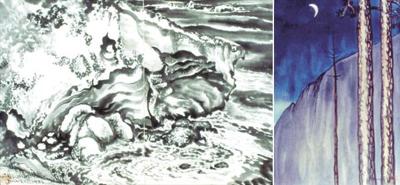
This Saturday, the National Steinbeck Center in Salinas is opening an important exhibition, From the Sierra to the Sea: The California Landscapes of Chiura Obata, that both sheds new light on the local art scene of the first half of the 20th century, and brings to the fore a gifted artist who fused a Japanese sensibility to California subjects. The selection of watercolors, sumi paintings and color woodblock prints (and one three-panel screen) is a must-see, exhibiting masterful technique and an artist’s emotional connection to nature.
Obata (1885-1975) was particularly fond of Point Lobos and Yosemite, and it is a revelation to view these familiar subjects executed with a brush informed by centuries of sumi painting and the compositional boldness of 19th-century Japanese woodblock print masters Hiroshige and Hokusai.
With this stylized rendering, subjects assume new potency, for the artist’s concern was essence, not documentation. There are the recognizable twisted cypresses, the bank of towering pines, the mountains tumbling into the sea to form the Big Sur coastline, and coastal rocks thrusting up from froth. There are Yosemite Falls and Half Dome and the moon in dialogue with the redwoods. But for all the familiarity, one is always aware of an interpretation rooted in a place where landscape is a metaphor for the individual’s communion with nature.
The works are as uncanny as haiku: essential detail suggesting the grandiose; a feather-touch brush evoking nature’s massiveness; the marriage of the fleeting and the permanent.
Obata was born in Japan and raised in the northern city of Sendai. During this time, the Meiji restoration was in full swing, with Western ways replacing the time-honored traditions of a sequestered Japan. A centralized bureaucratic government had replaced the feudal samurai warlords; the barons of industry were transforming an agrarian-based economy; the military, following Western models, was growing more powerful. It was a time of lively transitions, with the West serving as a model and magnet for many Japanese.
Obata showed a natural talent for drawing, beginning training in the ancient art of sumi-e at age seven. This style of ink brush painting requires a deft hand and a vision, for the white ground of silk or rice paper is altered into mountains or sea or fruit or flowers or fish with delicate washes and strokes of an articulating brush. Fluid, and created with the élan of fine penmanship, sumi painting is imbued with timelessness even though the technique is immediate and spontaneous.
After an apprenticeship to a painting master in Tokyo, Obata had by the age of 17 received commissions and recognition. But the attraction of the West was strong. He ventured to California in 1903, where he found work creating illustrations for local Japanese language publications. He continued to study painting and printmaking, as well as sharpen his English language skills. In 1912, Obata married Haruko Kohashi, an expert in ikebana, or flower arranging, and they settled in San Francisco’s Japantown to raise four children.
Mural commissions followed, as well as designs for major department stores, and even the set designs for a production of Madame Butterfly.
During the 1920s, Obata befriended the Kodani family in Carmel. Their home was one of many in a compound of homes perched above Whaler’s Cove at Point Lobos. Obata made many studies and finished paintings on his visits there. Many of his Point Lobos paintings grace the Steinbeck exhibition, and in them one sees the artist assimilating a Western “window” approach to the subjects, even while retaining the brushy fluidity of sumi-e .
Eventually, Obata became a professor of art at the University of California at Berkeley.
When the Second World War broke out, Obata, along with 120,000 other American residents and citizens of Japanese heritage, was interned in a detention camp. After retiring as Professor Emeritus from UC Berkeley in 1954, Obata began a new career leading tours to Japan. By focusing on the arts, gardens and architecture of Japan, the artist hoped a better understanding between Japan and the West would be achieved, and thus, future conflicts would be avoided.
Obata made numerous paintings of Point Lobos and environs. However, only a fraction is included in this exhibition. Indeed, family photographs depict Obata works that have disappeared into private collections and haven’t been seen by the public in years. It is the curator’s and the Steinbeck Center’s desire that the exhibition will bring forth other Obata paintings, that collectors might assist the scholars striving to achieve an accurate view of history.
From the Sierra to the Sea opens June 12 at the National Steinbeck Center in Salinas; reception June 17 from 5:30-7:30pm. 796-3833.


(0) comments
Welcome to the discussion.
Log In
Keep it Clean. Please avoid obscene, vulgar, lewd, racist or sexually-oriented language.
PLEASE TURN OFF YOUR CAPS LOCK.
Don't Threaten. Threats of harming another person will not be tolerated.
Be Truthful. Don't knowingly lie about anyone or anything.
Be Nice. No racism, sexism or any sort of -ism that is degrading to another person.
Be Proactive. Use the 'Report' link on each comment to let us know of abusive posts.
Share with Us. We'd love to hear eyewitness accounts, the history behind an article.