

Covid-19 has created a lot of confusion, including over how to interpret the Monterey County shelter-in-place order issued April 3, which is set to expire May 31. Take the paragraph about restaurants, which begins by saying they’re allowed to provide takeout or delivery only, but then switches gears to talking about schools that provide free meals to students. It ends stating schools or “entities that provide food services… shall not permit the food to be eaten at the site where it is provided, or at any other gathering site.”
Many took that to mean there could be no food consumed outside of restaurants or in public places. Others read it as related specifically to schools, not restaurants. In that reading, anyone can get a meal from a restaurant and sit on a curb or public bench to eat it.
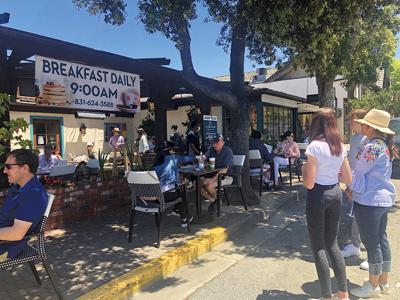
Carmel City Administrator Chip Rerig chose the latter reading, and in the days before Memorial Day weekend, the unofficial beginning of summer and the Peninsula’s tourist season, announced that Carmel restaurateurs could apply for encroachment permits to place tables outside on sidewalks or in public parking spaces. They had to submit a seating plan and sign an insurance document.
Rerig did not confer with Monterey County officials before opening up applications. “They don’t regulate outdoor seating in my right of way,” Rerig says.
By Saturday, May 23 the city had received 18 applications and approved about a dozen, Rerig says. Additional Carmel restaurants went ahead and placed tables without permits; Rerig says those may have had applications pending.
The result was that on May 24, Sixth Avenue between San Carlos and Dolores streets took on the air of a street fair, with dozens of people packed in tables and standing along sidewalks at lunchtime at Flaherty’s and Village Corner. The crush of visitors made social distancing difficult at times, and most were not wearing face coverings as required by a county order that went into effect April 30 and is set to expire on May 31.
Rerig’s self-described “experiment” came as a surprise to neighboring cities after the holiday weekend. “That was not our understanding or interpretation of the shelter-in-place order,” Pacific Grove City Manager Ben Harvey says. “If that is the county’s interpretation, we’ll follow suit.”
P.G. offered encroachment permits (with no fees or hearings) to restaurants ahead of the holiday weekend to facilitate curbside pickup from city parking spaces.
County spokesperson Maia Carroll says based on the shelter-in-place order, as long as restaurants are providing takeout only, setting up tables and chairs outside is not a violation. It’s akin to customers walking away with their food and sitting curbside.
The whole debate about whether outdoor tables are allowed by the shelter-in-place order that expires on May 31 could be moot by the time this issue of the Weekly is printed, and dine-in restaurant service could again be allowed. On May 26, the Monterey County Board of Supervisors voted 5-0 to petition the state for an expedited Stage 2 reopening schedule. The request – technically, the 140-page document is called the “Monterey County variance attestation” – was sent to the governor’s office and California Department of Public Health the same day.
Once Monterey County Health Officer Edward Moreno has a signed variance in hand, he’ll issue a new, less restrictive shelter-in-place order that incorporates the reopening guidelines laid out by the state. It would allow several sectors that have been shut down as “nonessential” to again do business, including dine-in restaurants; hair salons and barbershops; childcare; janitorial and cleaning services for commercial and residential; schools pet grooming and dog walking services; car washes; and curbside pickup for libraries.
In their letter, the Monterey County supervisors also asked for a special exemption for wine tasting rooms: “As you may know, the wine industry is an important sector of the County’s economy, and there are numerous wineries and tasting rooms throughout our communities. We therefore strongly encourage and support the inclusion of Wineries and Tasting Rooms as businesses that the state deems eligible for reopening in Stage 2, with appropriate social distancing and other protective measures, and the board appreciates your consideration of that issue,” they wrote.
All businesses that choose to open would have to abide by industry-specific guidelines for physical distancing and sanitizing protocols, as laid out on the state’s dedicated website, covid19.ca.gov.
According to the state’s guidance to reopening restaurants, businesses should “prioritize outdoor seating and curbside pickup to minimize cross flow of customers in enclosed environments. Restaurants can expand their outdoor seating, and alcohol offerings in those areas, if they comply with local laws and regulations.”
After Memorial Day weekend with outdoor seating in Carmel, Rerig heard just a few complaints, and noticed some restaurants set up more tables than agreed upon. Some restaurants served alcoholic drinks to-go, against the city’s ordinance for no alcohol consumption in public spaces. One had amplified music.
“Those are the people we’ll spend the next couple of days admonishing,” Rerig says.
Lessons learned from the city’s Memorial Day weekend experiment will be used moving forward as the city crafts a more permanent policy for outdoor dining. Other cities are also eyeing more outdoor dining beyond the pandemic; P.G. and Monterey are considering blocking off streets. Carmel had considered closing down Dolores Street, but abandoned the idea in favor of individual restaurant permits instead.


(1) comment
now if the county would simply listen to the experts.
"The World Health Organization is recommending healthy people, including those who don't exhibit COVID-19 symptoms, only wear masks when taking care of someone infected with the contagion, a sharp contrast from the advice given by American public health officials who recommend everyone wear a mask in public.
"If you do not have any respiratory symptoms such as fever, cough or runny nose, you do not need to wear a mask," Dr. April Baller, a public health specialist for the WHO, says in a video on the world health body's website posted in March. "Masks should only be used by health care workers, caretakers or by people who are sick with symptoms of fever and cough."
Welcome to the discussion.
Log In
Keep it Clean. Please avoid obscene, vulgar, lewd, racist or sexually-oriented language.
PLEASE TURN OFF YOUR CAPS LOCK.
Don't Threaten. Threats of harming another person will not be tolerated.
Be Truthful. Don't knowingly lie about anyone or anything.
Be Nice. No racism, sexism or any sort of -ism that is degrading to another person.
Be Proactive. Use the 'Report' link on each comment to let us know of abusive posts.
Share with Us. We'd love to hear eyewitness accounts, the history behind an article.