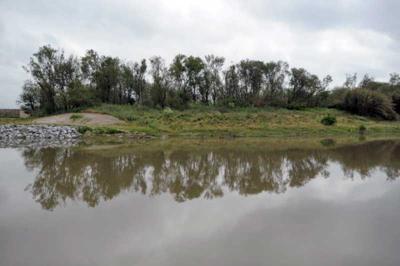

When Abe Claassen arrived in 1896 from West Prussia, settling on the Nacimiento River near where the Lake Nacimiento reservoir now stands, the fishing was good. He used to drop dynamite into a deep pool, stunning large numbers of fish.
In 1999 Claassen’s grandson, Harold A. Franklin, typed up the fishing stories Claassen told him. He reports they often speared and shot fish. “Everyone seemed to eat their steelhead fried,” Franklin wrote.
The 67-page account has become known as “the Franklin report,” effectively the only record of historical steelhead populations in the Salinas River watershed.
National Marine Fisheries Service biologists entered data from the Franklin report into their GIS system in 2005, trying to establish a baseline for what the steelhead population once looked like.
What they know for sure is that since they started counting Salinas River steelhead in 2010, thanks to a camera installed at the rubber dam in north Marina, the highest tally was 46 in the winter of 2012-13.
On July 2, Monterey County Water Resources Agency’s reservoir operations committee considered releasing more flow from Lake Nacimiento to help irrigate South County farms.
Doing so would leave less water for fish. NMFS biologist Joel Casagrande sent a July 1 letter to MCWRA urging them to back off.
“Steelhead have been hanging by a thread in the Salinas for a while,” he says. “We looked at [the proposed increase] as a complete disregard for conservation in a time of extreme drought.”
He cites record crop values as evidence that drought isn’t dragging agricultural production down for Salinas Valley farmers. The reservoir committee voted against the flow increase, and the full MCWRA board agreed July 6. But as some South County farmers watch wells go dry, water release requests are still coming.
Casagrande says he stands ready “to re-send the letter with a new date.”
Clarification: This story has been modified to accurately portray biologist Joel Casagrande's reference to Salinas Valley crop values. His comment, as well as his letter, are meant to show that crop values have remained high during the drought, not that the drought has caused no hardship on farmers, as originally stated.


(0) comments
Welcome to the discussion.
Log In
Keep it Clean. Please avoid obscene, vulgar, lewd, racist or sexually-oriented language.
PLEASE TURN OFF YOUR CAPS LOCK.
Don't Threaten. Threats of harming another person will not be tolerated.
Be Truthful. Don't knowingly lie about anyone or anything.
Be Nice. No racism, sexism or any sort of -ism that is degrading to another person.
Be Proactive. Use the 'Report' link on each comment to let us know of abusive posts.
Share with Us. We'd love to hear eyewitness accounts, the history behind an article.