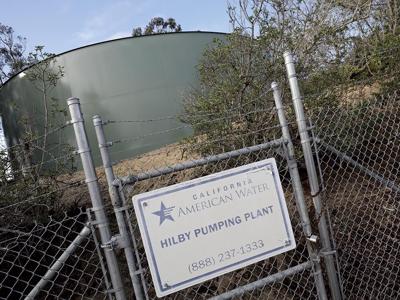

The reasons why a key commission rejected the local water district’s voter-approved mandate to buy water utility California American Water on Dec. 6 ranged from social equity to free-market politics. However, one major question hung over the vote: If all of Cal Am’s private property holdings turn into tax-exempt public assets, how will that impact public agencies reliant on those property taxes for funding?
George Riley, a board member on the Monterey Peninsula Water Management District – the agency responsible for leading the buyout of Cal Am’s water system – has been meeting with commissioners on the Local Agency Formation Commission of Monterey County since the commissioners voted 5-2 against activating the district’s power to become a water utility, a crucial step before the buyout. In their nay votes, commissioners Chris Lopez, Mary Ann Leffel and Pete Poitras cited uncertainties with how public agencies and satellite systems would fare without Cal Am. They wanted ironclad agreements that the water management district would subsidize some of the immediate property tax revenue loss for school and fire districts, and that Cal Am’s satellite service areas, such as Chualar, would not see water rate increases.
The water district has committed to addressing the issues – resolving the problems was a condition of approval when LAFCO voted against the district in December. However, district officials say they cannot agree to contractual dollar amounts at this point in the buyout process.
Dave Stoldt, the water district’s general manager, says the plan is to cover 75 percent of the tax revenue loss the first year after the acquisition, stepping down to 50 percent in the second and to 25 percent the third year, then zero.
LAFCO’s December vote was on a resolution to approve the district’s utility powers. Commissioners are scheduled to now vote to deny the water district’s application on Jan. 5. Riley, who says he was “pretty shocked” by the Dec. 6 denial, says his efforts to negotiate a change of heart with commissioners have “not been particularly successful.” He says if LAFCO votes against the district, the district will sue.
“I’m expecting a [denial],” Riley says. “If they vote no, the only option is a reconsideration vote in February. If they vote no then, they will get sued.”
On Wednesday, Dec. 29, the water district board met for one closed-session discussion to review “significant exposure to threatened or potential litigation… MPWMD v. LAFCO of Monterey County.”
The legal authority to be a water utility is a crucial element to the buyout. Stoldt says the district is also considering a route to bypass LAFCO. Since the water district sells water to local golf courses for irrigation, they could argue their powers as a water utility are already activated, making LAFCO’s decision irrelevant.
“From our standpoint, we’ve been doing the services, but we would rather first figure out whether we can prevail in litigation over the [LAFCO] decision itself,” Stoldt says.


(0) comments
Welcome to the discussion.
Log In
Keep it Clean. Please avoid obscene, vulgar, lewd, racist or sexually-oriented language.
PLEASE TURN OFF YOUR CAPS LOCK.
Don't Threaten. Threats of harming another person will not be tolerated.
Be Truthful. Don't knowingly lie about anyone or anything.
Be Nice. No racism, sexism or any sort of -ism that is degrading to another person.
Be Proactive. Use the 'Report' link on each comment to let us know of abusive posts.
Share with Us. We'd love to hear eyewitness accounts, the history behind an article.