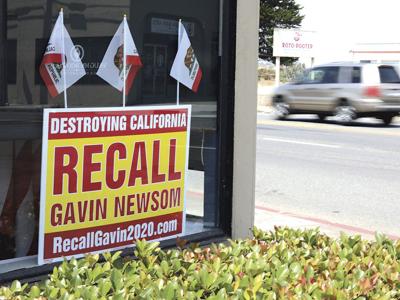

The second-ever governor recall election in California history has been largely defined by criticism. Criticism of incumbent Gov. Gavin Newsom, criticism of the dozens of candidates vying to replace him and criticism of the recall process itself.
Voters are posed two questions in this recall election. The first: “Shall Gavin Newsom be recalled (removed) from the office of Governor?” The second: select one of 46 qualified candidates as his replacement. The first question will be decided by a majority vote. If a majority votes yes on the recall, then the candidate among the 46 with the most votes wins.
So many candidate choices means if California votes Newsom out of office, his replacement could earn the governorship with far less than majority support. The latest polls show conservative radio host Larry Elder leading the replacement candidate race with support from only 21 percent of voters. Newsom could potentially get voted out, yet receive more votes to stay in office than the winning candidate receives in the replacement election.
Amid concerns over the election’s merit, Judge Michael Fitzgerald in California’s U.S. Central District on Aug. 27 denied a challenge and ruled the election constitutional.
Carol Moon Goldberg, president of the nonpartisan League of Women Voters of California, disagrees with how this election is playing out. She says her organization, which focuses on rallying electoral participation and informing voters, never wants to see an election based on plurality.
“We want to see any officer elected by a majority,” Moon Goldberg says. “The winning candidate should always win a majority.”
The process for recall was passed by voters in 1911 during a California progressive movement that sought to counter the power of railroad interests and the concentration of wealth in politics. Voters have since attempted 178 state-level recall elections. Only 11 recall petitions have reached the ballot, six of which successfully removed an incumbent from office – five state legislators and, in 2003, Gov. Gray Davis in favor of Arnold Schwarzenegger.
Changing the process of recall elections in California requires a constitutional amendment. Such a change requires either a petition signed by at least 997,139 registered voters (8 percent of votes cast in the last gubernatorial election), or a proposal passed by two-thirds of state legislators. Voters would then have to support the change.
Moon Goldberg says the scarcity of recalls makes it difficult to sustain the momentum required to make changes. Among the recall format’s vocal critics is Secretary of State Shirley Weber, who has suggested that a committee review the recall process. She has questioned the 12-percent signature threshold – of the 18 other states with recall ability, 16 have higher thresholds; the time limit on signature gathering – typically 160 days but this latest effort received a 120-day extension because of Covid; and whether a replacement should win with only a plurality.


(0) comments
Welcome to the discussion.
Log In
Keep it Clean. Please avoid obscene, vulgar, lewd, racist or sexually-oriented language.
PLEASE TURN OFF YOUR CAPS LOCK.
Don't Threaten. Threats of harming another person will not be tolerated.
Be Truthful. Don't knowingly lie about anyone or anything.
Be Nice. No racism, sexism or any sort of -ism that is degrading to another person.
Be Proactive. Use the 'Report' link on each comment to let us know of abusive posts.
Share with Us. We'd love to hear eyewitness accounts, the history behind an article.