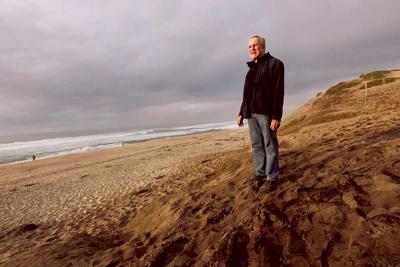

In the fight to shut down the Cemex sand mine in Marina, the lines in the sand have been drawn. Diplomacy, up until now, has not borne fruit, and a looming battle is starting to take shape.
On July 12-14, the California Coastal Commission will convene at CSU Monterey Bay’s World Theater for their monthly meeting, and Coastal Commission staff will present the commissioners with a recommended course of action – as yet unknown – regarding the Cemex mine, the last remaining coastal sand mine in the United States.
The mine is the reason, scientists contend, that southern Monterey Bay’s shoreline has one of the highest coastal erosion rates in the state.
For the last 15 months, after Coastal Commission staff sent a notice of intent to issue a cease-and-desist order against the Cemex operation in March 2016, the agency has been working to reach a settlement with Cemex in hopes of avoiding litigation.
No settlement has yet been reached, and on May 15, Cemex filed a statement of defense with the Coastal Commission – the formal response to the agency’s threat to issue a cease-and-desist order.
The document, which was obtained by the Weekly via a Public Records Act request, provides a blueprint for Cemex’s legal strategy, should they choose not to settle.
In short, Cemex – a Mexico-based cement manufacturer valued at over $13 billion – is seeking to cast doubt on the peer-reviewed scientific findings of the mine’s erosion impacts, and is arguing the operation is a vested right, and is therefore largely immune to the Coastal Commission’s regulatory reach.
Cemex’s statement specifically calls out a peer-reviewed October 2016 paper written by local coastal engineer Ed Thornton, a retired Naval Postgraduate School professor who in 2007 was given the International Coastal Engineering Award, the profession’s highest honor. Thornton, after realizing the erosion impacts of local sand mining operations in the early 1980s, has since campaigned to shut them all down.
But the Cemex mine, because it operates in a dredge pond above the mean high tide line, was deemed outside the jurisdiction of the U.S. Army Corps of Engineers and the State Lands Commission, the two agencies that helped shut down the other sand mines in Sand City and Marina in the mid – to late 1980s, due to erosion concerns.
Cemex states Thornton’s peer-reviewed paper “wrongly accuses” its mine “of being the cause of perceived beach erosion in this region. While published in a peer-reviewed journal, the article is a theoretical construct not based on measured data. This unproven approach stands in stark contrast to the data driven methodologies used in recognized academic literature.”
Yet just a paragraph later, Cemex asserts that Thornton “ignores the fact that highest rates of beach retreat occur more than seven kilometers to the south of the Lapis Sand Plant.”
That claim was true as recently as the 1980s, before dragline mines in Sand City and Marina were shut down, but it is not true now – numerous studies show that in recent years, the region’s highest coastal erosion rates are in Marina.
There is no citation in Cemex’s statement for where their data comes from – and they did not respond to questions seeking clarification – but elsewhere in the 59-page document there are numerous citations to a state report from 1972.
As for Cemex’s vested rights claim, the latest county permit they provide is from 1964, and it does not explicitly authorize the operation’s dredge pond on the beach, which was formed in the mid-1960s and is the crux of the current operation.
The potential options that could be presented to the Coastal Commission are: settle, take no action, or follow through on the threat to issue a cease-and-desist order.
The city of Marina is also joining the fray: On June 6, City Council voted 5-0 to authorize City Attorney Rob Wellington to explore legal options – drawing on both municipal and state code – that would argue that the Cemex mine is a “public nuisance” due to its erosion impacts, and as such, it must mitigate the impacts of its operation. The council chambers were so packed at the meeting the city opened up a second room.
Wellington says that though he is now permitted to explore potential legal action, he may wait and see how things play out with the Coastal Commission and the State Lands Commission – the latter of which ordered Cemex last month to apply for a lease for their mining operation, an application that would potentially be subject to environmental review.
The report presented to Marina City Council was written by Molly Melius, a Stanford environmental law professor whose department is working the case pro bono. In her report, Melius states that Cemex’s vested right claim is trumped by the city’s claim the operation is a public nuisance, and is therefore immaterial. Her analysis also draws from a scientific evaluation – also done pro bono – by Rob Young, director of the Program for the Study of Developed Shorelines, a joint program between Western Carolina and Duke universities.
Young says he finds the doubts Cemex seeks to cast on the scientific findings regarding the mine to be suspect.
“If you’re going to challenge peer-reviewed scientific literature,” he says, “you need to do it with peer-reviewed scientific literature.”
He also adds, when referring to the estimated 270,000 cubic yards of sand mined at the operation annually, “You cannot remove that volume of sand without causing impacts, there’s absolutely no question about that.”


(1) comment
So glad it's finally, hopefully going to end. Now if the Coastal Commission can keep the awful Ghandour from developing his "eco" hotel nearby. Wouldn't life be nice if we didn't always have to fight businesses and developers.
Welcome to the discussion.
Log In
Keep it Clean. Please avoid obscene, vulgar, lewd, racist or sexually-oriented language.
PLEASE TURN OFF YOUR CAPS LOCK.
Don't Threaten. Threats of harming another person will not be tolerated.
Be Truthful. Don't knowingly lie about anyone or anything.
Be Nice. No racism, sexism or any sort of -ism that is degrading to another person.
Be Proactive. Use the 'Report' link on each comment to let us know of abusive posts.
Share with Us. We'd love to hear eyewitness accounts, the history behind an article.