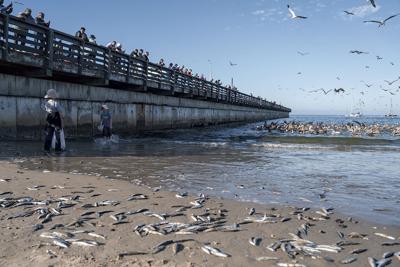

Over the last couple of weeks, anchovies have been showing up in shallow waters of Monterey Bay en masse, causing a local feeding frenzy among the marine mammals, sea birds and beachgoers. Tens of thousands of the bony fish have been cutting through crystal clear waters, often ending up on shorelines and causing a noisy scene of seagull squawks and sea lion barks.
While the phenomenon is not new, the exact forces driving these changes in populations, especially in such large quantities in Monterey Bay, is not well understood.
Francisco Chavez, a researcher with the Monterey Bay Aquarium Research Institute, has been tracking these fish for the last nine years. He suggests that the high anchovy numbers could be due to larger climate shifts, changes in food availability early in their life cycle, or a combination of various factors.
“We have no idea how all of this happens, but in California, Japan and Peru, the fluctuations in the anchovies and sardines are coincident,” says Chavez. “Recently, climate cycles have changed.”
What we do know is anchovies move up and down the coast, as well as up and down the water column. They are motivated by food like copepods and other small crustaceans living on kelp forests, and they have been found to retreat to lower areas of the submarine Monterey Canyon to seek refuge from whales and other predators.
In response to prior anchovy influxes, the Monterey municipal marina installed aerators to oxygenate the water and prevent mass die-offs, which can occur when large numbers of fish deplete the available oxygen and asphyxiate.
“In the past five years, this is the first time that they’ve been turned on,” says Nichole Rodriguez, harbor coordinator for the City of Monterey. “It’s not something that we use regularly.”
On Friday, Oct. 25, beachgoers at Del Monte Beach were harvesting anchovies in ankle-deep water, some simply by scooping them up with their hands; children used small fish nets.
Biologists at Monterey Bay Whale Watch believe that upwelling has driven anchovies up from the depths for food, but closer to shore to escape predation from whales.
“We had 71 humpbacks on our morning trip, which is a crazy amount for this time of year,” says Levi Blair of Monterey Bay Whale Watch. “Normally, we’d be seeing those every few days during the prime time of the year, not necessarily right now.”





(0) comments
Welcome to the discussion.
Log In
Keep it Clean. Please avoid obscene, vulgar, lewd, racist or sexually-oriented language.
PLEASE TURN OFF YOUR CAPS LOCK.
Don't Threaten. Threats of harming another person will not be tolerated.
Be Truthful. Don't knowingly lie about anyone or anything.
Be Nice. No racism, sexism or any sort of -ism that is degrading to another person.
Be Proactive. Use the 'Report' link on each comment to let us know of abusive posts.
Share with Us. We'd love to hear eyewitness accounts, the history behind an article.