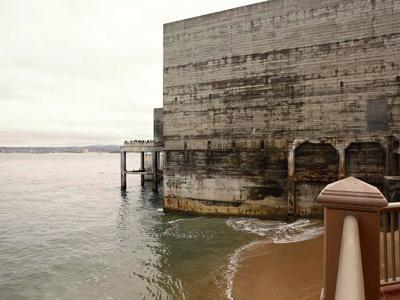

It can be difficult to make history come alive, and that is the case for the old cannery building at 300 Cannery Row in Monterey. It’s under the purview of three different agencies: the State Lands Commission, which has a say over anything in the tidelands (from the high tide line to the sea), the California Coastal Commission (which oversees the amorphous coastal zone) and the city of Monterey.
On Sept. 25, the Monterey Planning Commission approved a project to redevelop the site into 10 condo units and retail. A resident appealed, and on Nov. 20, Monterey City Council voted 4-1 (Ed Smith dissenting) to grant the appeal, thereby killing the project for now.
Why the council denied the project is complicated, and speaks to why the property might sit vacant for many years to come: According the city’s land use policy for the Cannery Row area, there cannot be more than 30 residential units per acre, and 10 units on the property would be more than double that cap.
The developer – Silicon Valley-based GPR Ventures, which acquired the property in 2010 for $2.8 million, as well as two nearby properties on Foam Street for another $1 million – sought to get around that by combining the properties as one, which would meet the density requirement, at least in spirit.
Attorney Tony Lombardo, representing GPR, told the council the project was “the world’s most difficult application.”
Monterey planner Elizabeth Caraker says that’s a fair assessment, especially with overlapping requirements from numerous agencies.
“It’s the most difficult [project] I’ve seen,” Caraker says.
City staff recommended the council deny the appeal and approve the project, but a majority of council thought the proposal bent too many rules.
Aside from the density issue, the proposal also sought a creative interpretation of the city’s policy for the area, which dictates there can’t be residential units on the first floor – the developer suggested considering the below-street level as the first floor, and Lombardo said the only way the project would pencil out financially was to put two residential units on the street level. (As a condition of approval, GPR would also be required to build two affordable units on-site or off-site.)
Developers at GPR didn’t respond to requests for comment as to what’s next, but Lombardo says they’re still trying to figure if there’s some way to make a project work. One possibility, he says, is if a new water supply comes along that could allow for a waterfront bar or restaurant, which would boost the value of the building’s off-street, commercially zoned spaces that face the bay.


(0) comments
Welcome to the discussion.
Log In
Keep it Clean. Please avoid obscene, vulgar, lewd, racist or sexually-oriented language.
PLEASE TURN OFF YOUR CAPS LOCK.
Don't Threaten. Threats of harming another person will not be tolerated.
Be Truthful. Don't knowingly lie about anyone or anything.
Be Nice. No racism, sexism or any sort of -ism that is degrading to another person.
Be Proactive. Use the 'Report' link on each comment to let us know of abusive posts.
Share with Us. We'd love to hear eyewitness accounts, the history behind an article.