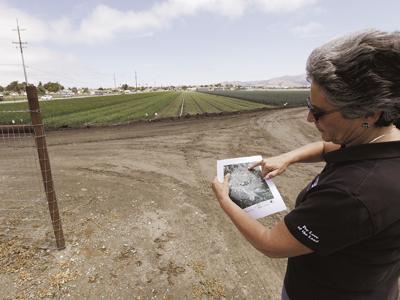

A century ago, before the wetlands of the Salinas Valley were drained to make way for farmland, Carr Lake was the largest of a seven-lake system, which flowed into Elkhorn Slough and out to Monterey Bay. In the 1920s, the lake became 480 acres of farmland, where lettuce is the primary crop today, with rotations of leeks, cauliflower and broccoli.
Urban growth has since risen up around Carr Lake, leaving 480 acres of cropland between East Laurel Drive and Highway 101. It’s a green oasis in the middle of the city and a critical flood control site – the reclamation ditch that flows through catches more than 90 percent of stormwater runoff in Salinas, directing that water to Monterey Bay.
Talks began in the ’70s about converting this land into a public park, then stopped and started for over 40 years. Now, a significant portion of the property is finally slated to become parkland.
In January, the Big Sur Land Trust signed a $4 million purchase agreement with the Ikeda family for 73 acres, and on May 26 clinched a $2.5 million grant from the California Coastal Conservancy to help with the acquisition. There’s another $550,000 to raise to close the deal before year’s end, but with the CCC funding boost on top of $1 million from the Packard Foundation, trust officials are confident the deal is a go. (The remaining 407 acres of Carr Lake, owned by the Higashi and Hibino families, are not currently for sale.)
Buying land in urban Salinas is part of a new direction for the trust, a nonprofit that has acquired property and conservation easements on tens of thousands of mostly coastal land.
“Having accomplished so much in Big Sur and on the Carmel River, it really made sense for us to look at where else conservation and open space is most needed,” says Jeannette Tuitele-Lewis, president and CEO of the Big Sur Land Trust. “Salinas is one of those places.”
Salinas provides just 2.9 acres of parkland per 1,000 residents, well below Los Angeles and San Francisco, which have 9.3 and 6.8 acres of parkland per 1,000 residents, respectively, according to a report by the Coastal Conservancy. “Salinas is a park-poor and economically depressed community,” the report states.
Not much will change right away after the deal closes. Big Sur Land Trust plans to lease the land back to farming for a years while they hire hydrologists and landscape designers, as well as launch a community engagement process to get input. That planning stage is expected to cost about $5 million.
Jeanette Pantoja, land use project coordinator for Building Healthy Communities in East Salinas, has heard some ideas already about what community members might want on those 73 acres. “Before, people said, jungle gyms or a pool,” Pantoja says. “Now people say, access to nature and open space, gardens and plants – feeling connected to the environment.”
The future could hold walking trails, picnic areas, sports fields and restored habitat, prime for attracting birds.
Rachel Saunders, director of conservation for the Big Sur Land Trust, imagines a trend for the future: “We hope this is a very catalytic project for the city and raises the level of interest and visibility for the greening of [Salinas].”

(1) comment
Bravo! BSLT showing the rest of us how to spread the wealth, in this case the treasure of open space through restoration of long lost wetlands. Salinas families and others are going to love it!
Welcome to the discussion.
Log In
Keep it Clean. Please avoid obscene, vulgar, lewd, racist or sexually-oriented language.
PLEASE TURN OFF YOUR CAPS LOCK.
Don't Threaten. Threats of harming another person will not be tolerated.
Be Truthful. Don't knowingly lie about anyone or anything.
Be Nice. No racism, sexism or any sort of -ism that is degrading to another person.
Be Proactive. Use the 'Report' link on each comment to let us know of abusive posts.
Share with Us. We'd love to hear eyewitness accounts, the history behind an article.