About 20 miles up the Carmel River from the sea there is a steep canyon with fragrant walls of chaparral and stout-bearded oak that few have ever laid eyes on. It is one of the most beautiful sections of a very beautiful river.
A pair of geese rocket up the wild, idyllic gorge, its path long since dictated by the roaring current below. The geese twist and turn up the canyon, where a small, rugged service road runs along the northern bank, and a thick diversion pipe emerges from the ground and runs alongside the road.
The geese pass over a squat bridge. Today, storm-fed water flows beneath the bridge and pours off a four-foot step like a wide, gray tongue. It is late February and a flash of silver in the small fish ladder which circumvents the step on the far side of the bridge indicates a lone steelhead trout’s struggle upriver.
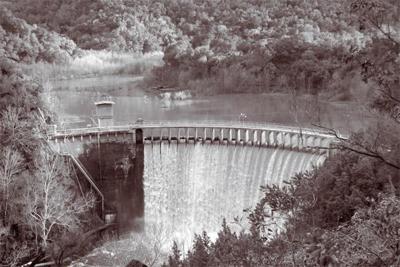
The geese round the next bend and are confronted by a white monolith, a graceful curve of concrete and roaring water. Rapidly gaining elevation, the two birds clear the 107-foot wall and splash down into the shallow, muddy waters of the reservoir, which is more like a braided sediment field than a lake.
Far behind and below them, the exhausted steelhead clears the short fish ladder, rounds the bend and is confronted by the San Clemente Dam. Driven by instinct, the sapped fish follows the current to the base of another fish ladder, this one much bigger than the last. With 27 steps, and at 68 feet tall, it is one of the biggest fish ladders in the state.
Driven by an abiding desire to get upstream and spawn, the steelhead determinedly begins the long climb. The fish is of course unaware that, even if it manages the ascent, it still has to negotiate the sediment field in the reservoir above the dam in order to migrate to spawning grounds. Shallow conditions and the lack of clearly defined channels make the traverse a very dicey prospect.
Assuming the steelhead overcomes all of these obstacles and actually spawns, it eventually has to turn around and begin a dramatic return to the sea that will kick off with a daredevil plunge off the 107-foot dam itself.
Considering all this, it’s a miracle there are any steelhead left in the Carmel River at all. Historically, biologists estimate the river once supported 12,000 to 20,000 steelhead. By the early 1990s, the population had declined to a few hundred fish. In recent years an estimated 400 to 800 steelhead have successfully climbed the fish ladder. Much fewer than that have survived the return fall.
~ ~ ~
The San Clemente Dam has been making life difficult for steelhead since 1921. For most of that time, the dam stored drinking water for thousands of people, and its benefits were thought to outweigh its devastating effect on the steelhead population. But over the decades the reservoir has slowly choked itself on 2.4 million cubic yards of sediment.
“We’re interested in getting a bunch of groups together to make it possible for Cal Am to remove this dam.” —frank Emerson, Carmel Valley Steelhead Association
Today, the dam holds less than 10 percent of its original water capacity. It is practically useless.
At the same time, the dam has become a hazard—in 1986, state inspectors declared it a safety hazard in the event of a major earthquake.
“This is a dam at the end of its lifespan,” says Frank Emerson of the Carmel Valley Steelhead Association. “Unfortunately it still impacts the life cycle of salmonids, which are a very important cultural, historic, and economic resource.”
In 1992, the California Division of Dam Safety (CDDS) ordered Cal Am Water to make expensive safety improvements to the structure.
“The dam has been found deficient in the design earthquake condition and in the design flood condition. It could fail,” says Ynhi Enzler, an engineer with the CDDS.
Enzler points out that the dam’s failure is not imminent and that it would take an extreme seismic event or flood for this to happen.
“We’ve determined that the fault is capable of the kind of movement that could cause the dam to fail,” Enzler says. “But that doesn’t mean it would fail tomorrow at the smallest shaking.”
In fact, Enzler says, the dam was shaken “a little bit” last year during the Paso Robles quake without causing any damage. Regardless, Enzler and the CDDS began working with Cal Am to resolve the San Clemente Dam’s outstanding safety issues.
Then on Aug. 17, 1997, the feds got involved when steelhead, the seagoing cousins of resident rainbow trout, were listed as an endangered species. Steelhead are anadromous, which means they migrate as juveniles from freshwater to the ocean, return to spawn in freshwater, and then go back out to sea.
Suddenly the dam wasn’t just making life difficult for the steelhead, it was also making life difficult for its owner, Cal Am Water. The steelhead’s new designation meant Cal Am would have to get a permit for any future project on the Carmel River, no matter how small, from the National Oceanic and Atmospheric Administration (NOAA) Fisheries agency.
Cal Am was faced with getting a permit from NOAA to spend $13 million to $14 million to strengthen the San Clemente Dam with 11,200 tons of concrete, even though the dam stores a miniscule 147 acre-feet of water. All in all, it’s a lot of trouble and money to shore up a virtually defunct dam.
To complicate matters, NOAA made it clear it thought the dam should come down because it would increase the Carmel steelhead run by 50 percent.
According to Steve Leonard, Cal Am’s manager of Central Coast operations, the reservoir has not been much of a water supply for 20 years now, primarily due to the sediment build-up.
Although capable of diverting 30 cubic feet per second, Leonard says, the dam diverts more like “two to three” cubic feet per second in order to maintain flow for the fish. In addition, Cal Am must pump that water back up river.
“We used to take water from the highest point for purity purposes,” Leonard says. “But with fish mitigation in mind, we’ve begun taking it lower and pumping it back up to the filter plant. It’s completely opposite to how you would run a water system.
“The main cost of water is energy. As a result, it’s a lot less cost effective, so the amount diverted is much less now. We don’t operate it much of the year because of the fish.”
Leonard is adamant that the San Clemente Dam is not a problem, but an opportunity for agencies and organizations to come together and realize a solution beneficial to everyone.
“We recognize there’s a lot of interest in having the dam come down,” Leonard says. “A restored river and a healthy steelhead population is not just important to Monterey County residents, but people across the state of California and the nation.”
Environmentalists like Emerson applaud Cal Am’s willingness to find a solution and hope to help make the removal of the dam a reality.
“We’re not interested in making this a conflict,” Emerson says. “We’re interested in getting a bunch of groups together to make it possible for Cal Am to remove this dam.”
According to a 2003 report by the State Coastal Conservancy, two-thirds of the potential spawning habitat in the Carmel River watershed occurs behind San Clemente Dam. Removing the dam would open the river up five miles to Los Padres Dam, the only other dam on the river. It would also establish access to a majority of the steelheads’ spawning and rearing habitats, which are also located above the dam.
In addition, it would allow gravels to naturally flow downstream, creating better spawning beds and insect breeding grounds all the way to the ocean.
“The river has been starved of sand below the dam for the last 80 years,” Leonard says.
~ ~ ~
Unfortunately, taking the dam down is no simple project.
If the dam was blasted Monkey Wrench Gang-style, the resulting avalanche of gravel, sand and mud would probably smother miles of river, effectively destroying the few steelhead which remain, not to mention a lot of other wildlife. In addition, it would probably flood a lot of million dollar homes and a golf course or two.
As a result, a number of different plans are being proposed. As the lead agency on the project, the CDDS will issue a draft Environmental Impact Report-Environmental Impact Statement (EIR-EIS) next month which highlights all possible avenues available to Cal Am.
“There will be alternatives on how to resolve this issue,” says Ynhi Enzler, an engineer with the CDDS. “This is the draft report, so you will see what is being proposed by the dam owner and what other alternatives are out there and what the benefits are and what the impacts of those alternatives are. It will be out for the public to comment on.”
Enzler is quick to point out that the CDDS is not officially supporting any of the proposed alternatives and that her division’s sole responsibility is making the dam safe, not restoring the river to its natural state. Yet two of the four plans outlined in the forthcoming EIS-EIR accomplish both objectives.
One alternative is Cal Am’s primary plan. The “dam strengthening” or “dam thickening” alternative would simply re-buttress the dam with a couple thousand square feet of concrete and let it be for a few generations. This is considered the most likely option due to expense, but opponents say it accomplishes little while incurring long-term costs.
“If the dam is buttressed it provides no benefit to the public other than a point of diversion of the water. But it doesn’t provide flood control or store water. It would be just a continued public nuisance,” Emerson says. “Plus, you’re talking about the ongoing maintenance of one of the highest fish ladders in the world.”
In a November 2001 report, the National Marine Fisheries Service [NMFS] objected to the dam strengthening alternative, stating that the dam “would continue to have little purpose other than to hold back nearly 2,000 acre feet of sediment for another 50-plus years while serving as one of the many water diversion points along the river. By retaining the dam, the restoration and enhancement of the many miles of stream habitat would be unrealized, passage for migratory steelhead would continue to be adversely affected, and the effects of sediment releases from the sediment filled impoundment will continue to be an unresolved problem.”
This four-year project would be no small operation. According to an initial study, a tower crane would have to be staged at the base of the dam to move construction materials from a concrete batch plant to the dam face and fish ladder. Plus, a new road would be built along the east side of the Carmel River, between the Old Carmel River Dam and the base of the San Clemente Dam.
Yet it’s still the cheapest option, outside of doing nothing. And key to the issue, Leonard says, is the fact that Cal Am’s rate payers are going to end up footing the bill of re-commissioning the dam.
“Seismic safety of the dam is the top priority and putting a bunch of concrete in front of the dam is one way to make it stronger. We could also lower the dam 20 feet or so by notching it so it didn’t hold back the water,” says Leonard. “This option accomplishes all that with the least amount of cost to our customers.”
Cal Am could roughly double the thickness of the dam, make the necessary notches and construct a new fish ladder for about $30 million. In contrast, options requiring the dam to be razed could cost $70 million or more.
“We’re open to the possibilities,” Leonard insists. “We need to balance human safety, human economics and fish survival. But we have to be very fiscally sound. Cal Am is for what’s right for the river and for our customers.”
As a result, Leonard hopes that interested parties such as private foundations, state water bond money, Congress or other sources will help Cal Am “go the extra mile” to remove the dam and restore the river to its natural state.
“We’re open to help from interested parties, so people can reclaim the watershed,” Leonard says. “We want to hook some people on the idea. It has public benefit at all levels.”
~ ~ ~
The EIR-EIS also outlines two “reasonable alternatives” which outlines possible ways to remove the dam without burying the steelhead beneath a torrent of mud and sediment. The first includes a labor-intensive process of removing the sediment from the reservoir before tearing down the dam.
“No mean feat,” Leonard says. “You’re talking about 250,000 truckloads. Either that or a conveyor belt system stretching over a mile down the river. Either way it’s not an insignificant process.”
Plus, the sediment would have to be trucked out through the wealthy gated community of Sleepy Hollow, and deposited at Cal Am-owned sites downstream.
The second option, referred to in the EIR-EIS as the “Carmel River Re-route Alternative” is promising and appears to give both Leonard and environmentalists like Emerson the most reason for optimism.
Prepared by the Institute for Fisheries Resources, utilizing grant funds from the Coastal Conservancy, the plan calls for the construction of dikes or “cells” above the dam which would, in effect, sequester the sand, stabilizing the sediment so crews could remove the dam to the point where it would flow freely.
“It’s the preferred alternative of removal,” Emerson says. “The sediment would remain there and become a field. They’d plant it over with natural grasses and the river would be routed around that field of sediment.”
This option restores the river to a natural flowing state and opens up miles of spawning and rearing habitat, but leaves alluvial floodplains, the sandy habitat which has been proven valuable to the endangered red-legged frogs which also inhabit the area.
In addition, according to the Coastal Conservancy, the plan has strong community support, including letters of support from Senator Bruce McPherson, Assemblymember John Laird, and County Supervisor Dave Potter.
~ ~ ~
Emerson understands Cal Am’s predicament but hope they find the support and resources necessary to do the right thing.
“They really only have two options: re-buttress or remove; and the fishery agencies favor the removal of the dam,” Emerson says. “But [Cal Am’s] not opposed to removing the dam. They’re just not sure how much community and public financial support they would get.”
Plus, Emerson points out, Cal Am has liability. “If they remove the dam and there are flooding problems or a massive fish kill, that could be messy,” he says.
Obviously, finding a way to remove the San Clemente Dam would be complicated, but not without precedent. In fact, more than 50 dams a year have been removed nationwide in the past few years. Down in Ventura County, officials have begun plans to tear down the 170-foot Matilija Dam on the Ventura River and restore the surrounding ecosystem. Slated for completion in 2012, the project calls for engineers to remove the 1946 dam all at once, piling up most of the silt on the river banks, where it could wash away during heavy storms. The primary difference between Matilija and San Clemente is that the Ventura River has a series of levees downstream which reduces flood risk.
Ideally, Steve Leonard of Cal Am and Frank Emerson of Carmel Valley Steelhead have said they would like to see the area around the dam restored to its natural state and donated to a land trust, which could include public access. Even with its limited population, biologists say that the Carmel is still considered the best steelhead river between San Francisco and Mexico, rivaled only perhaps by the San Lorenzo. It’s a rare and valuable distinction.
Restored to its full glory, the Carmel River would rank among the great rivers of the world. In Sweet Thursday, John Steinbeck wrote that the Carmel is everything a river is supposed to be. Here is an opportunity to finally prove him right.


(0) comments
Welcome to the discussion.
Log In
Keep it Clean. Please avoid obscene, vulgar, lewd, racist or sexually-oriented language.
PLEASE TURN OFF YOUR CAPS LOCK.
Don't Threaten. Threats of harming another person will not be tolerated.
Be Truthful. Don't knowingly lie about anyone or anything.
Be Nice. No racism, sexism or any sort of -ism that is degrading to another person.
Be Proactive. Use the 'Report' link on each comment to let us know of abusive posts.
Share with Us. We'd love to hear eyewitness accounts, the history behind an article.