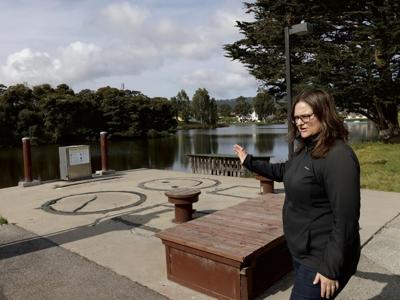

As winter rains caused Monterey County’s rivers to swell past capacity and rush out to the sea, people began asking: Isn’t there a way to catch and reuse all that water? That’s what Monterey is preparing to do through a project financed by the state – in this case turning runoff lost to Monterey Bay into drinking water.
The Lake El Estero Diversion to Sanitary Sewer Project will reroute drainage from the city stormwater system at the lake into existing sanitary sewage pipes along Del Monte Avenue, which lead to Monterey One Water’s regional treatment plant in Marina for recycling into drinking water as part of the Pure Water Monterey project. Currently, stormwater from the hills above Lake El Estero drains into the lake, and then untreated into the Monterey Bay National Marine Sanctuary. Once the project is completed, city officials estimate it will capture 100 to 173 acre-feet of water each year, depending on rainfall. (In theory, 100 acre-feet would serve 50 typical five-person households per year, according to the Water Education Foundation. Pure Water Monterey at its current size can produce 3,500 acre-feet of recycled wastewater per year.)
It’s a small project at just $1 million, but was deemed important enough by the California State Legislature, which approved the money in the 2022-23 state budget. It was a joint effort between Monterey One Water, the city and former assemblymember Mark Stone’s office to submit the project for consideration. The Monterey City Council voted on May 2 to accept the funding allocation. The city will pay upfront for planning, environmental review and construction to be reimbursed through the State Water Resources Control Board. It’ll take three years to get to construction in the fall of 2025, says Monterey Environmental Regulations Manager Tricia Wotan.
During the discussion on May 2, councilmembers alluded to such a project leading to water credits that in turn could give the greenlight to more housing, but it’s not clear yet if that’s a possibility, Wotan says: “We’ve got a lot to do before that would be on the table. Once we understand the potential for the range of water that can be recycled, then we can talk with our partners as to how much water is being saved.”
Originally in the plans for construction of the Monterey One Water plant, the Lake El Estero project was at one time dropped for further study, Wotan says. Now it’s been added back in. “It’s a small piece in the puzzle of Monterey One Water,” she says.


(0) comments
Welcome to the discussion.
Log In
Keep it Clean. Please avoid obscene, vulgar, lewd, racist or sexually-oriented language.
PLEASE TURN OFF YOUR CAPS LOCK.
Don't Threaten. Threats of harming another person will not be tolerated.
Be Truthful. Don't knowingly lie about anyone or anything.
Be Nice. No racism, sexism or any sort of -ism that is degrading to another person.
Be Proactive. Use the 'Report' link on each comment to let us know of abusive posts.
Share with Us. We'd love to hear eyewitness accounts, the history behind an article.