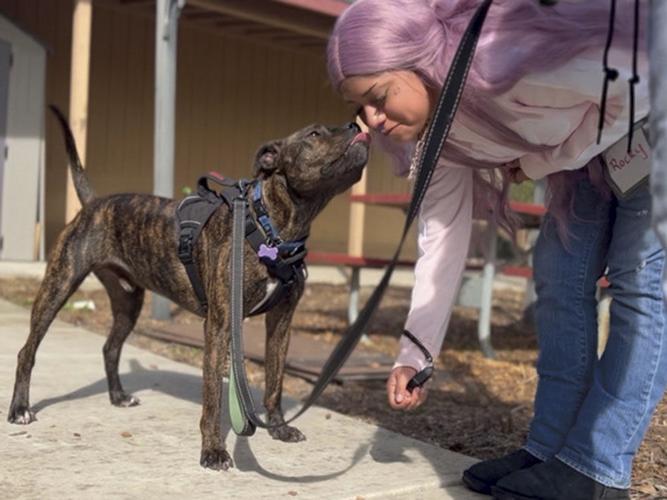



Those who organize the UnChained program, as well as those who participate, say that it benefits both humans and animals.
The success of UnChained can be measured several ways. Anecdotally, staff of the program point to testimony from participating youth, or to the fact that several alumni have returned to volunteer.
There is also data. Since UnChained was founded in 2011, they have had a 92-percent adoption rate for dogs.
There is another indication of success: “We get so many people asking for the program at their facility,” Executive Director Marlo Botello-Aepli says.
The concept is remarkable in its simplicity. Dogs and children can have a restorative connection. The St. Louis Children’s Hospital uses therapy dogs to help patient recovery. A study by the National Institutes of Health showed interacting with an animal improved a child’s sense of responsibility.
But what if it worked both ways? UnChained pairs dogs from shelters with at-risk youth who spend time training the animals and preparing them for adoption, under the supervision of experts. The youths absorb lessons such as setting and achieving goals, teamwork and empathy, while the dogs are freed from the trauma of a shelter and learn new behaviors.
“Part of our curriculum is humane education,” Botello-Aepli explains. “What does it take to be responsible for a dog? Their goal is to make sure the dog has a second chance. Everybody deserves a second chance.”
The nonprofit’s Big Idea is also simple: reach more children. In Monterey County, UnChained runs programs at Rancho Cielo Youth Campus and the Monterey County Youth Center. The organization plans to add an additional course at Juvenile Hall.
Each eight-week session pairs teams of two children with a dog. The structure of the Canines Teaching Compassion program emphasizes teamwork, development of new skills, patience and a sense of responsibility. But, Botello-Aepli adds, there is also a sense of accomplishment and compassion. At graduation, when dogs are handed off to new owners or foster homes, “there is not a dry eye,” she says.
Despite success, it remains a targeted program. The number of at-risk youth who have gone through UnChained is closing in on 400. Botello-Aepli would like to see that grow. “We’re the best-kept secret,” she says. “We have to change that.”



(0) comments
Welcome to the discussion.
Log In
Keep it Clean. Please avoid obscene, vulgar, lewd, racist or sexually-oriented language.
PLEASE TURN OFF YOUR CAPS LOCK.
Don't Threaten. Threats of harming another person will not be tolerated.
Be Truthful. Don't knowingly lie about anyone or anything.
Be Nice. No racism, sexism or any sort of -ism that is degrading to another person.
Be Proactive. Use the 'Report' link on each comment to let us know of abusive posts.
Share with Us. We'd love to hear eyewitness accounts, the history behind an article.