
In 1883, two years after he created Hotel Del Monte, railroad baron Charles Crocker facilitated the construction, near Cachagua, of the so-called Chinese Dam – the Carmel River’s first – which aimed to provide 400 acre-feet of water annually to his hotel.
The San Clemente Dam – which sought to provide water to the Monterey Peninsula – followed in 1921, and the Los Padres Dam, which was built in 1949 and is the only one left, sought to do the same.
Downstream, meanwhile, along the river’s banks, homes, ag fields and golf courses cropped up, encroaching on the river and narrowing its banks, sometimes with manmade fortifications. The result is a river that is tightly constrained and largely kept out of its historical floodplain except in years of deluge, a natural process that for adjacent property owners can be a disaster.
There is a plan in the works, years in the making, though not yet quite near the finish line: the Rancho Cañada Floodplain Restoration Project.
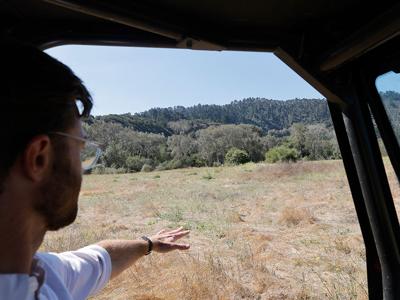
The project calls for widening and restoring the riverbed and banks where the river flows through a 40-acre, mile-long stretch of Palo Corona Regional Park through the section that was reclaimed from part of the Rancho Cañada Golf Course in a purchase facilitated by the Trust for Public Land, Trout Unlimited the Santa Lucia Conservancy and the Monterey Peninsula Regional Park District.
The idea behind the purchase – other than just creating more parkland for the public – was to “re-wild” the land, and as part of that, ensure there was a wildlife corridor from the Ventana all the way to Fort Ord.
It’s not just for wildlife with four legs. The restoration will help amphibians, fishes, and other creatures. Crews plan to propagate the re-formed banks with seedlings collected from about 30 species of native plants found along the river.
“This is going to be [a project] that people will sit up and take notice of all across the country,” says Christy Fischer, TPL’s conservation director of coastal Northern California. “It will be a spectacular gem in the watershed, a national stature project.” She ticks off a list of benefits: enhancing habitat and natural processes along almost a mile of river, lowering flood risk, increasing recreational opportunities and climate resilience.
Jake Smith, the park district’s planning and conservation program manager, agrees with Fischer’s assessment.
Final – so-called “100-percent” – plans are still being detailed, and Smith says the district has about $30 million in grant applications outstanding that will help pay for it all. He is optimistic about applications pending before the National Fish and Wildlife Foundation and the Wildlife Conservation Board, but says the district has backup grants planned in case those fall through, and still expects, or at least hopes, construction will start sometime next year.
“It’s a major legacy project for the community,” he says, adding a phrase oft-heard in land restoration and conservation circles: “It’s like a relay race, and people are handing off the baton.”



(0) comments
Welcome to the discussion.
Log In
Keep it Clean. Please avoid obscene, vulgar, lewd, racist or sexually-oriented language.
PLEASE TURN OFF YOUR CAPS LOCK.
Don't Threaten. Threats of harming another person will not be tolerated.
Be Truthful. Don't knowingly lie about anyone or anything.
Be Nice. No racism, sexism or any sort of -ism that is degrading to another person.
Be Proactive. Use the 'Report' link on each comment to let us know of abusive posts.
Share with Us. We'd love to hear eyewitness accounts, the history behind an article.