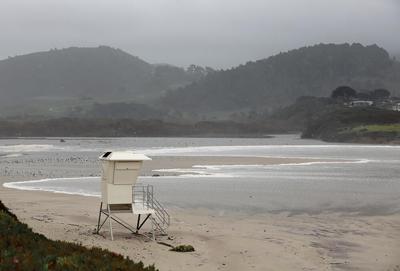

As parts of the Carmel Valley flooded last week, it highlighted the stark risks of living in a floodplain, and for some residents, perhaps, was a reminder that they indeed live in a floodplain. But for residents and businesses in lower Carmel Valley, there is hope that in the future those risks will be less.
Since 2010, Big Sur Land Trust has been working on a “green infrastructure” project called Carmel River FREE (Floodplain Restoration and Environmental Enhancement) that would restore a former agricultural field in a natural floodplain that would give the river another path to the sea when its flows get high. The 128-acre property, known as Odello East, was donated to BSLT by Clint and Margaret Eastwood. It is located south of the river and just east of Highway 1.
“With these atmospheric rivers we’ve all been experiencing, it’s a very vivid reminder, and a painful reminder, of the need for a green infrastructure project like this,” says Rachel Saunders, BSLT’s director of conservation. “We hope all the agencies get a renewed sense of urgency to get this project to happen.”

The County Board of Supervisors approved the project’s environmental impact report in 2020, and all the necessary state and federal permits have since been obtained. What’s holding it up now is the finalization of an environmental review by the Federal Emergency Management Agency, which is necessary if the county – the lead agency for the project – wants to obtain a $25.3 million grant from FEMA to help fund it. Saunders estimates it will cost about $56 million in total, a number that has risen due to inflation.
Shandy Carroll, a planner who is managing the project with the county, says that while there’s already a federal environmental review, FEMA requires doing its own before awarding grants.
Carroll feels confident the county will get the FEMA grant, and if it does, that the project will essentially be fully funded. “If not, we’ll find funds for the rest of the project as needed,” Carroll says, adding that FREE has had strong support from the outset. “When we’ve asked for help, we’ve always received it.”
FREE will work like this: Where the river flows westward, south of Rio Road and east of Highway 1, parts of the existing levee on its southern bank will be removed, giving high water another place to go. Presently, when the river gets above a certain height, it jumps its northern bank, flooding homes and businesses near Rio Road. The river didn’t breach there in the recent storms, but Saunders adds, “If it had kept raining for another day at the same rate, that was certainly a strong possibility.”
The project will be built in two phases. The first is grading the field east of the highway, carving some channels into it and planting native plants. The fill created by the construction will then be piled up on the southern part of the field to create an agricultural preserve, elevated high enough to be out of the 100-year floodplain.
The second phase involves constructing a causeway under the highway, where the floodwaters will flow into the Carmel River Lagoon.
“It’s complex and has been more challenging than we would like to get this going,” Saunders says, “but we are hoping there will be a renewed sense of urgency right now.”


(1) comment
Building on low ground is always problematic. Hopefully this will help. Perhaps bringing back the beavers, too. https://baynature.org/article/beavers-used-to-be-almost-everywhere-in-california/#:~:text=The%20Wappo%20in%20Sonoma%20called%20them%20%E2%80%9Cma%E2%80%99-nah%20ow%E2%80%99-we%2C%E2%80%9D,In%20short%2C%20they%20were%20trapped%20out%20of%20existence.
Welcome to the discussion.
Log In
Keep it Clean. Please avoid obscene, vulgar, lewd, racist or sexually-oriented language.
PLEASE TURN OFF YOUR CAPS LOCK.
Don't Threaten. Threats of harming another person will not be tolerated.
Be Truthful. Don't knowingly lie about anyone or anything.
Be Nice. No racism, sexism or any sort of -ism that is degrading to another person.
Be Proactive. Use the 'Report' link on each comment to let us know of abusive posts.
Share with Us. We'd love to hear eyewitness accounts, the history behind an article.