
Josh Frost was born into rodeo.
Both his father and grandfather competed on the Professional Rodeo Cowboys Association circuit. A great uncle was part of the first-ever National Finals Rodeo lineup. Joe Frost – his brother – has qualified for Las Vegas three times.
As for Josh, he finished at the top of the Wrangler NFR standings in 2021 and entered the current season ranked as the world’s number-two bull rider.
“I never remember wanting to do anything different,” Frost says in a nonchalant tone.
Rodeo is both sport and lifestyle. The riders are athletes versed in skills unusual to the urban experience. The sport plays at dusty arenas in wide-ranging locations – Cheyenne, Moab, Wahoo – with distant titles like the National Western Stock Show and Rodeo or the California Rodeo Salinas. And there are expectations of cowboys and cowgirls, codes of dress, demeanor and respect that permeate the pens and chutes, as well as the stands.
Hollywood helped establish the Wild West cowboy as a parable of rugged individualism with unique virtues and justifications for action. Western films condensed grueling, dangerous drudgery into captivating moral tales based upon characters writ larger than life.
The main character in the Outlaw Josey Wales sets off to settle a score, only to find there are scars to be healed on almost everyone.
In The Searchers, the thirst for revenge cannot be sated until a glimmer of humanity breaks through. Destry Rides Again has a sheriff trying to do right without harming others, until the code is broken and he must act. Fort Apache is a moral epic, Unforgiven plays out when codes are taken too far. From the 1930s through the ’50s studios churned out “B-Westerns” and serials. The genre spilled over into comedy, with titles like Rustlers Rhapsody and Blazing Saddles.
When it comes to rodeo, however, movies have been far less forthcoming. In a paper presented to the 1990 National Cowboy Symposium and Celebration in Lubbock, Texas, Jim Hoy noted “of the thousands of film Westerns made, only a handful depict rodeo even tangentially, and fewer than 10… could legitimately be called ‘rodeo’ movies.”
Westerns could easily pit good against bad, even when – as in The Good, The Bad and The Ugly – the concepts were blurred. But rodeo is family. There are no clear protagonists and antagonists, just professionals sharing in the lifestyle.
“We all want to win, but we all want each other to do well,” Frost explains.
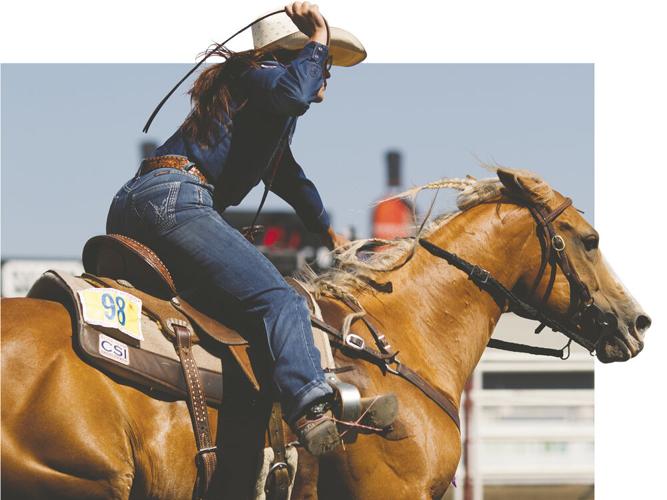
Rodeo is a series of distinct competitions. Bull riding and saddle bronc set a rider in a dance in opposition of an animal. The rider anticipates moves, swerving one way an instant before the animal twists the other. It’s rhythmic discord that is over before cinematic drama can develop. Roping events play out a quick choreography, precise and thundering at the same time. Barrel racing asks rider and animal to combine power and agility.
These are not easy concepts to adapt to the big screen. So instead of featuring riders, film directors tend to use rodeo as a setting. On the hunt for a criminal, 1934’s The Man from Utah finds John Wayne going undercover at an arena. In the 1979 comedy-drama The Electric Horseman, Robert Redford plays a retired rider who rescues an abused horse. Rodeo is the backdrop.
Hoy cites three rodeo-based films that appeared in the 1950s, at the height of the Wild West movie craze: The Lusty Men, Bronco Buster and Arena. Four more movies hit the big screens in 1972, including J.W. Coop. But in Hoy’s opinion, these are riddled with inaccuracies and cliches.
Even in the best of them, Frost agrees, “those eight-second rides seem to last 25 seconds, and the bull changes color.” At its worst, Hollywood is careless of details. In When Legends Die, a character learns to ride on one type of saddle, turns to another in the chute and then finishes the same competition back on the original. Riders switch hands on the reins. Even the order of events is of no importance to some directors, who throw roping and saddle bronc, barrel racing and bull riding out on a seeming whim.
Even in some of the more renowned rodeo films, they misplay the lifestyle. In the iconic 8 Seconds, for instance, a barrel racer complains about bull riders and their aloof attitudes toward others. Hang out at a rodeo and speak to the riders, however, and you see a completely different face.
“We’re all approachable,” Frost says. It’s a world where greetings like “sir” or “ma’am” are common. “I love it when a kid climbs the fence to ask questions.”

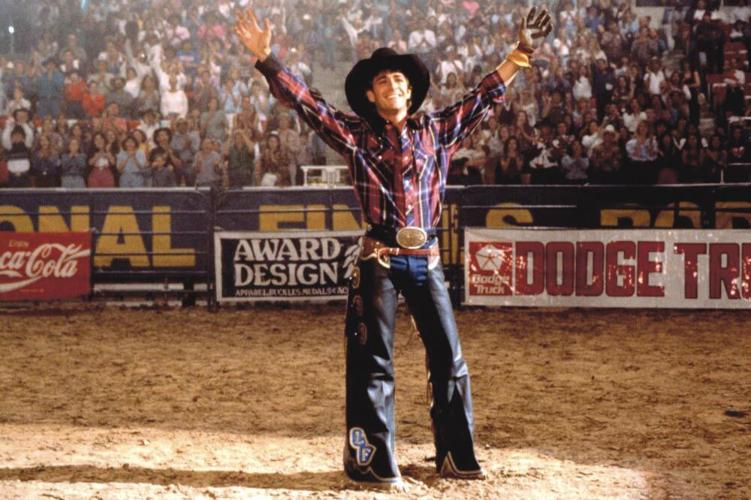
Luke Perry as Lane Frost in 8 Seconds, the first rodeo film to truly capture the public imagination.
The time – eight seconds – is the span a bull rider must hang on in order to score full points. It’s also the name of a film released four years after Hoy aired his complaints.
Josh Frost is second-cousin of the legendary Lane Frost. He never had the opportunity to meet the Hall of Famer, former world champion and five-time NFR qualifying bull rider. Josh was born too late.
At Cheyenne Frontier Days in July of 1989, Lane Frost held on to his bull for the full eight seconds and then bailed off its back safely and huddled in the dirt. But the bull whipped its head, cracking its horn across Lane’s back, shattering some ribs. He rose, stumbled and fell to the dirt. The impact reportedly caused broken bones to slice through Lane’s lungs.
Luke Perry played Lane Frost in the 1994 cinematic telling of his story. Although critics panned 8 Seconds, the focus on his big personality and the cowboy lifestyle – the camaraderie on the road and in the arena – caught the attention of audiences.
“There are a pile of riders out there who got interested in rodeo because of the movie,” Josh Frost points out. “It’s cool to see.”
In tragedy there can be nobility. The film gave a glimpse into the lifestyle of rodeo – weeks on the road, little hotels and arenas, personal bonds – sacred only to those in the game.
Since 8 Seconds, rodeo has played a role in several features. “The Cowboy Way is pretty fun,” Frost says. “The Longest Ride is a little more up to date.”
In The Longest Ride, Scott Eastwood trained with professional bull riders to achieve the look. Real cowboys were on the bulls for action scenes. And that’s what has given more recent films an appearance of reality. The Rider stars actual rodeo athlete Brady Jandreau. Frost and his brother did stunt work for the Mark Wahlberg film Joe Bell. And he’s generally impressed by what he’s seen.
“I give Hollywood a good grade,” Frost admits. “People who do good movies, they do their research. It’s cheesy sometimes, but the ones I’ve seen are pretty good. Maybe the ones I haven’t seen are terrible.”

(1) comment
ENUF WITH THE RODEO PROMOTIONS, AWREDDY!
Rodeo is condemned by EVERY animal welfare organization in North America
due to its inherent cruelty. For most of these abused creatures the rodeo
arena is merely a detour en route to the slaughterhouse.
Rodeo has almost NOTHING to do with agriculture or life on a working
ranch, it's mostly hype. REAL cowboys/girls never routinely rode
bulls, or wrestled steers, or rode bareback, or barrel raced, or practiced
calf roping (babies!) as a timed event. Nor did they put flank straps on
the animals, or work them over in the holding chutes with painful
"hotshots," kicks and slaps.....Some "sport"!
Indeed, rodeo is not a "sport" at all. It's a macho exercise in
DOMINATION, and it needs to end. LEGISLATION IS IN ORDER. The United
Kingdom (England, Scotland, Wales) outlawed rodeos back in 1934; Germany
and the Netherlands have since followed suit. Can the U.S. be far behind?
Rodeo has had its brutal day and now--like those Confederate statues--
belongs in the Dustbin of History, R.I.P.
Welcome to the discussion.
Log In
Keep it Clean. Please avoid obscene, vulgar, lewd, racist or sexually-oriented language.
PLEASE TURN OFF YOUR CAPS LOCK.
Don't Threaten. Threats of harming another person will not be tolerated.
Be Truthful. Don't knowingly lie about anyone or anything.
Be Nice. No racism, sexism or any sort of -ism that is degrading to another person.
Be Proactive. Use the 'Report' link on each comment to let us know of abusive posts.
Share with Us. We'd love to hear eyewitness accounts, the history behind an article.