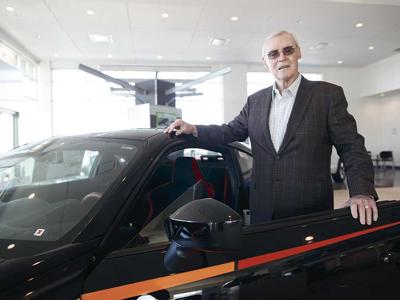

In 1982, Peter Blackstock bought the Leslie Motors car dealership (which had opened in 1965) and changed its name to Victory Toyota. Victory was a good name. So was Toyota… eventually.
Blackstock had come to California from the East Coast, where he worked for Ford Motor Company after getting out of the military, intending to buy a Chevy dealership. But the bank loan manager suggested he might make a deal with Leslie Motors. And he did.
“[The early years] were very interesting,” Blackstock says. “Toyota was coming along. But we were limited in what we could sell.”
There were legislative quotas on the number of imports: “We had to go fight a lot of battles in Washington because the domestics just wanted to get rid of us.”
Plus, in the 1980s there was reactionary backlash against Japanese automakers. But demand for the cheaper, more reliable and more fuel-efficient Japanese cars was climbing. As Toyota’s reputation and quality grew, so did Blackstock’s dealership. Today the business comprises new cars, used cars, service, parts and financing.
“Try to find what the customer wants, what their needs are, how they want to be taken care of, and you try to get people in there that can do that,” Blackstock says when asked about his formula for success.
When the economy crashed in 2008, one of Victory Toyota’s neighboring competitors didn’t survive. Blackstock bought that lot, doubling the footprint of his own business. He built a 50,000-square-foot facility for the dealership’s showroom and offices. They occupy 5.2 acres in Seaside’s Automall (they like to have 300 to 350 vehicles in inventory), employ 160 people, and estimate they’ll sell 1,200 to 1,300 new vehicles, 500 used vehicles and do $90 million in revenue this year.
“If I look at where I started in the business and how it’s progressed over these years,” Blackstock says, “it’s a completely different ballgame.”
They’re selling just about every model Toyota manufactures, including hybrids and electrics. But there’s been a cycle.
“We’re back now in the truck busness,” he says. “It used to be 65-percent cars, 35-percent trucks and SUVs. It’s completely flipped.”
He attributes their longevity and growth to relationships – with the customer, the manufacturer, each other and the community. In the future, Blackstock sees bigger stores and more reliance on digital and internet technology, but the relationships, he says, will remain.

(0) comments
Welcome to the discussion.
Log In
Keep it Clean. Please avoid obscene, vulgar, lewd, racist or sexually-oriented language.
PLEASE TURN OFF YOUR CAPS LOCK.
Don't Threaten. Threats of harming another person will not be tolerated.
Be Truthful. Don't knowingly lie about anyone or anything.
Be Nice. No racism, sexism or any sort of -ism that is degrading to another person.
Be Proactive. Use the 'Report' link on each comment to let us know of abusive posts.
Share with Us. We'd love to hear eyewitness accounts, the history behind an article.