
THERE IS A CERTAIN BENEFIT TO A TRULY SHORT PIECE OF FICTION.
Tackling a novel requires commitment – finding a block of time here or an evening there, waiting for plot lines to develop. Lose interest midway through and you’ve tossed away several hours of your life.
Condense the tale – significantly – and the advantage becomes evident. “It could be the worst story you’ve ever read, but it’s over in 30 seconds,” explains Scotty Cornfield.
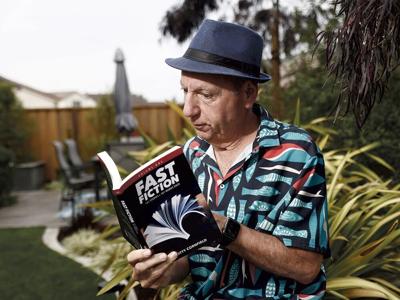
Inspired by the Weekly’s annual 101-Word Short Story Contest, Cornfield has published Fast Fiction, a collection of micro novels – 101 stories, each playing out in exactly 101 words.
The opening tale follows a homeless man nicknamed Shakes who finds a key fob to a Mercedes, and by chance (and with a little button pushing) locates the car and then drives away “like he owned the thing.” That is not how it ends – and really, the final line amounts to a beginning. Something of consequence will happen next, but the author can’t take you there. The 101st word, “trunk,” leaves readers in an unusual place: hanging, but having finished a complete thought.
Fast Fiction’s 101st story tells of a street where, for reasons scientists have yet to determine, all the resident children are surprisingly ignorant. The piece, as well as the book, ends on “They would have – if someone had explained the joke.”
Cornfield says 101-word fiction works when the author can stick the point quickly and leave enough space for readers to fill in the blanks. It’s much like the legendary bet that had Ernest Hemingway sketching out a six-word story: “For sale: baby shoes. Never worn.” Fortunately, in the 101-word format, writers can ease off the terse staccato and include dialogue.
An exchange in Cornfield’s “Reality Check” sets up for an ending that may or may not be expected:
“How can I help this time?” he asked Tony.
“I come to you, Don Romano, seeking your wise counsel, as I have done many times before.”
Spoiler alert: This particular bit has no mafia ties. But Cornfield has plenty of experience with crime and the underworld. He spent 28 years with the San Jose Police Department, working homicide cases, abuse cases and even in deep undercover assignments – a background that gives him plenty of material to draw from.
Yet somehow he managed to fit other careers into his schedule. Cornfield has written screenplays, ran a production studio (America’s Most Wanted was a client, fittingly), dabbled in print and television journalism and took to the stage as part of an improv troupe.
“I have never experienced boredom,” Cornfield says with a smile.
But it was his law enforcement work that introduced him to 101-word stories. In Carmel one winter, while teaching a course on interrogation techniques to a gathering of officers, Cornfield happened upon a copy of the Weekly.
The notion of teasing out a complete story on such a tight word budget intrigued him enough that he entered a few writeups – and did it again the next year, as well as the year after.
“I was just winging it,” Cornfield says of his initial effort. “Last year all three stories were published. Every year I’ve gotten progressively better.”
The annual contest is judged by a team at the Weekly. In a typical year, more than 300 entries reach the judges by deadline. Three earn prize money and about 30 are deemed worthy of publication.
While Cornfield hasn’t won – yet – being selected for print several times over is testament to the effort he now puts into the craft. “I totally got hooked on it,” he says. “Eventually I decided, ‘I’m going to do this every day.’ I feel really bad when I can’t do it.”
Since deciding to downsize, Cornfield has produced around 500 pieces of 101-word fiction. Each day he receives prompts from friends, words or phrases to trigger some thoughts. On a Friday morning at the end of September, he was wrestling with the prompt “antagonistic rodent.” Cornfield carries a digital recorder to capture ideas before they disappear. He has developed a comfortable routine, each morning selecting from the list of prompts then taking his dog for a walk while verbally brainstorming into his recorder – which must leave any passers-by curious, but it’s a helpful process.
“Most of the time when I sit down, I know where I’m going with it,” he explains. “Sometimes I kill a lot of brain cells to find a way in.”
There are two challenges present. One is familiar to all fiction writers, and that is devising a plot and filling it with appropriate characters and settings. The other is also familiar, but becomes more diabolical when the word count is so tight.
Being too descriptive can easily bog a story down. So editing – and recognizing a few grammatical tricks – is crucial.
“The first casualty is adjectives,” Cornfield points out. “Adjectives are my enemy, contractions are my friend.”
The Fast Fiction author makes no secret of his passion for the format. Even on the cover of his book, the phrase “Volume One” rides above the title, a promise of more to come.
To borrow from a line in one of Cornfield’s 101-word stories: “Unconventional? Perhaps. True love? Absolutely.”


(0) comments
Welcome to the discussion.
Log In
Keep it Clean. Please avoid obscene, vulgar, lewd, racist or sexually-oriented language.
PLEASE TURN OFF YOUR CAPS LOCK.
Don't Threaten. Threats of harming another person will not be tolerated.
Be Truthful. Don't knowingly lie about anyone or anything.
Be Nice. No racism, sexism or any sort of -ism that is degrading to another person.
Be Proactive. Use the 'Report' link on each comment to let us know of abusive posts.
Share with Us. We'd love to hear eyewitness accounts, the history behind an article.