

THE AT&T PEBBLE BEACH PRO-AM DOES NOT MAKE A PROFIT.
Close to 200,000 spectators file through the gates. There is a title sponsor, 60 secondary sponsors, beers, wine and cocktails downed at the event’s many party pavilions. To enter Palmer’s Club 18, one must shell out $1,000. To be an Honorary Observer and peek inside the ropes, that’s $4,000.
But after everything is tallied, the $30 million or so collected by the Monterey Peninsula Foundation as a reward for operating the event is gone.
It may not be well known outside of golf circles, but tournaments under the PGA umbrella – including the Pro-Am – are fundraisers operated by nonprofit organizations. In fact, the PGA has raised more money for charity than all other professional sports in this country combined.
And with the 2022 event, Pebble Beach will pass the $200 million mark in philanthropic giving since the tournament moved to the area in 1947 – the first on the PGA Tour schedule to reach that figure.
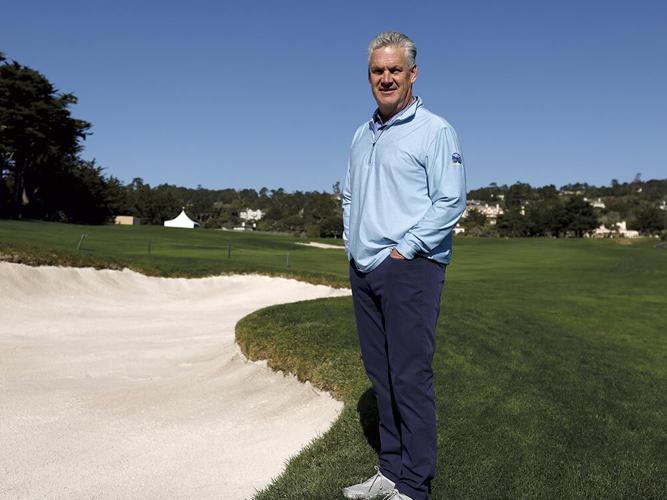
“Isn’t that crazy?” says Steve John, CEO of Monterey Peninsula Foundation, the nonprofit responsible for putting on the Pro-Am. The organization topped $100 million for charity in 2012. John, who was new to the position at the time, recalls being prodded on raising the next $100 million, but it didn’t seem believable: “I jokingly said 10 years. It shows you the support we get is remarkable.”

Steve John, CEO of the Monterey Peninsula Foundation, says of the annual fundraising effort “the machine we built is sustainable.” He expects amounts to increase.
PLAYING THE FIELD
Through the Pro-Am and a second professional golf event, the Pure Insurance Championship, Monterey Peninsula Foundation raises money which is then distributed to more than 200 other nonprofits in Monterey, Santa Cruz and San Benito counties. Recipients include large operations like the Monterey Bay Aquarium down to focused groups like Girls’ Health in Girls’ Hands.
The tour tournaments combined for a pool of $12.2 million in grant money in 2020. Because fans and amateurs were not allowed due to Covid-19 in 2021, the amount dropped to $10.8 million. But the foundation can expect to distribute between $10 and $15 million each year.
“It’s such an amazing investment in the community,” says Gabriela López-Chávez, director of Loaves, Fishes & Computers, a nonprofit that started 12 years ago in a Salinas garage and now has eight staff and can call on more than 200 volunteers. Loaves is committed to improving digital fluency by providing low-income families with computers and computer literacy courses. They were able to distribute more than 2,500 devices during the height of the pandemic’s first wave alone.
They are the tournament’s featured nonprofit this year, which means some television time. “That will help us get our message out,” López-Chávez adds.
John refers to the foundation as a machine. While there are many parts – lining up celebrities, overseeing construction of pavilions and stands, marketing, attracting sponsors, sorting through grant applications and so on – everything meshes smoothly and grant money can be dispersed as quickly as it is needed.
A Play-Doh machine is his more precise analogy. A significant lump of money is fed into the foundation, which turns the crank, pushing many smaller portions back out into the local market.
The largest amounts paid into the foundation’s coffers are from the title sponsor, AT&T, and 60 secondary sponsors. Ticket sales – including for places in the party pavilions – contribute more than $1 million. And amateurs pay a fee to participate.
That Covid-19 didn’t put too much of a dent on fundraising in 2021 is due the sponsors and amateurs. When the foundation decided just a few weeks before last year’s event was scheduled to tee off to allow only a professional field, all 156 amateurs elected to contribute their fee. AT&T paid in full, as did many of the other sponsors.
“That’s incredible,” observes Jeannette Tuitele-Lewis, president and CEO of the nonprofit Big Sur Land Trust. “That speaks to the long philanthropic effort that’s supporting the community.”
Monterey Peninsula Foundation was instrumental in helping the land trust launch its youth outdoors program, as well as starting the process of creating a park at Carr Lake in Salinas. The foundation has also aided the organization on several other projects over the past three decades as they sought to conserve forests, dunes, grasslands and other lands.
“We’re lucky,” Tuitele-Lewis says, offering congratulations for the $200 million milestone. “A lot of regions don’t have a [Monterey Peninsula] foundation.”
Or a PGA Tour stop, for that matter.
Through fundraising efforts of the PGA Tour, the PGA Champions Tour (formerly the seniors tour) and the Korn Ferry Tour (like a minor league), the organization reached the $3 billion mark six years after crossing the $2 billion line. That was in 2014. The tour first made its charitable mark in 1938 at the Palm Beach Invitational, which raised $10,000.
The AT&T Pebble Beach Pro-Am began as a bit of golf with a clambake hosted by crooner Bing Crosby at Rancho Sante Fe in 1937. After taking a break for the duration of World War II, Crosby moved the event north and renamed it the Bing Crosby Pro-Amateur Golf Championship, starting the unique format.
Crosby died in 1977 – fittingly or ironically on a golf course. AT&T became the tournament’s title sponsor in 1986.
In fundraising terms, PGA tournaments operate differently. The Waste Management Phoenix Open, for instance, developed a stadium around the 16th hole, where a party atmosphere rules – fans heckle players who miss the green; golfers enter the arena throwing gifts to the crowd (once including raw red meat) – and skybox seating tops $50,000.
Events like the one in Phoenix, which follows the AT&T this season, donate receipts to several local charities. Others, such as the WGC FedEx St. Jude Invitational in Memphis, provide for a single purpose – in this case helping support the St. Jude Children’s Hospital.

Jeannette Tuitele-Lewis is president and CEO of Big Sur Land Trust, one of some 200 nonprofits that benefit from the Pro-Am. “There is so much need,” she says. “We all benefit.”
LOW SCORE
However, some watchdog groups are less than impressed by the numbers. The tour made its shift to the nonprofit format in the 1970s and did not reach $1 billion in charitable giving until 2005. Following a 2013 investigation by ESPN’s “Outside the Lines,” the network’s Paula Lavigne chastised the PGA, writing “that philanthropy has been bolstered by millions of dollars of annual tax breaks for the PGA Tour and its tournaments, which often are run by charities that spend far more on prizes, catering and country clubs than they do on sick kids, wounded vets or economic development.”
The investigation found that the tour events averaged donating just 16 percent of revenue toward charities. Those who cry foul draw the line at 65 percent before an organization can be labeled a responsible nonprofit. Writing in Golf, Paul Sullivan noted that the 2016 Phoenix Open took in $48 million but distributed just $8 million, according to tax filings.
Tax filings for the fiscal year ending in June 2020 show that the Monterey Peninsula Foundation reported revenue of $38.8 million, the overwhelming majority from the AT&T Pebble Beach Pro-Am ($29 million) and Pure Insurance Championship ($7.5 million). They issued grants totaling $12.3 million, or 31.6 percent of revenue.
But golf tournaments carry tremendous overhead. Out of the haul of money coming in they must pay salaries – a modest $1.9 million, benefits included, for the foundation, where John is the highest paid employee at $330,000 a year – construction and removal of stands, leaderboards and pavilions. There are equipment rental costs, trash and recycling removal, insurance and many other expenses, including prize money paid to golfers who make the Friday cut.
It is, after all, a golf tournament. This year the purse is staked at $8.7 million, with more than $1 million going to the winner on the pro side.
Proponents note that big events compensate by bringing people and important outside money to feed the hospitality and retail industries, boosting tax revenue. Staff of organizations like Monterey Peninsula Foundation are tasked with operating massive golf tournaments in addition to philanthropic institutions. There’s also the $200 million that might not have otherwise reached local nonprofits.
“This year all donor support was significant,” López-Cháves says. With Covid and its variants rampant, volunteers became scarce. “The need was great. We did take a hit.”
PLAYING THROUGH
At the low point of their funding a year ago, after a Pro-Am without amateurs or fans, the foundation was forced to dedicate grants to the most immediate needs. This time around John expects a sellout and full coffers. “Ticket sales have gone crazy,” he says. “People are tired of doing nothing.”
The foundation fulfills the grant requests of 200 organizations, but they focus on five categories. One is to help the regional arts and culture scene, where facilities like Sol Treasures, a King City arts education group, benefit. They also earmark funds for community services and environmental protection. Funding for the Food Bank for Monterey County or the Coastal Watershed Council are examples.
The other funding focal points are education, health and youth. First Tee is a partner, and some of its members take part in the Pure Insurance Championship with PGA senior golfers.
“All of the tournaments focus on their strengths,” John explains. “We found a sweet spot in our celebrity-amateur field.”
John believes that success can be generated through a solid team. The board of directors, who volunteer for the role, includes such celebrity heavyweights as Clint Eastwood, Peter and Heidi Ueberroth, and a cast of business leaders. Of the 1,600 or so volunteers needed to assist with the actual event, many are seasoned.
“I’ve worked different booths with my daughter,” Tuitele-Lewis says. “Volunteers, that’s what it takes.”
The team tries to line up new attractions – Clint’s Saloon, for instance – and celebrities, without upsetting the quality of play.
“If we have the same people playing year after year, fans might lose interest,” John points out. “What’s going to move the needle? Relevant celebrities, people you wouldn’t expect.”
Rapper ScHoolboy Q is in this year’s lineup, as is Los Angeles Dodgers star Mookie Betts. Boxer Canelo Álverez will see if he can make the cut, along with Pro-Am regulars like Bill Murray, Ray Romano and Steve Young (see story, p. 30).
“I inherited a very successful model,” John says. “We’ve attracted a strong team. We all love what we do at the tournament.”
They must. Distributing funds is a stroll compared to the behind-the-scenes tempest of a golf tournament. They’ve dealt with power cutting out before hitting the save button and erasing all of the tournament’s updated information, a truck flailing uselessly in mud blocking the exit, a fan calling to ask if their “service monkey” was allowed on course. (No.)
John’s routine, once the celebrations are over and the course has emptied of players and fans, is to settle into a nice wine and good cigar.
“In mid-December, you forget about normal work days,” he says. “When we’re done with tournament week, we’re exhausted.”





(0) comments
Welcome to the discussion.
Log In
Keep it Clean. Please avoid obscene, vulgar, lewd, racist or sexually-oriented language.
PLEASE TURN OFF YOUR CAPS LOCK.
Don't Threaten. Threats of harming another person will not be tolerated.
Be Truthful. Don't knowingly lie about anyone or anything.
Be Nice. No racism, sexism or any sort of -ism that is degrading to another person.
Be Proactive. Use the 'Report' link on each comment to let us know of abusive posts.
Share with Us. We'd love to hear eyewitness accounts, the history behind an article.