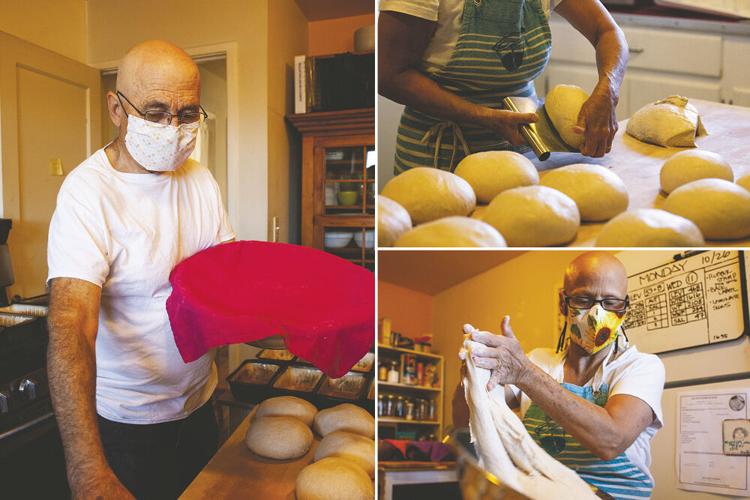


Cathy and Robert Lewis have been married for eight years, and for a year have baked full-time together. Cathy sees it as a metaphor: “Baking is a relationship. You have to let it be what it is, and honor the process. It has a gift. You need to see the gift, and let it be the best it can be.”
For Cathy Lewis, it began with a bread that tasted unlike any other bread she’d ever eaten. A friend of hers, Anina Marcus, had been baking sourdough loaves and intermittently selling them as Ye Olde Highlands Bakery Shoppe. Lewis bought a loaf, and bread was never the same.
“It was a revelation,” Lewis says. “Her bread was astounding. We ripped it open and ate it. It was a meal. That’s what sparked it for me, to realize bread is not just a side – it was originally essential and people depended on bread.”
The way Lewis and her husband, Robert, came to be defined as essential workers in the food industry who make their living as sourdough bakers began less with a spark of culinary inspiration than a business idea. They had relied on Airbnb income, and then the city of Monterey cracked down on short-term rental rules. About three years ago they were looking for an alternative income stream when they were in San Francisco at the celebrated Tartine Bakery, where Robert decided to approach a baker on Cathy’s behalf.
“I said, ‘Do you sell your starter?’ He said no, and he was very gruff. I said, ‘Can you give me some?’ He comes back a few minutes later with a pint of this precious starter. My words to Cathy were, ‘Here’s your big opportunity, you can’t waste this starter.’”
She did not waste the starter.
She got a cottage food license, and started baking. Robert started marketing. This fall, the couple passed their 20,000-loaf mark under their Pure Bake label (and that accounts for only about half of what they’ve baked). They sell wholesale only, to a few small grocery stores (Jerome’s in Carmel Valley, Grove and Andronico’s in Pacific Grove, Cornucopia in Carmel) and one cafe (Captain+Stoker). They both now make a living as full-time bread bakers in their Monterey home kitchen. Their bread is mildly sour, the texture chewy and doughy.
Cathy had more than eight years of professional baking experience on her side; Robert had none, but she taught him – he took over as the primary baker when she went to work at another job.
“Baking sourdough is a full-body skill,” Robert says. “You’ve really got to be sensitive with your body to the whole process – the heat in the oven, the smell, the touch. Now it’s just second nature.”
These days, the Lewises bake together, producing 60-80 loaves per day starting at 4am. By 8am, Robert leaves to deliver fresh-baked bread, while Cathy preps for the next day’s loaves. And the orders keep coming in.
“It’s been like this business chose us,” Cathy says. “It took off in spite of what we did. Every so often we have to giggle about the whole thing.”
ANOTHER THING the Lewises giggle about is that early in the pandemic, there was a rush on flour. They were accustomed to buying 400 pounds a week from Costco, and all of a sudden there was a limit on the basic staple and it was hard to find.
“There was this big rush on flour for a couple of months,” Cathy says, then flour was easy to buy again. “My theory was that people found out how difficult it was.”
Yes, sourdough baking surged in popularity early in the pandemic. For some home bakers though, it has not gotten too difficult – they’ve become masters.
After Chelsea Belle Davey, who lives in Carmel Highlands, was laid off from her job at Sierra Mar restaurant early in the pandemic, she started experimenting with four different types of flour. “It was full mad scientist mode in the beginning,” she says. “I don’t know if it’s my location that gave me a really active starter.”
Feeding her starter and baking became part of a pandemic ritual oriented around making food: Wake up, make coffee, feed the starter, tend to the garden. “It just became this really comforting thing to work on,” she says.
By April, she was going through 50 pounds of flour a month. She would use her sourdough starter to make bread, but also carrot cake, hamburger buns, pretzels, cookies, muffins, cinnamon rolls. Her failures were fun, too – she describes tossing a couple of unrisen, heavy loaves like frisbees from the deck.
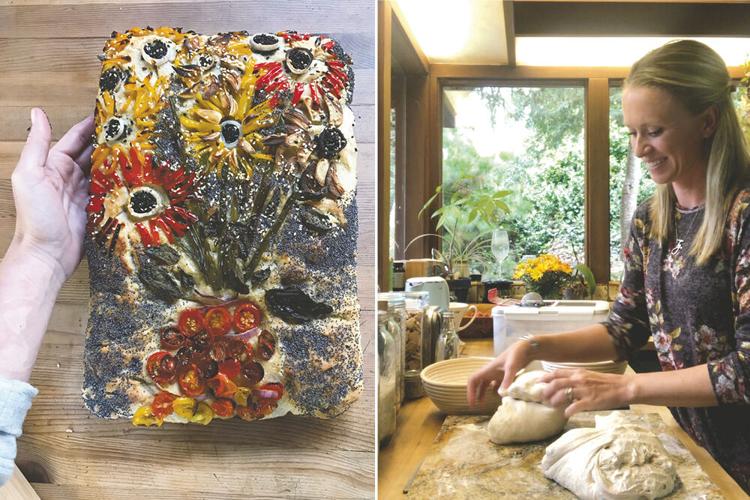
But mostly, she succeeded at her baking craft. And then she got fancy. Davey, an artist uses herbs and flowers from her garden to decorate focaccias as if they are a canvas, composing bouquet images out of sprigs of rosemary, leaves of basil, slices of tomato.
Even as she gets more ambitious, she starts almost every day with a piece of toast for breakfast. “I’m happy with just the OG sourdough,” she says.

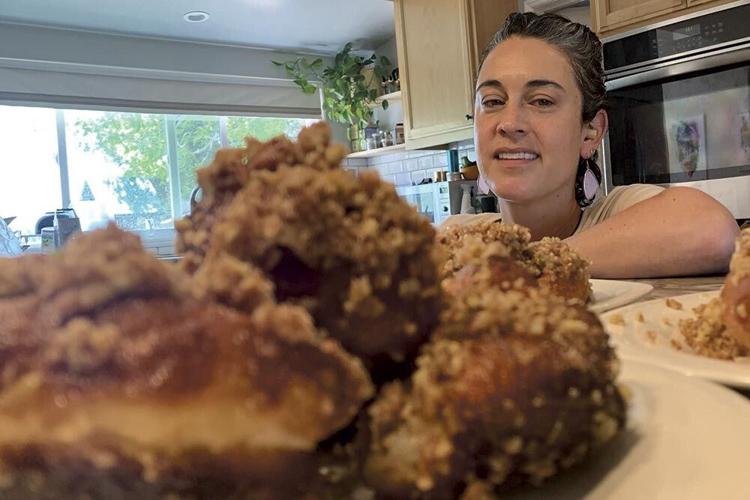
Panni made beignets, which she says looked better than they tasted: “Next time I’ll skip the fancy glaze and use powdered sugar.”
DAVEY KNOWS SHE IS THE PANDEMIC SOURDOUGH CLICHE. Part of how she knows is that she was invited to join a group (virtual, of course – it’s on Facebook) called the “Secret Sourdough Society” for swapping tips and recipes, and going on bulk flour purchases together. “When I got added to the Secret Sourdough Society, I was like, ‘I made it,’” Davey says.
There were about 35 members at the time. Now there are 169. They post occasional photos of baking fails, but mostly of exquisite creations – baguettes, bagels, English muffins, pizza. “We are now in the maple-pecan-lemon-glazed sourdough beignet phase of lockdown,” Kera Abraham Panni posted back in May.
Panni was already baking sourdough bread pre-pandemic, but she’s invested more time and energy than ever refining her baking skills. “It offers comfort and control when in the outside world there is fear and powerlessness,” she says.
When she saw the surging popularity of sourdough early in shelter-in-place, she gave out bits of starter to friends and neighbors. Then she created the Facebook group as a place to share tips. And then it became a serious baking confab. There’s a recent post about why one boule in a batch of four didn’t rise (one theory: different temperatures for proofing). There’s discussion about the best kinds of scoring knives. There are tips on different types of flours and fold-ins.
“It’s been motivating, inspiring, and I’ve improved my game,” Panni says. “I got inspiration about fold-ins.” (Her favorite is cheddar-chive bread.)
Beyond the social media connection, Panni found pandemic-era baking to be a way to connect to her real-life Seaside neighbors. She’d drop off a loaf of fresh-baked bread, and then receive a fresh-caught fish or bouquet of flowers or jar of homemade kimchi.
And in some cases, the virtual space led to in-person interactions; its original purpose was to help new bakers tend to their starter, and if they killed it, get a new supply.
Panni’s original starter came from Cathy Lewis of Pure Bake. “I named Cathy the sourdough godmother,” Panni says. “She shared the starter and the knowledge.”
A SIMPLE SOURDOUGH BREAD is made of only three ingredients: flour, water and salt. Plus the invisible yeast from the sourdough starter, if you count that. “It’s almost like magic,” Cathy says.
It is like magic, even to scientists. In 2017, the Global Sourdough Project invited more than 1,000 bakers to provide information about their sourdough starter, and 576 people from 17 countries submitted samples so scientists could determine which species of microbes are in their starter. A new offshoot, the Wild Sourdough Project at North Carolina State University’s Department of Applied Ecology, is connecting bakers virtually during the pandemic, with a series of seminars on fermented foods.
Sourdough starter itself is a living thing, but it’s not easy to bring to life – that’s why bakers like Lewis share with bakers like Panni, who shared with a bunch of friends and neighbors (see recipe, at right). It begins with a mixture of flour and water, left out at room temperature where yeast and bacteria naturally occurring in the air will begin feeding on the sugars in the flour. It’s not uncommon for starter to hit a gross phase early in its life – not all of these microbes smell like something you want to eat.
Done right, enough of the microbes produce enough lactic acid that the starter becomes a bubbly, sour-smelling goop – fermentation in action. Once it’s off and running, a baker can scoop a chunk of the starter to bake with, each time leaving behind more starter for next time. An attentive baker will watch over their starter and continuously feed it flour and water, or the living, biological mass can die.
There is a shortcut for home bakers – you can buy packages of yeast at the grocery store – but sourdough imparts a different flavor, and is truly a wild food.
It also has the impression, at least, of imparting a lineage. By now, Lewis’ Tartine starter has no doubt attracted its own microbiome, with wild yeast and bacteria from her Monterey home colonizing the starter. But the passing down and sharing, sometimes over generations, is part of what gives sourdough that feeling of magic.
When people ask Robert Lewis how old his starter is, he’ll sometimes answer 2,000 years old. He’s referring to the Bible, to a story that appears in all four Gospels. In the story, a throng of hungry people approach Jesus. All the group has are five loaves of bread and two fish. With those five loaves, the story goes, Jesus fed 5,000 people: “They all ate and were satisfied.”

Chelsea Belle Davey started baking sourdough at the beginning of the pandemic, and went all in on other domestic projects like gardening. She uses herbs, flowers and vegetables from her garden for an artistic flair on focaccia. “I had no idea when I first started how much you can do with sourdough,” she says. “It’s so alive and malleable, it’s so awesome.”
Starting Starter
A recipe for sourdough requires mostly invisible microbes – and attention.
Start with two simple ingredients: flour and water. You can use any flour; Chelsea Belle Davey tried a few options, with whole wheat flour and all-purpose flour. Experiment and see what works – sourdough is a science, but it’s also an art, and different bakers and cookbooks swear by different approaches.
As general guidelines, start out by mixing 1 cup of flour with q cup of water, to get a thick paste. Cover with cheesecloth, and let the mixture sit at room temperature (ideally about 70 degrees, like on top of the refrigerator; warmer temperatures generally mean a more active starter) for roughly 48 hours.
When you see the first signs of bubbling, you’re seeing that some activity has begun; yeast are feeding on your starter and producing gases. This is the first sign of fermentation. Remove and discard all but ½ cup of the starter.
Now it’s time to start feeding your starter – giving it more water and flour. Begin with 1 additional cup of flour and ½ cup of water, and stir twice a day.
Depending on how active your starter is, you should see more bubbling within a few days. After the bubbling starts to slow down and the mixture gets liquidy, it’s a sign that the yeast has metabolized most of the previous feeding – discard all but ½ cup of your starter, and again add 1 cup of flour and ½ cup water. (Pros recommend underfeeding to overfeeding – wait for a cycle of bubbling then turning runny before feeding it again.)
This cycle is likely to continue for at least a week – depending on factors like temperature and whatever wild yeast is in the air – until you have a healthy starter ready to use for baking.
Each time you use starter, you’ll leave some behind. Keep it refrigerated in an airtight container, and keep feeding it weekly. To bake, bring the starter to room temperature to reactive the yeast – and then set some aside to refrigerate for next time.
There are recipes for discarded starter in things like pancakes, waffles, dinner rolls and donuts.


(0) comments
Welcome to the discussion.
Log In
Keep it Clean. Please avoid obscene, vulgar, lewd, racist or sexually-oriented language.
PLEASE TURN OFF YOUR CAPS LOCK.
Don't Threaten. Threats of harming another person will not be tolerated.
Be Truthful. Don't knowingly lie about anyone or anything.
Be Nice. No racism, sexism or any sort of -ism that is degrading to another person.
Be Proactive. Use the 'Report' link on each comment to let us know of abusive posts.
Share with Us. We'd love to hear eyewitness accounts, the history behind an article.