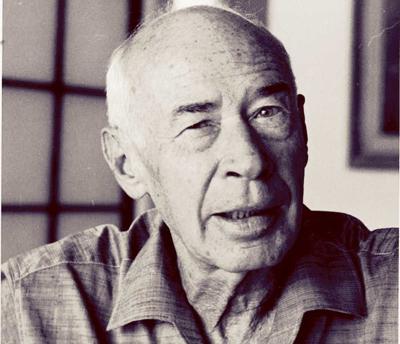
There’s an image of Henry Miller as a lusty, larger-than-life former Brooklynite who left an indelible imprint on Big Sur and our national literature. One of the towering figures of local literary history, Miller is a successor to D.H. Lawrence in his depiction of carnality. He’s a predecessor of the Beats in his repudiation of Establishment norms and his advocacy for a return to nature.
His footprint remains in the namesake nonprofit event center and bookstore, the Henry Miller Memorial Library (now also with a Carmel outpost), founded in 1980 by Miller’s good friend Emil White. But how many of the visitors who drop by the library – for fashion shows, film screenings or live music – have actually read Miller’s work? And how good is it, anyway?
There’s a reason Miller is not up there in the literary canon with the likes of Fitzgerald or Hemingway, notwithstanding his liberated lifestyle.
But let’s give Miller his due: Tropic of Cancer, set in Paris during his time there as a struggling writer in the ’20s and ’30s, is a great book, earthier and more accessible than more canonical works of the same period by Hemingway and Fitzgerald. After being banned in the United States for decades, its publication here in 1961 led to a groundbreaking obscenity trial whose verdict was a landmark in the fight for free expression. Miller was not to be denied.
And Tropic of Capricorn, a semi-autobiographical prequel to Cancer and written a few years later and also not published in the U.S. until ’61, is a rollicking account of his personal and sexual adventures while working for the “Cosmodemonic Telegraph Company of North America,” a fictional stand-in for his time at Western Union.
“I was to be a spy for a few months and after that I was to have the run of the joint,” Miller writes. “Maybe they’d make me a general manager one day or a vice president. It was a tempting offer even though it was wrapped in horseshit. I said Yes.
“In a few months, I was sitting at Sunset Place hiring and firing like a demon. It was a slaughterhouse, so help me God. The thing was senseless from the bottom up. But just as I had accepted the spying so I accepted the firing. If the vice-president decreed that no cripples were to be hired, I hired no cripples. If the vice-president said that all messengers over 45 were to be fired, I fired them without notice… The whole system was so rotten, so inhuman, so lousy, so hopelessly corrupt and complicated, it would have taken a genius to put any sense into it.”
His first-person protagonist, named “Henry Miller,” is in on the cosmic joke of modern capitalism. But his managerial duties don’t get in the way of the nominally married narrator’s real interest: seducing every woman he can get hold of, starting with Valeska, a Russian co-worker, then moving on to Mara, Monica, Pauline Janowski, “a little Jewess of 16 or 17 who was without a home or friends or relatives,’’ an Egyptian girl a friend introduces him to, a “nymphomaniac called Paula,’’ Lottie, the sister of his dead friend Luke, Rita, Agnes… the list goes on.
It’s Miller at his exuberantly lecherous best, though his celebration of rutting is not without critics.
As the feminist writer Grace Paley put it, drily raising an eyebrow at his serial description of conquests: “Who’s this guy Henry Miller? You know, big deal. He’s not talking to me. My life is not going to get a lot sexier on account of him. His is, no question about it.’’
Miller’s life, from 1891-1980, mirrored massive changes in a society that was adapting to the industrial, and then the sexual, revolution. His career echoed those changes, too. After the publication of Tropic of Cancer in 1934 – the work which he is still primarily identified – Miller quickly followed with Black Spring (1936), tracing his journey from the streets of New York to the cafes of Paris, and Tropic of Capricorn. In 1941, he published The Colossus of Maroussi about his stay in Greece, and returned to the U.S. on a cross-continental trip recounted inThe Air-Conditioned Nightmare in 1946.
He moved to Big Sur in 1944, and continued to be furiously productive, despite (or perhaps because of) a complicated love life that ultimately tallied five wives and countless affairs.
While in Big Sur, he completed The Rosy Crucifixion, an autobiographical trilogy, and Big Sur and the Oranges of Hieronymus Bosch, an account of his encounters with friends and strangers at his home in Big Sur.
He moved to Pacific Palisades in 1963 and spent the remaining 18 years of his life there, but Miller’s image – as a reckless rapscallion, incorrigible womanizer and prolific novelist – was forged during his time on the Central Coast. He symbolized a middle finger to ’50s conformity, an avatar of ’60s freedom and an uncompromising voice of individuality.
He fought (and won) in obscenity battles akin to those waged on behalf of “Ulysses” or “Howl,” earning writers the right to be indecent.
But after Tropic of Cancer, Miller tends to go on – and on, and on. Miller was writing before the internet age, but many of the books read like a long email from a friend who doesn’t know when to sign off.
And it’s not all quite as true to his experience as it might first appear. Big Sur and The Oranges of Hieronymus Bosch, Miller’s account of his escape from the urban grind to the paradisiacal surroundings of Big Sur’s Partington Ridge, gets bogged down in lengthy descriptions of random conversations with people wandering around the rural woods. And his complaints about unexpected drop-ins from seekers wanting to drink in his wisdom ring false, since it’s clear that he didn’t mind playing the Great Man to these visitors – especially if they were female and attractive.
A pop culture figure long before Pop Art, his mystique drew admiration from many who confused the legendary rake with the reality of a hard-working writer.
Still, he remains an undeniable life force. It’s tempting to declare that he should be required reading on every California syllabus, if only to upset his rigorously anti-academic spirit. (The Henry Miller Reader, edited by Lawrence Durrell, is a good place to start, offering a not-too-daunting selection from Miller’s massive body of work.)
Yes, Miller overwrote, and his prose could be too ornate. But he celebrated sex at a time of deep repression. He communicated the life of the expatriate in Paris with less pretension than the Lost Generation compatriots he outlived. He walked away from bourgeois society with relish. And he did it his way.


(1) comment
That was well-done Paul!
Welcome to the discussion.
Log In
Keep it Clean. Please avoid obscene, vulgar, lewd, racist or sexually-oriented language.
PLEASE TURN OFF YOUR CAPS LOCK.
Don't Threaten. Threats of harming another person will not be tolerated.
Be Truthful. Don't knowingly lie about anyone or anything.
Be Nice. No racism, sexism or any sort of -ism that is degrading to another person.
Be Proactive. Use the 'Report' link on each comment to let us know of abusive posts.
Share with Us. We'd love to hear eyewitness accounts, the history behind an article.