
They say a cowboy’s work is never done. Yet somehow – after all that riding, roping, herding and mending – the people who work the ranches still have time for rodeo.
Rodeo reflects the work of cowboys and cowgirls. Many of the events evolved from the routine of chasing down wayward cattle, bringing livestock to the ground for treatment or branding, breaking in unruly horses and the like.

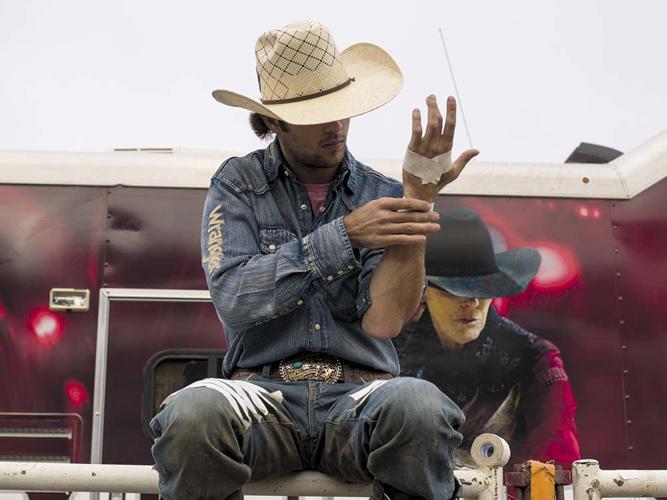
Bull rider Lonnie West of Calgary, Canada tapes his wrists before last year’s professional Bull Riding competition.
Professionals on the rodeo circuit don’t have things any easier. To start with, it’s a pay-to-play world. The bull riders and steer wrestlers, along with the other competitors, pay an entry fee to take part. They travel around the country, often hauling their own horse, hitting the dirt at more than 100 arenas a year.
If they have an off-night, they head to the next event empty-handed.
The California Rodeo Salinas offers its own unique challenges. The arena is larger than most. The box from which cowboys start in timed events like tie-down roping is on the opposite side of the chute – technical details that can cross up a veteran roper or force a rider to use up valuable time chasing a steer.
In rodeo, the animals are as much a part of success or failure as the rider. In events like saddle bronc, bareback riding and bull riding, judges award points for the animal’s performance, so a weak draw – being paired against a horse or bull that doesn’t put up much of a fight – can mean an empty wallet. In timed events, a slower or faster animal also affects the outcome.
It’s a way of life, and has been for a long time. Even the experts at Colorado’s Pro Rodeo Hall of Fame can’t confirm where and when the very first rodeo took place. It’s likely impromptu competitions took place between ranch hands as far back as the early settlers. Some say the first formal rodeo took place in Santa Fe, New Mexico in 1847. Others point to an 1869 event in Colorado, or a gathering of cowboys in Pecos, Texas a couple decades later.
But they agree that the rodeo we’re familiar with today – with roping and riding events – started in the dust of Prescott, Arizona. That was on July 4, 1888.
Here’s a look at how modern professional cowboys and cowgirls carry on this tradition.

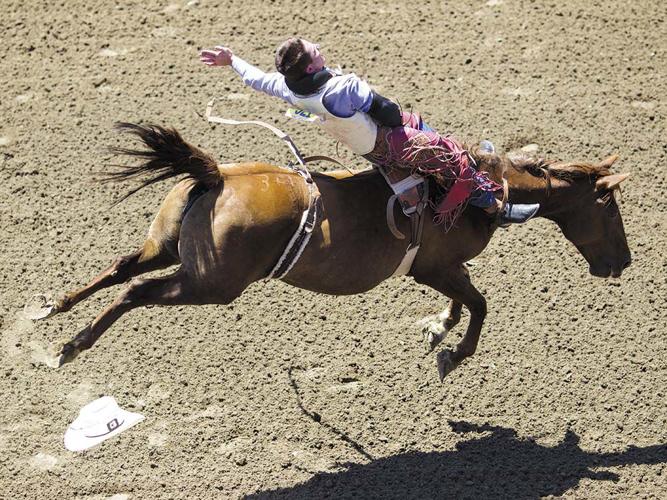
Bill Tutor of Huntsville, Texas holds on during the bareback bronc riding finals.
Saddle Bronc
In the Old West, some horses fiercely resisted being broken in to a saddle. And some cowboys became adept at bronco busting – hanging on as the mount reared and bucked and otherwise tried to fling both rider and saddle from its back.
That’s essentially the foundation for saddle bronc, except the rodeo event comes with a set of rules. For instance, as the animal leaps from the gate, the cowboy must “mark out” his ride, which involves keeping his heels on the horse’s shoulders until the animal’s front hooves pound into the dirt. As the wild bucking continues, the rider must keep spurring action in synch, pitching forward and back from the horse’s shoulders to the back of the saddle. He must keep one arm free, away from the horse – and himself – at all times. Violate any of these, or fail to remain in the saddle for eight long seconds and there is no score.
“It’s rough on you when you’re just starting out,” Texan Sterling Crawley says. “The most difficult part is to execute the basics – all at once.”
Crawley is good at what he does. He is ranked in the top ten in the world’s saddle bronc standings and is a five-time qualifier for the Wrangler National Finals Rodeo. He finished second at Salinas a year ago.
Part of a successful ride is the horse itself. Judges award points based on a rider’s actions as well as the bucking prowess of the horse, so the animal drawn for a particular go round matters.
“Different horses fit different guys,” Crawley observes.
Bareback Riding
“You’ve got to get on a good horse,” says bareback rider Zach Hibler, explaining that full points from the animal puts you in position to score big. And if a cowboy gets the right horse? “You gotta do your part.”
The cowboy’s part involves a fluid dance – marking out his mount, just as in saddle bronc then dragging his legs up the horse’s shoulder as it kicks to the ground, straightening them out as the horse begins to buck, keeping the toes of his boots pointed out and back firm – all while being pummeled and pounded and otherwise abused by the angry beast.
Hibler is also a Texan, from the lonely panhandle. He earned the top rookie rider spot in last year’s Professional Rodeo Cowboys Association Resistol Rookie Standings and tied for the win at Salinas. The 22-year-old shrugs off the sport’s reputation for physical punishment.
“It’s like any other event – once you figure out how to ride, your body gets used to it,” he says. “If I’m in rhythm with [the horse] and it looks good to the judges – as long as they’re signing my name on the check.”

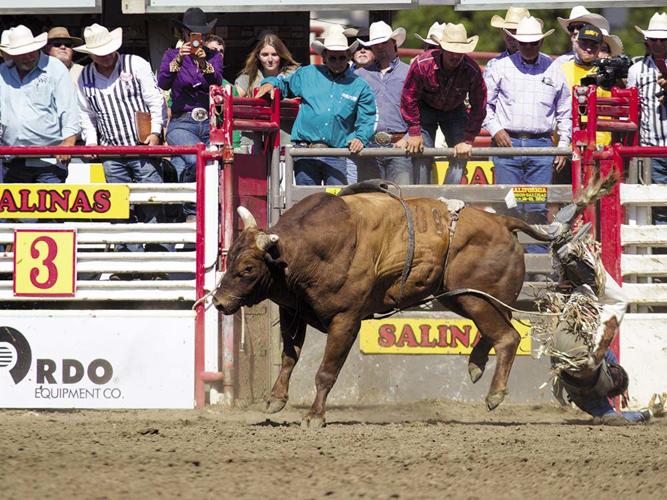
A cowboy gets tossed to the ground during the bull riding finals on Sunday in 2018.
Bull Riding
No, hopping on the back of a wild bull was not part of a ranch hand’s day-to-day routine. And yes, someone has to be a bit foolhardy to take part. The legendary Lane Frost was gored to death in the arena. Still, modern bull riding is safe – relatively. Cowboys can don protective gear and helmets. And rodeo clowns are nearby to distract a bull and hasten a bucked rider to safety.
The requirements are simpler than saddle bronc or bareback. While the cowboy must keep one arm free, there are no rules about marking out or spurring action. The point is to stay on for eight seconds and try to be as smooth as possible while hurled back and forth.
Success comes from hanging on through the bull’s first violent kick – it may rear its hind legs high into the air or vault suddenly in one direction or the other – and then finding its rhythm. If the first move knocks the rider off balance, the ride is generally short and ends with a hard plant in the dirt.
It’s an extreme sport, but one with a history dating back centuries in Mexico. According to the magazine The American Cowboy, bull riding was simply a twist on bull fighting. Eventually it became a thing in the American Southwest, but it was not subject to a set of consistent rules until 1936.
Barrel Racing
Most of what matters in barrel racing happens in small, dusty corrals. Sure, every event in rodeo requires practice – a lot of it. But the work cowgirls put in behind the scenes makes Women’s Professional Rodeo Association races seem rather straightforward from the spectator’s point of view: Riders burst across the starting line, weave tightly around barrels spaced across the arena and then sprint home.
Simple? Barrel racing is the equine equivalent of sports car racing at Laguna Seca. Speed in a straight line is important, but cornering – the ability to slow and turn sharply without compromising exit speed is necessary. So cowgirls need to have a feel for their horse and how it is handling, the amount of loose dirt, changes in the track over several runs.
The slightest error can cost a race.
So all of the work back at the ranch translates into a high speed, dirt-flying spectacle that novice rodeo fans can easily appreciate, but that veteran riders from every genre of competition recognize for what it is: the mastery of horse and rider in a show of speed and horsepower.
Real horsepower.

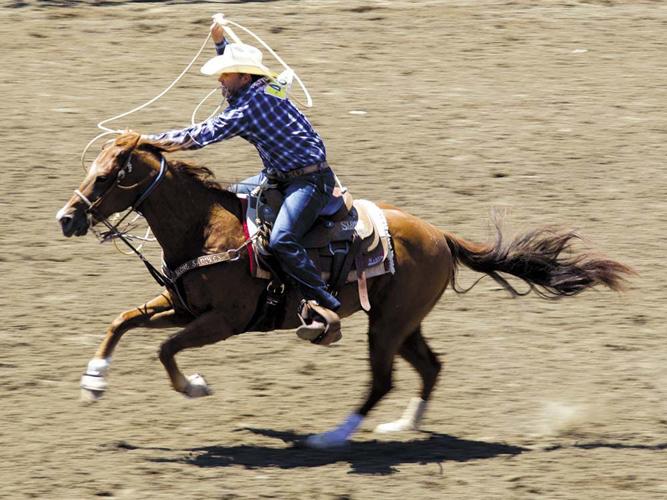
Caleb Smidt of Bellville, Texas throws his lasso during the tie down roping finals.
Tie-Down Roping
Even though tie-down roping involves a lone rider chasing down a calf, Monty Lewis refers to it as a true team sport.
“You gotta ride a horse that complements what you do,” says Lewis, who won the event at Salinas last year. “The timing is so intricate.”
Because the rider must leap from his saddle after roping the calf, the horse is left to pull the line tight and hold position. This frees up the cowboy to use both hands, quickly bringing the calf to the ground and securing three of the animal’s legs with a “piggin’ string” carried between clenched teeth.
It all takes a matter of seconds.
Lewis is another Texan on the circuit. He explains that the horse must understand the rider’s cues and work with precision. Any twitch at the wrong time – such as when the cowboy leaps from the mount and races along the taut rope – could spell doom. So most tie-down ropers prefer to bring their own horses to the rodeo.
Tie-down showcases all the skills of a working cowboy. These are techniques used for centuries to capture runaways or bring in cattle for treatment or branding. In rodeo settings, the calf is given a head start (and the long chute at Salinas gives more of an advantage to the animal). The riders must know how to handle horses for speed and finesse. They need roping skills. And they have to be able to quickly gain control over a running calf. And a lot of things can go wrong.
“It can be a religious experience if you’re not careful,” Lewis says.

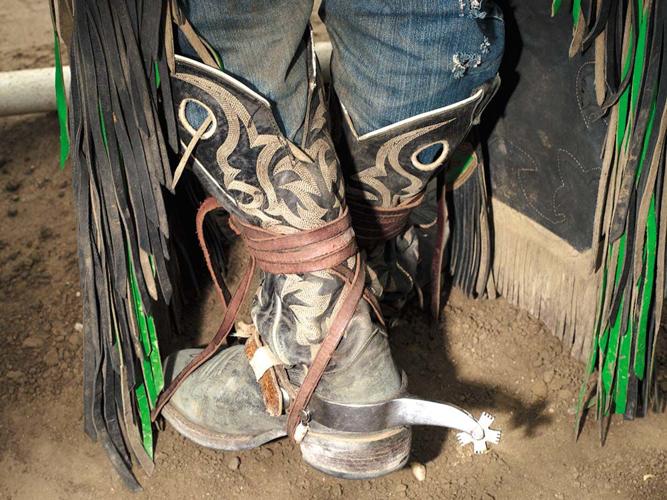
A cowboy’s spurs are illuminated by the midday sun.
Steer Wrestling
If tie-down seems fast, steer wrestling is like a blur. A steer races from the chute, the cowboy gallops after it. The moment he catches up to the hurtling animal, the cowboy slips from the saddle while grabbing its horns and dragging it down. Whatever leverage the cowboy can muster goes into grounding the steer so that its hooves are in the air.
That’s when the clock stops and the wrestler – bulldogger is the preferred term – receives his time. The world record for all of that is 2.4 seconds.
The task is made easier – if you can use “easy” and “steer wrestling” in the same sentence – by the presence of a hazer, a second rider who races alongside the steer, essentially herding it in line with the bulldogger.
Although quickness and strength come into play, the essence of this event is timing. The cowboy must slip from the saddle as he gets a grip on the horns, and at a point where he carries enough momentum to overpower the big animal. If he misses that mark and loses balance, he also misses out on points.
Team Roping
The unusual layout at Salinas changes the way riders approach the timed events. For team roping, the two riders always start on either side of the chute – well, almost always. At the California Rodeo Salinas, both header and heeler launch from the same box.
Header and heeler? The pair work in tandem to rope a steer, so timing is again a critical factor. The header leads the chase and, when he gets within throwing distance, must lasso the running animal around both horns (around the neck or around a horn and the steer’s head are also legal catches). He then tries to turn the steer as the heeler closes in.
The heeler’s task is to throw a low rope and capture both hind legs. If he snags just one, the pair take a five-second time penalty – which at the Salinas Sports Complex can be a huge blow.
“The box is longer than anywhere else,” explains header Pat Boyle, who rides with heeler Jared Hixon. “If you draw one that runs, it’s going to run a lot longer.”
Last year at Salinas, the pair managed nicely, winning the team roping title. Boyle says the key to victory is patience. Because the organizers average the score from five different rounds, teams have a chance to make up time lost to a quick animal.
The event is rodeo’s only true team sport. And it requires more than just two solid ropers to win.
“In our sport there has to be some chemistry,” Boyle points out. They have to anticipate each other’s actions and get their timing down. He has seen two standout tie-down ropers team up together, but fail to put in competitive times.
Boyle says he has been roping since before he could remember, growing up in Shandon, a couple hours from Salinas.
“The California Rodeo is huge,” he adds. “Being a kid from California, it’s like a family holiday.”

(4) comments
Let's leave the animals alone now . . .
P.S. - Six horses were killed last week at the Calgary Stampede in the chaotic chuckwagon races. Incredibly, the California Rodeo in Salinas (today through Sunday) is featuring this event, animal--and human--welfare be damned. I was present at the 1995 rodeo when FIVE animals were killed. Only iin the aftermath of the mayhem did the PRCA begin to require on-site veterinary care for injured animals. The great majority of the estimated 5,000 rodeos held annually in the U.S. don't even provide for this basic care. Shame! The rule should be: NO VET, NO RODEO.
Just for the record, rodeo has little to do with life on a working ranch. REAL working cowboys/girls never routinely rode bulls, or wrestled steers, or rode bareback, or practiced calf roping (terrified BABIES!) as a timed event, nor did they barrel race (which author Larry McMurtry claims ruins the horses for any practical work). And they certainly did NOT put flank straps on the horses and bulls, or work them over with "hotshots," kicks and slaps in the holding chutes. Some "sport"! Indeed, rodeo is not a "sport" at all--that word denotes willing, evenly-matched participants. Rodeo does not qualify. It's a macho exercise in DOMINATION. For most of the exploited and abused animals, the rodeo arena is merely a detour en route to the slaughterhouse. The United Kingdom (England, Scotland, Wales) outlawed this cruelty in 1934. Can the U.S. be far behind? Legislation is in order. Until that happy day, boycott all rodeos, their corporate sponsors and advertisers. Follow the money.
test
Welcome to the discussion.
Log In
Keep it Clean. Please avoid obscene, vulgar, lewd, racist or sexually-oriented language.
PLEASE TURN OFF YOUR CAPS LOCK.
Don't Threaten. Threats of harming another person will not be tolerated.
Be Truthful. Don't knowingly lie about anyone or anything.
Be Nice. No racism, sexism or any sort of -ism that is degrading to another person.
Be Proactive. Use the 'Report' link on each comment to let us know of abusive posts.
Share with Us. We'd love to hear eyewitness accounts, the history behind an article.