
BETWEEN THE END OF 2020 AND THE END OF 2021, THE AVERAGE ASKING RENT IN MONTEREY COUNTY SHOT UP 8.6 PERCENT, TO ABOUT $1,900 PER MONTH, keeping with a national trend as the U.S. economy’s knees continue to wobble from the weight and complications of the pandemic and, more recently, Russia’s invasion of Ukraine.
Set against the backdrop of rental housing demand rapidly outstripping supply, prices of most goods continue to rise even as the country looks down the barrel of a possible recession.
These times have brought comparisons to the 1970s, when, following the Vietnam War, the country, in many places, saw an unstable housing market characterized by relatively unaffordable rents, soaring inflation and a slowdown in the U.S. economy. The crisis back then stirred a wave of local advocacy pushing for creative solutions. In California, specifically, this led to a series of rent stabilization policies in cities such as Los Angeles, Oakland, San Francisco, Santa Monica, Berkeley, Los Gatos and Hayward, where ordinances exist that cap annual rent increases for some rental properties. Amid the economic realities of today, action around rent stabilization is once again ramping up.
Pasadena voters collected enough signatures to put a rent stabilization ordinance on the ballot this fall. It would cap rent increases at 75 percent of the annual increase in the consumer price index (CPI). Fairfax in Marin County is mulling whether to pilot rent stabilization for at least one year, and supervisors in Orange County are eyeing a one-year ordinance.
California’s soaring rents were a problem even before the pandemic, leading lawmakers in 2019 to adopt the state’s first statewide rent stabilization policy, which caps annual rent increases at 5 percent plus the rate of inflation, but not more than 10 percent, with exceptions for single-family homes and rental housing newer than 15 years old. The policy took effect in 2020 and expires in 2030.
Although covered by that statewide law, rent stabilization as a policy does not exist anywhere in Monterey County. Discussions around rent stabilization have touched the city council dais in Monterey and Salinas in the last year but brought no substantive results. Much of the conversation around housing has focused on increasing supply to mitigate demand and constructing more government-subsidized units to meet the needs of low-income renters – solutions that Matt Huerta, housing program director at the Monterey Bay Economic Partnership, sees as most important.
“If we don’t increase the supply of rental housing to meet low, very low and even moderate income, then the cause for rent control is a lot stronger,” Huerta says. “But you can’t continuously increase rent every year between 5 and 10 percent and expect the workforce to stick around.”
BUILDING MORE HOUSING HAS BEEN A CHALLENGE FOR MANY JURISDICTIONS IN MONTEREY COUNTY. Salinas City Councilmember Anthony Rocha is one vocal proponent for a local rent stabilization policy, calling it one of the most effective tools in the battle against displacement and gentrification. “Rent stabilization is a data-driven approach to ensure we have a fair housing market that protects tenants,” Rocha says.
He helped include rent stabilization as a topic in the city’s strategic plan for the next three years.
Rent stabilization is a polarizing issue in communities across California: Tenants’ rights groups paint it as a critical policy to battle the housing and displacement crisis, while real estate lobbyists liken it to a bogeyman that will thwart construction of new housing. A 2019 study out of Stanford University found San Francisco’s rent stabilization policy curbed displacement by up to 20 percent, and the impact was most prevalent for minority and senior households; however, the study also found a trend of landlords taking housing off the rental market and converting it into condos to subvert the policy. The study found impacted landlords reduced the supply of available rental housing by 15 percent.
In 1995, California legislators bought into the argument that rent stabilization stunts investment in construction. They passed the Costa Hawkins Act, which placed, among other restrictions, two important limits on local rent stabilization rules. The first: multifamily units built after 1995 were exempt from rent stabilization. The second: local jurisdictions could not enforce vacancy controls, meaning once a tenant left a unit, the landlord was free to list the unit at whatever price they desired.
Efforts to repeal the Costa Hawkins Act via voter referendum – Prop. 10 in 2018 and Prop. 21 in 2020 – failed overwhelmingly at the ballot box. Leah Simon-Weisberg, chair of Berkeley’s Rent Stabilization Board, says rent stabilization’s biggest obstacle is the Realtor lobby, which she called the most powerful in California.
Berkeley’s policy, which caps rent increases to 65 percent of the annual CPI increase, was the result of a local voter referendum. She says the best path to passing rent stabilization today is “a strong movement” and putting it on the local ballot.
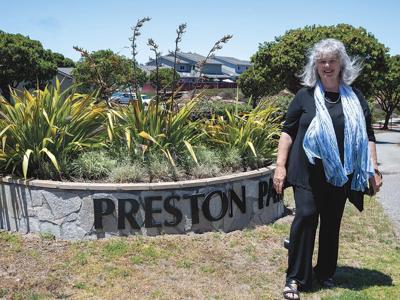
MONTEREY COUNTY DOES HAVE AT LEAST ONE EXAMPLE OF SUCCESSFUL RENT STABILIZATION. The Preston Park and Abrams development is a city-owned housing development that caps annual rent increases at 3 percent. Thanks to this policy, Paula Pelot, 71, has, on a fixed income, been able to remain in her two-bedroom Preston Park townhome since 1997.
Marina Mayor Bruce Delgado says the Preston Park and Abrams development is a success, but not easily duplicated as it requires a local jurisdiction to own and become the landlord for rental housing. That, he says, is prohibitively expensive in today’s market, especially for smaller jurisdictions.
He makes a similar argument for citywide rent stabilization. He says any small jurisdiction that wants to pass such a policy is all but guaranteed to be sued by the rental housing political machine.
Delgado speaks from some experience, having helped pass a citywide rent stabilization policy in Marina on mobile home parks – a fight that he says took 12 years. He says the interests Marina faced in the mobile home battle would be dwarfed by those in the apartment battle.
“We would be outgunned – the money in the rental industry makes Marina look small,” Delgado says, who says a city alone in the battle would likely have to spend millions just to fight lawsuits.
“It would need to be a regional effort. If the county and all 12 cities agreed we were going to go after rent control together, then it might stand a chance.”


(0) comments
Welcome to the discussion.
Log In
Keep it Clean. Please avoid obscene, vulgar, lewd, racist or sexually-oriented language.
PLEASE TURN OFF YOUR CAPS LOCK.
Don't Threaten. Threats of harming another person will not be tolerated.
Be Truthful. Don't knowingly lie about anyone or anything.
Be Nice. No racism, sexism or any sort of -ism that is degrading to another person.
Be Proactive. Use the 'Report' link on each comment to let us know of abusive posts.
Share with Us. We'd love to hear eyewitness accounts, the history behind an article.