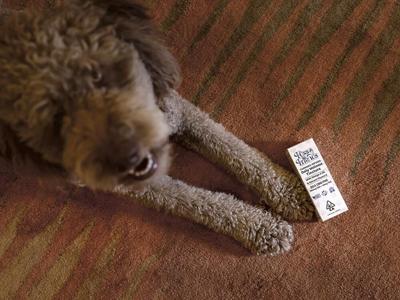

Tim Matta, a pet parent who until recently ran a small business called Healthy Pets Heal, is no stranger to the suffering that animals can experience. He has lost a pit bull and a border collie to cancer. When a veterinarian found his collie had a tumor, Matta says his dog was given just two months to live, but those two months on medication were not looking to be good ones.
“My dog turned into a zombie on the pills, he didn’t walk around, he didn’t eat,” Matta says. “That’s when I started to research CBD. After about a week of taking CBD, he started moving again. A few weeks later, when he was supposed to die, he was walking again.”
Matta has another pitbull and border collie today, and uses CBD for more minor issues, specifically treating seasonal allergies. He has also seen success with larger animals: “I’ve treated a horse with scars, and CBD helped the scarring go away and some hair even grew back.”
The CBD market for pets generates more than $500 million each year, according to cannabis-focused research by the Brightfield Group. With the growing popularity comes more questions on whether these products are safe and effective, but also the ability to talk about claims and for patients to try various products.
In 2018, the California Legislature passed a law allowing veterinarians to speak with their patients’ humans about CBD.
“Before that, we weren’t even able to talk about it,” says Brynie Kaplan Dau, a veterinarian at Pacific Grove Animal Hospital. “People wanted to know if they can use it for their cats or dogs, and we couldn’t have that discussion.”
Veterinarians still cannot prescribe CBD to animals, according to state law. Instead, they are sold as over-the-counter supplements (without approval from the Food and Drug Administration Center for Veterinary Medicine) at various pet supply stores.
“I like that they are talking to a veterinarian, not Google,” Dau says. “This way, they can ask specific questions about how it may affect their dog, or if there are downsides.”
Dau says she has seen better results for pets who stick with prescribed medicine and exercise, instead of relying exclusively on CBD to treat a condition. “I don’t see it makes a lot of difference, but it’s worth trying,” Dau says. “It’s what’s trending right now. I always recommend a brand created by veterinarians, and tell patients to let me know how it goes.”
At The Raw Connection in Carmel, about half of customers who try CBD come back to purchase it again, says staffer Cat Martinez.
Dau and Martinez agree that results may vary due to the animal’s breed, age, size, weight and medical conditions. THC products are not sold at pet stores, so there are not psychoactive effects associated with some forms of cannabis consumption, but Martinez says some customers report pets become hyperactive after taking CBD, and some get sleepy. However, CBD is not known to be addictive, and pet owners can stop giving doses without fear of withdrawal symptoms.
“We tell people if they want to try it, use it for a couple of days then give your pet a break,” she says. “Some customers say it isn’t what they were looking for, but they appreciate having the option. I’m happy to see it being used.”


(0) comments
Welcome to the discussion.
Log In
Keep it Clean. Please avoid obscene, vulgar, lewd, racist or sexually-oriented language.
PLEASE TURN OFF YOUR CAPS LOCK.
Don't Threaten. Threats of harming another person will not be tolerated.
Be Truthful. Don't knowingly lie about anyone or anything.
Be Nice. No racism, sexism or any sort of -ism that is degrading to another person.
Be Proactive. Use the 'Report' link on each comment to let us know of abusive posts.
Share with Us. We'd love to hear eyewitness accounts, the history behind an article.