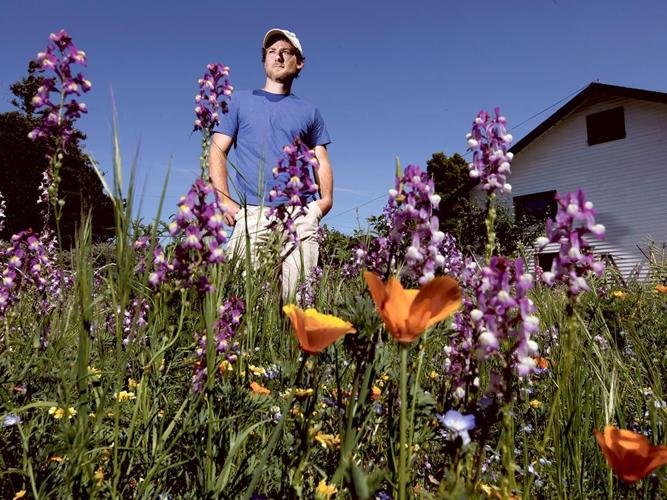

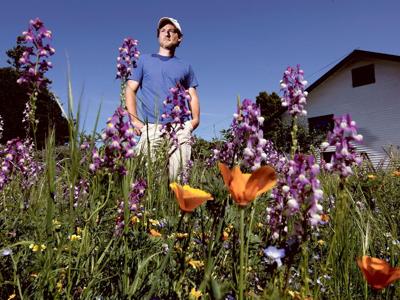
It’s a sun-splashed Easter Sunday afternoon, and young children pick their way through shoulder-high wildflowers, scouting for eggs that may have been missed.
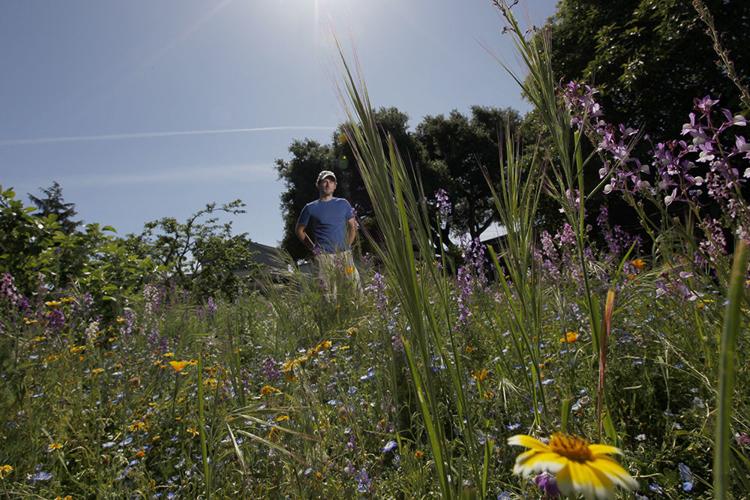
Honeybees buzz from blossom to blossom, be it lupine, California poppy or baby blue eyes, and together, this garden – which is in a residential neighborhood in Monterey – presents a stunning array of color that might resemble a field in Fort Ord, Big Sur or beyond.

There’s a key difference: This bed of wildflowers sprung from the handiwork of one man, nine chickens and two geese.
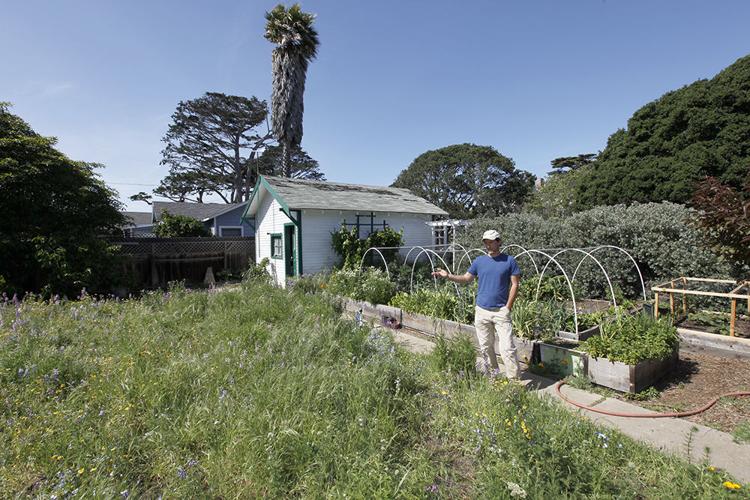
A few weeks later, Corey Hamza, the garden’s creator, sits in the living room of his Monterey home. With the permission of his landlord, he has turned his yard into a laboratory for native plant restoration.
Hamza is a restoration ecologist for the Elkhorn Slough Reserve and Elkhorn Slough Foundation. A Monterey native, he studied ecological management and restoration at UC Davis, and spends his days at the reserve helping to restore landscapes filled with invasive, non-native plants back to something closer to their native state.
Hamza, who’s become a friend over the past two years, says he’s always loved the outdoors, but it wasn’t until college that he discovered his love of grasslands.
“It almost feels like it was something I was discovering about myself that was always there,” he says.

That love for grasslands comes in part from their importance to another love of his, one he’s held since childhood: endangered species. In an email, Hamza writes that 90 percent of California’s rare and endangered species inhabit grassland ecosystems, and that native grasslands are themselves endangered.
“Most people don’t know that the rolling hills and meadows of grassland seen all over the state are overwhelmingly dominated by non-native species,” he writes. “If you were to go out and point at what you thought was a typical grassland anywhere in California, 99 percent of the plants are non-native.”
For his own yard, Hamza chose to focus on bringing in wildflower species, as he and his roommates keep bees. Besides, who doesn’t like wildflowers?
It’s how Hamza pulled it off that’s most fascinating: Since he embarked on the project last fall, he has only put in about six hours of work, and hasn’t watered or weeded once.
“That’s the beauty of it,” Hamza says. “You don’t have do anything.”
Hamza is an acolyte of Masanobu Fukuoka, a Japanese farmer who, in his 1975 book One-Straw Revolution, popularized a landscape management technique known as “do-nothing farming.”
Hamza admits he didn’t actually do nothing to create his garden, but the point is, he did – and continues to do – very little.
Last fall, Hamza let his nine chickens pick over the tilled soil of his yard, though he says tilling wasn’t necessary, and that simply mowing the weeds would’ve worked fine.
“If chickens are kept in an area, they won’t let anything grow. If you can exploit that when you want, it can be a very powerful tool,” he says. “They’re getting food, I don’t have to do any work, and the job is getting done.”
One thing that’s critical, he says, is to watch the weather in the fall and early winter, and make sure to give the chickens the run of the yard after the first rains have hit, so they can upturn and eat any sprouting weeds in the soil.
“Really, you start managing weeds way before anyone would think about it,” Hamza says. “It’s a simple process but timing is really important. You have to be in tune with the natural processes going on, when things are growing, and target your management fairly precisely to that.”
After the yard was denuded by the chickens, Hamza then scattered about $100 worth of wildflower seeds he bought online – which he mixed with compost or rice hulls – and then raked them into the soil. The idea, he says, is to give natives a competitive advantage.
“Once natives establish a dominance over an area, they do a great job in outcompeting non-natives, and persisting,” he says.
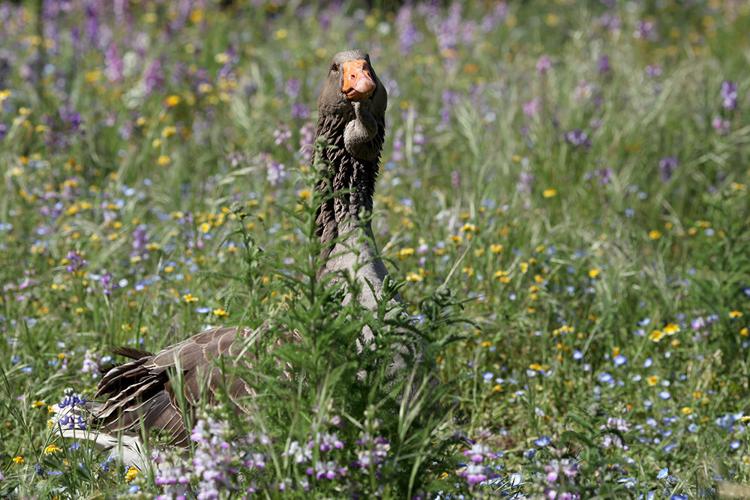
When the winter rains came, and seedlings sprouted from the soil, it was time for Hamza’s two geese – Dewey and Toulouse – to put in some work: Geese selectively eat grasses, and they very discriminately picked through his garden, eating the grasses, not the wildflowers.
On a recent afternoon, Hamza’s garden – which aside from the aforementioned plants, was seeded with tidy tips, Chinese houses and clarkia – is far more invaded by grasses than it was Easter Sunday, which Hamza attributes to the geese not foraging as much recently, as they have instead been guarding a nest of 10 eggs. Nonetheless, he says he’s confident they’ll get the grasses before they go to seed.

Hamza has also been experimenting with biochar in his garden, a charcoal-based soil amendment that not only helps sequester carbon, but increases the soil’s water retention.
As Hamza stands in his yard, describing the biochar, he pulls the lid off a barrel-sized container, revealing the bits of charcoal inside. A few feet away, Dewey – the male goose – hisses defensively, on guard for Toulouse and her eggs.
But more so than biochar, it’s Hamza’s idea of using chickens and geese to restore a landscape that’s truly innovative.
“I don’t know that I’ve ever heard of the specific regime of chickens and geese being used,” he says.
So, to recap: Step one, chickens clear the weeds in the fall and early winter. Step two, scatter native wildflower seeds when the chickens are done. Step three, once the plants sprout, set the goose on the loose. And from here on out, aside from making sure the geese keep the grasses at bay, he doesn’t have to lift a finger.
“That’s the beauty of having nature, or in effect, animals, do the work for you,” Hamza says. “It’s like having a mini replica of what might exist in nature.”
The replica ranks among the most beautiful gardens this reporter has seen.
“Everyone’s pretty amazed by it,” Hamza admits. “I just like to see people smile and looking at beautiful native plants. That’s one of the rewards for me, spreading word of the benefits and beauty of native grasslands.”



(1) comment
The headline made me think there might be hope for revitalizing our weed-infested yard. Unfortunately, the chicken and geese part isn't doable for us.
Welcome to the discussion.
Log In
Keep it Clean. Please avoid obscene, vulgar, lewd, racist or sexually-oriented language.
PLEASE TURN OFF YOUR CAPS LOCK.
Don't Threaten. Threats of harming another person will not be tolerated.
Be Truthful. Don't knowingly lie about anyone or anything.
Be Nice. No racism, sexism or any sort of -ism that is degrading to another person.
Be Proactive. Use the 'Report' link on each comment to let us know of abusive posts.
Share with Us. We'd love to hear eyewitness accounts, the history behind an article.