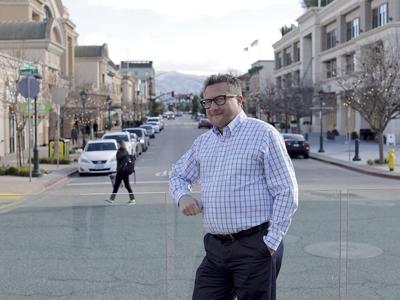

IT’S TAKEN YEARS OF PLANNING, tens of millions of dollars and a pandemic’s worth of disruption, but Salinas is now home to one of the newest and more notable urban core revitalizations in California. Monterey County’s largest city has seen its center spruced up through a coordinated effort involving public agencies and private investors – with the result of a beautified downtown that promises to draw more foot traffic, lure more residents and generate more economic activity.
The heart of the ongoing transformation is Main Street. Since Salinas City Council approved its Downtown Vibrancy Plan in 2015, the three blocks stretching north from San Luis Street up to the National Steinbeck Center have seen improvements including more than 50,000 square feet of newly paved concrete and sidewalks; 56 newly planted trees; new electrical, lighting and traffic signal systems; and updated landscaping equipped with an automatic irrigation system. There’s also the 70-foot-long, 17,000-pound steel arch now spanning Main Street, emblazoned with its city’s name in bold white letters, that has helped establish a sense of place.
Mixed-use redevelopments like 301 Main St., where the popular Alvarado Street Brewery has taken the street retail space beneath 50 luxury studio apartments, have attracted residents and brought the activity needed for any bustling city center. While it’s still a work in progress – one not aided by a pandemic that has exacerbated street retail vacancies in urban cores across the country – Main Street teems with bars, restaurants, coffee shops and other retail offerings, all within a short stroll.
“I think it’s one of the crown jewels of urban redevelopment in the entire state,” says Kevin Dayton, government affairs director for the Salinas City Center Improvement Association (SCCIA), which formed to promote the area’s redevelopment. The group advocated for public measures like the Adaptive Reuse Ordinance, passed by Salinas City Council in 2018. The ordinance removed zoning barriers prohibiting the residential conversion of older properties like 301 Main St. and the former Bruhn Building, located across the street at 300 Main St.
In addition to strong public-private partnerships, Dayton credits the investment made by companies like Taylor Farms, the Salinas-based vegetable processing giant that has snapped up downtown properties on the way to becoming one of the city’s most influential landlords – while “not expecting the kind of return on investment that a typical, out-of-town developer would.
“We’ve been fortunate that we’ve gotten some property owners who really care about downtown Salinas and are willing to accept a lower investment return to make the city vibrant,” he notes. “Downtown redevelopment is a risk, and you can lose money on it.”
Moving forward, stakeholders like the SCCIA hope to spur more redevelopment by converting downtown’s wealth of surface parking lots into new mixed-use projects. While some residents and business owners have complained that the reconfigured downtown has already made it harder to find convenient parking, a less car-friendly environment is very much by design.
“You have to slow down traffic, you have to make it friendly to pedestrians and you have to make it interesting to be there,” says Greg Hamer, a local realtor who serves as district coordinator for the SCCIA. “The more welcoming it is, then the more businesses are going to gravitate to that, because it’s going to enable foot traffic.”



(1) comment
Interesting take on this Measure X-funded project. No mention of the rush to move forward as soon as the pandemic lock down began, the more than 70 mature trees that were cut down (and the community protests surrounding this), nor the destruction of the historic streetscape by world-renown and urban design award-winning architect Will Shaw, lack of bike lockers, no public restrooms provided, unneeded scramble crosswalks, untimed or synchronized traffic lights, and no plan for upkeep and maintenance. Unfortunately, downtown is losing many of it's longtime retail businesses as landlords raise rents for local merchants to make way for all the corporate tenants property owners dream of filling up downtown with. Without basic amenities such as parking, public restrooms and overnight security, the corporations won't biting.
Welcome to the discussion.
Log In
Keep it Clean. Please avoid obscene, vulgar, lewd, racist or sexually-oriented language.
PLEASE TURN OFF YOUR CAPS LOCK.
Don't Threaten. Threats of harming another person will not be tolerated.
Be Truthful. Don't knowingly lie about anyone or anything.
Be Nice. No racism, sexism or any sort of -ism that is degrading to another person.
Be Proactive. Use the 'Report' link on each comment to let us know of abusive posts.
Share with Us. We'd love to hear eyewitness accounts, the history behind an article.